
PODCAST
Jack Siney built FrontRace out of a real operational crisis: when COVID sent his sales team home, all the organic knowledge transfer that happened in an office disappeared overnight. The internal tool he built to fix that problem became a nine-figure exit. In Episode 157, he explains why your sales process probably has twice as many steps as you think, why AI on the business side is not ready yet, and what insurance agencies should be doing right now to prepare for the tools that will actually matter in 2027.
Most insurance professionals have heard of surety bonds. Almost none of them can explain what one actually is. In Episode 156, SwiftBonds founder Gary Eastman — attorney, 18-year surety specialist, and self-described young person by industry standards — breaks down how surety works, why it underpins trillions of dollars of economic activity that barely anyone in InsurTech is paying attention to, and why a niche still running on 1980s underwriting models is finally ready for a technology moment.
Kinetic started as a wearable device company with a prevention thesis. It is now a $100M+ workers comp MGA built around claims oversight software — and the pivot happened because Adam Price asked customers what they actually needed, instead of what Kinetic had assumed they needed. In Episode 155, Adam explains why prevention technology struggles in mid-market workers comp, how data fusion creates a claims experience that scales like software but feels like dedicated attention, and what MGA investors actually want to hear — hint: it is not the $6 trillion TAM slide.
Luis Pino built ProducerFlow by accident — it started as an internal compliance tool for Agentero, the carrier-agency network he founded after leaving CoverWallet, and became a standalone product when carrier partners kept asking if they could buy it. In Episode 154, Luis explains what producer compliance actually involves, why carriers approach AI with a fundamentally different risk appetite than agencies, and why the question of the insurance agent's survival in an AI-native world is one of the most genuinely open questions in distribution right now.
Will Johnson spent a decade at Oscar Health watching brokers — the most important node in health insurance distribution — get chronically underinvested in technology. In Episode 153, he explains how Gyde is fixing that: an AI-powered operating system combined with an acquisition-based partnership model that aligns incentives completely and brings a dedicated team into agencies post-acquisition to actually build the growth infrastructure together. The insight at the core of it is simple: most brokers are spending less than half their time on new business. Gyde exists to change that ratio.
Upstage's Kasey Roh came to enterprise AI through Tesla, Meta, and venture capital — which means she has seen enough AI companies to know the difference between real technology and a wrapper. In Episode 152, she makes the case that insurance companies have only ever been able to read about 20% of their documents, explains why throwing the rest into frontier LLMs is not a scalable solution, and shares what one Asian carrier found when it finally digitized a decade of untouched claims records — enough to launch two entirely new product lines from data it already owned.
InsurTech Israel CEO Kobi Bendelak crossed a desert, a border, and two countries to make it to InsurTech Insights London — during wartime. In Episode 151, he shares what that journey says about Israeli startup culture, how the InsurTech industry has matured from tech tourism to serious procurement, and why he believes core systems may be obsolete within a few years.
James Benham has been building technology for insurance companies for 25 years — not InsurTech, actual technology. In Episode 150, he makes two arguments the industry needs to hear: first, that shadow AI is a compliance crisis hiding in plain sight at virtually every carrier, TPA, and MGA; and second, that roughly a third of the insurance workforce is performing manual clerical tasks that should be automated — while the industry simultaneously struggles to find enough qualified adjusters and underwriters. The fix to both problems runs through the same place: AI that is embedded, tested, and governed rather than bolted on or used ad hoc.
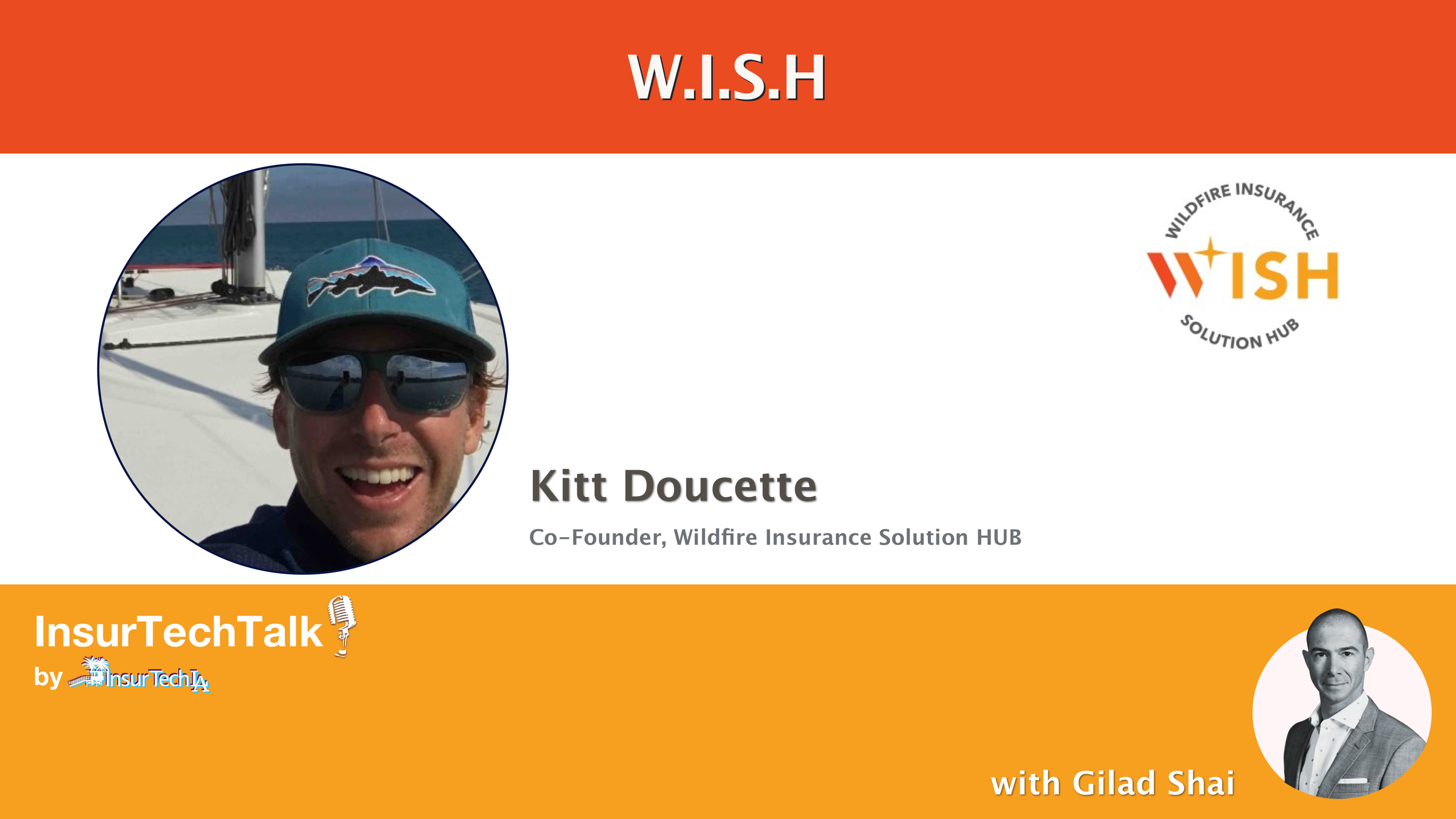
Kitt Doucette is a fourth-generation insurance professional, former adventure journalist, and the co-founder of WISH — the Wildfire Insurance Solution Hub. In Episode 149, he makes a case the industry needs to hear: wildfire conflagration is not the same peril as wildfire, and treating it as a line item inside a legacy package policy is why the California market is broken. The fix isn't just better models — it's using those models proactively, communicating risk at the parcel level, and giving homeowners a clear ROI for mitigation before the fire arrives.
Sid Jha didn't come from insurance — he came from Citadel, trading commodities, pricing weather risk. In Episode 158, he explains how that background shaped Arbol's thesis: that parametric insurance wasn't just a claims shortcut, but a bridge to entirely new pools of capital that traditional insurance could never access. We also get into why Arbol stopped being a pure parametric company — and why being ideological about your product is the fastest way to miss what the customer actually needs.