
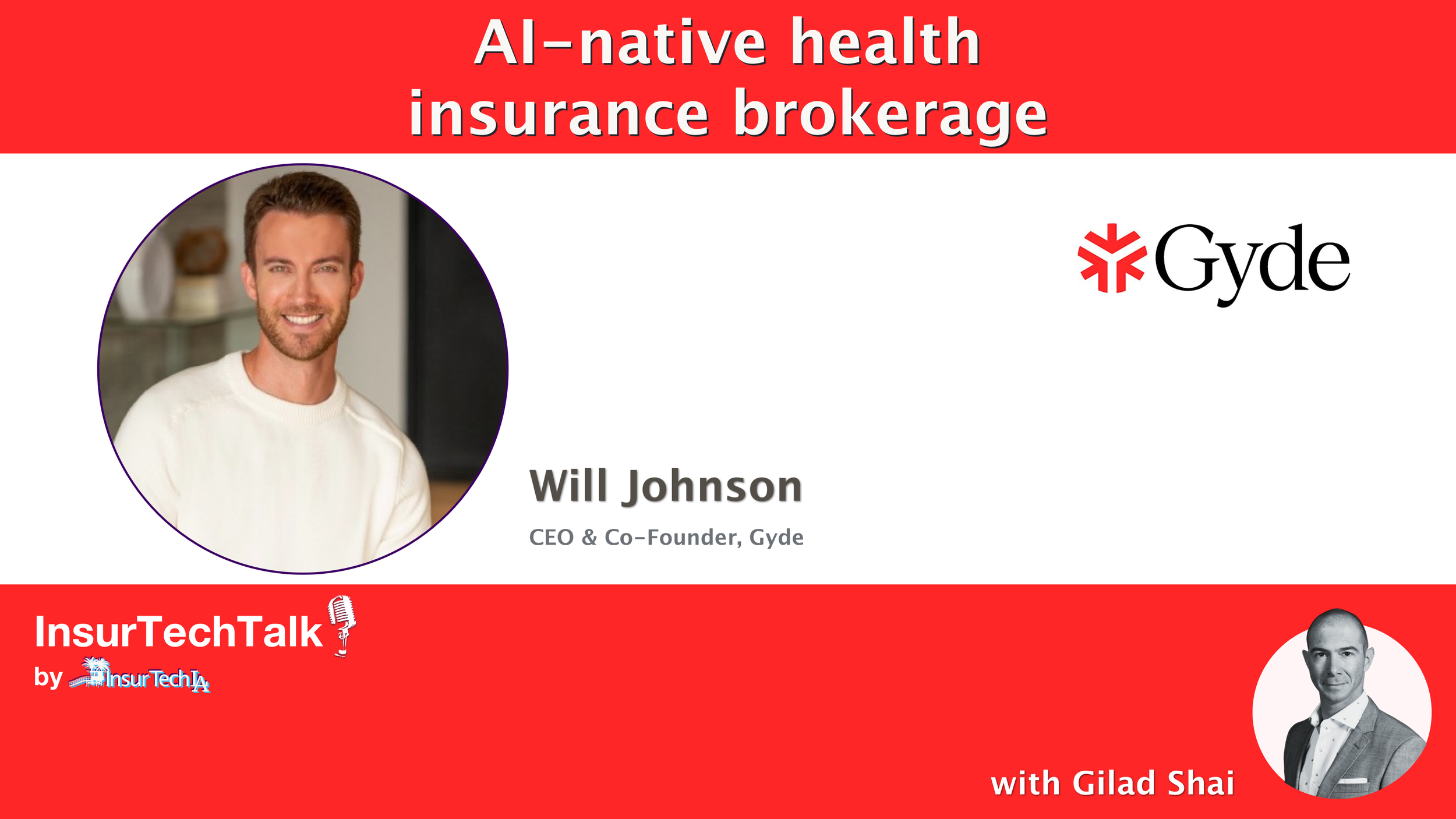
The Health Insurance Broker Has Been Underinvested For Too Long — Gyde Is Here to Fix That
Will Johnson spent a decade at Oscar Health watching the same problem play out from the inside: brokers were the most important node in the health insurance distribution chain, and nobody was building serious technology for them.
Carriers were getting investment. Clinical infrastructure was getting investment. Digital-first insurance products were getting investment. The broker — the person actually sitting across the table from employers and individuals making coverage decisions — was getting spreadsheets, carrier portals, and a inbox that never emptied.
Gyde was built to change that. In Episode 153 of InsurTechTalk, Will Johnson, CEO and Co-Founder of Gyde, walked me through what is broken in health insurance distribution, why the acquisition model is the right way to align incentives, and what an AI-powered operating system for health insurance brokers actually looks like in practice.
About Will Johnson
Will Johnson is the CEO and Co-Founder of Gyde, an AI-powered platform for health insurance agency owners that combines technology with an acquisition-based partnership model. Before founding Gyde, Will spent a decade at Oscar Health across a range of senior roles: launching new markets during the company's early expansion phase, managing state-level P&Ls, leading Oscar's technology business and commercializing their member engagement suite to other health plans and providers, and leading growth initiatives in the company's later years. His throughline across all of those roles was distribution — specifically, watching at close range how brokers actually function in the market and how underinvested they were relative to their importance in the value chain.
What Is Happening in Health Insurance Right Now
Health insurance is in a period of multi-segment disruption — and there is, as Will put it, nowhere to hide. Carriers are struggling across employee benefits, Medicare Advantage, and the individual market. Brokers are caught in the middle, facing rate disruption, product complexity, and clients who are increasingly anxious about coverage and cost.
The Three Markets Gyde Serves
Employee benefits: Primarily small to mid-size employers, where brokers remain the primary distribution channel and the primary advisor relationship
Individual under 65: A market of approximately 25 million Americans, increasingly complex as rate disruption pushes people toward novel solutions
Medicare Advantage and supplements: A large and growing population where brokers serve as the critical guide through an increasingly confusing product landscape
Together, Will estimates these three markets represent roughly half of the US health insurance population — and all three are experiencing meaningful disruption simultaneously.
The Broker's Problem: Playing Defense Instead of Offense
The core diagnosis behind Gyde is straightforward. Most brokers got into the business to do a handful of things: win new clients, have rich strategic conversations, help employers and individuals find the right coverage, and be a genuine guide for the families and businesses they serve.
That is not where they are spending their time.
Where Broker Time Actually Goes
Manually processing renewals across dozens or hundreds of clients
Navigating carrier portals and websites to answer questions that should take seconds
Sorting through inboxes and spreadsheets for information that should be instantly accessible
Doing compliance diligence manually for questions that follow predictable patterns
Managing account service requests that are low complexity but high volume
Will's estimate: most brokers are spending less than 50 percent of their time on new business growth or high-value client conversations. The rest is low-value, high-frequency administrative work that technology should be handling.
The Gyde Model: High-Tech and High-Touch
Gyde's approach has two components that work together — and the combination is what makes it distinct from a pure software play.
The Acquisition Partnership Model
Gyde acquires the agencies it partners with, rather than selling them a SaaS subscription
This aligns economic incentives completely: Gyde's success is directly tied to the agency's growth, not to software seat count
Post-acquisition, Gyde brings a dedicated team into the agency — showing up in person, working alongside the broker's existing team, and building the growth infrastructure together
The model is similar in structure to what Kovr has done in P&C: acquire, integrate, and build the technology layer into agencies that already have distribution
The AI Operating System
Gyde's platform is built around four core capabilities that address the specific capacity constraints agency owners hit as they try to grow:
Renewal automation: Automatically surfacing the best product options for each client at renewal time, at a scale no individual broker can match manually
Client service automation: Handling the high-volume, low-complexity questions that flood broker inboxes after open enrollment — plan benefits, in-network providers, compliance questions — answered dynamically without the broker having to run down each one manually
Account management infrastructure: Tooling that serves not just producers but account managers, giving the full agency team productivity gains
Cross-sell enablement: Identifying and surfacing opportunities across health, life, ancillary, and eventually wealth products like annuities and 401k services — products brokers have always wanted to offer at scale but lacked the mechanism to do so systematically
AI in Health Insurance: What Brokers Actually Want
Will's answer to the AI question was grounded and practical — and it mirrors what we hear across every line of insurance.
The Gap Between Personal AI Use and Commercial AI Deployment
In any room of insurance agents, most will raise their hand when asked if they use ChatGPT or Claude personally
Almost none of them raise their hand when asked if they are applying AI to automate work in their own business
The chasm between personal AI curiosity and commercial AI deployment is where Gyde operates
What Automation Actually Means for a Broker
Low complexity, high frequency tasks — the things that eat 40 to 50 percent of a broker's day — are the right targets for automation
High sensitivity, high complexity conversations — renewals with anxious clients, coverage gap analysis, strategic employer advisory — stay with the human
The goal is not replacement. It is reallocation: get the broker from spending 40 percent of their time on new business to spending 80 percent on new business, with the administrative load handled by the platform
The Cross-Sell Imperative
One of Will's sharpest observations was about why cross-selling has gone from a nice-to-have to an existential necessity for health insurance brokers.
Why Brokers Have No Choice But to Expand
Benefits disruption is accelerating — premiums are rising, coverage is getting more complex, and clients are more anxious about gaps
This creates both a need and an opportunity for brokers to become true financial guides for their clients — covering health, life, ancillary, and eventually wealth products
Brokers who can offer a comprehensive coverage and financial infrastructure will retain clients that single-product brokers will lose
The technology to do this at scale has not previously existed; Gyde is building it
Where Gyde Is Today
Gyde launched mid-2024 and has been moving fast for a nine-month-old company.
Current Status
First acquisitions closed, with an active pipeline of additional agency partnerships
Renewal automation product live for Medicare and individual markets since Q4 2024
Active product development across the full platform roadmap
Team dedicated to post-acquisition integration and growth support embedded with partner agencies
Focused for the next 12 months on accelerating the product roadmap and finding agency partners that are both commercially and mission aligned
Key Takeaways
Health insurance brokers are the most important and most underinvested node in the distribution chain — that gap is the opportunity Gyde is building into
The acquisition model aligns Gyde's incentives completely with the agency's growth, which a SaaS subscription model cannot replicate
AI's highest-value role for brokers is automating low-complexity, high-frequency tasks — not replacing the high-sensitivity conversations that are the core of the relationship
Cross-selling is no longer optional for health insurance brokers; benefits disruption is making comprehensive client advisory an existential necessity
The chasm between personal AI use and commercial AI deployment in insurance distribution is large — and that gap is the addressable market for platforms like Gyde