
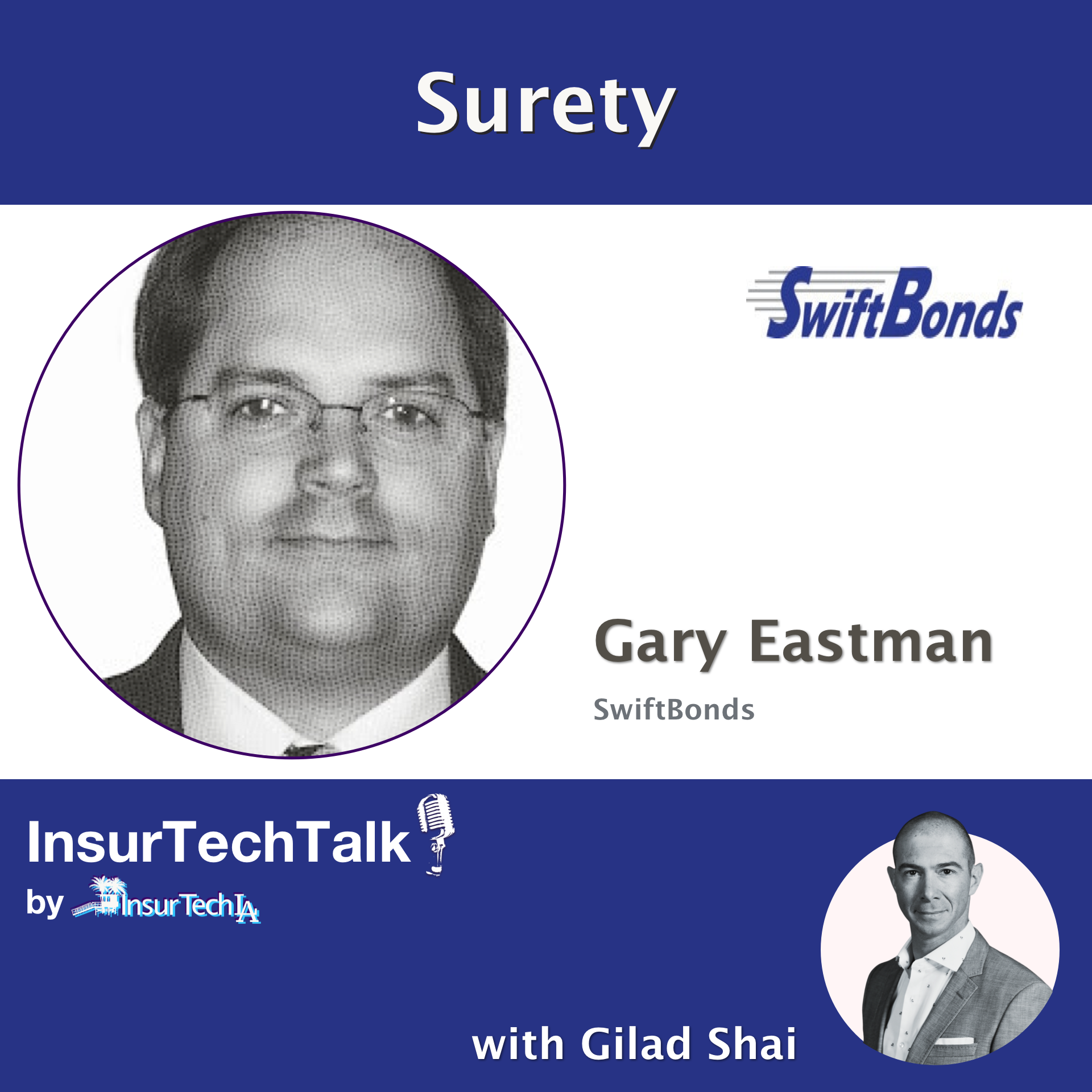
The $100 Billion Niche Nobody Talks About: A Surety Bond Primer with SwiftBonds Founder Gary Eastman
Gary Eastman did not plan to spend 18 years building a surety bond brokerage. He was an attorney doing estate planning work, needed probate bonds for his clients, got licensed to write them, and then one thing led to another. Contract bonds. Commercial bonds. Cannabis dispensary bonds. Fishing and hunting license bonds. An estimated 35,000 types of bonds that nobody in the industry can count precisely because new ones keep getting created.
Surety is one of the least-discussed corners of the insurance industry — and one of the most structurally important. It underpins trillions of dollars of construction, government contracting, and commercial activity every year. And it is run, by Gary's own description, by old white guys using underwriting models developed in the 1980s.
That is both the problem and the opportunity.
In Episode 156 of InsurTechTalk, Gary walked me through what surety bonds actually are, why they matter, how SwiftBonds built a business in a niche where most people cannot even explain the product, and where technology — including AI — is finally starting to make inroads.
About Gary Eastman
Gary Eastman is the founder of SwiftBonds, a Kansas City-based surety bond brokerage he has been running for 18 years. He is also a practicing attorney with 28 years of experience — a background that turns out to be a significant competitive advantage in a product category that is fundamentally contractual in nature. SwiftBonds operates a team of about nine people focused exclusively on surety bonds, with a sister company called Access-Assure serving related needs. Gary has built the business primarily through word of mouth, referrals from P&C agents, SEO, and targeted Google advertising — without ever expanding into other insurance lines despite regular temptation to do so.
Surety 101: What It Is and Why It Matters
Surety bonds are one of those products that most insurance professionals have heard of but few can explain clearly. Gary's explanation is worth understanding because it reframes surety as something meaningfully different from both insurance and lending.
The Three-Party Structure
The fundamental difference between surety and insurance is the number of parties and the nature of the obligation:
Insurance is a two-party arrangement — insurer and insured — built on a shared risk pool where premiums are priced assuming losses will occur
Surety is a three-party arrangement involving the obligee (the party requiring the bond, such as a school district or municipality), the obligor (the contractor or business required to get the bond), and the surety (the guarantor, typically a division of a large insurance company)
The surety writes the bond assuming no loss — it is a guarantee of performance, not a risk pool product
If the obligor defaults, the obligee goes directly to the surety, which either pays damages or more commonly steps in to get the job finished — because roads and schools cannot wait years for legal resolution
The Three Main Types of Surety Bonds
Contract bonds: Required under the Miller Act for any federal construction project over $125,000 — guarantees the contractor will finish on time and pay all subcontractors and material vendors
Court bonds: Probate bonds, guardian bonds, appeal bonds — guarantees that administrators and guardians will not misappropriate funds from estates or minors
Commercial bonds: The largest category by number — roughly 25,000 to 35,000 types — including license bonds for contractors, cannabis dispensary bonds, and bonds required to sell fishing and hunting licenses
How Big Is the Market
Premium written is in the hundreds of billions of dollars annually
The underlying economic activity guaranteed by those bonds is approximately 80 to 100 times the premium — meaning surety underpins tens of trillions of dollars of construction and commercial activity per year
Nobody in the industry knows exactly how many types of commercial bonds exist — the industry's best estimate is around 35,000, with new bond types being created regularly by municipalities and government entities that have never needed one before
Why Surety Is Underbuilt as a Business
Gary's description of the surety industry's current state was honest and specific: it is run by experienced people using methods developed 40 years ago, with a structural bias toward personal relationships over financial analysis — which has actually produced some of the industry's worst outcomes.
The Old School Problem
Surety underwriters traditionally relied heavily on physically meeting clients and building personal relationships
The result: some of the largest claims in recent years have involved contractors who presented well in person but whose financials clearly showed the risk — relationships substituted for analysis
Underwriting models have barely changed since the 1980s
The industry is only now beginning to attract younger professionals; Gary describes himself as young by surety standards
The consequence is a technology adoption curve that is significantly behind even the rest of the insurance industry
What Good Surety Underwriting Actually Looks Like
According to Gary, the core of sound surety underwriting is the three Cs — capacity, capital, and character — applied through financial analysis, not personal charm:
Does the contractor have the operational capacity to complete the job?
Do they have the financial wherewithal — working capital, equity, cash flow — to sustain the project?
Is there anything in the background of the business or its owners that signals character risk?
The goal is not just to write the bond but to help clients build the financial profile that earns larger bond lines over time — enabling them to bid on bigger projects, face less competition, and generate higher margins.
How SwiftBonds Built Its Business
SwiftBonds is a focused, nine-person operation that has resisted expansion into other insurance lines for 18 years — not because other opportunities were not available, but because the surety niche consistently absorbed all available capacity for growth.
Distribution That Actually Works
Word of mouth and referrals remain the core — the highest-quality clients and the most efficient acquisition channel
P&C agent referrals are a significant source: because SwiftBonds writes surety only, it does not compete with the referring agents for their other business — a clean, non-threatening referral relationship
SEO built around deep expertise content — not broad keyword targeting but specific, actionable surety guidance that reaches people actively searching for help
Targeted Google ads focused on defined client profiles, not broad awareness
No Meta advertising, no content marketing for its own sake — focus over volume
The Content and AI Search Shift
Gary's observation about how content strategy is evolving was practically useful: the goal is no longer primarily to rank on Google. It is to be the expert source that AI engines cite when someone asks a surety question. The content strategy has not changed — be genuinely expert, be specific, be actionable — but the optimization target has shifted from search algorithms to AI retrieval systems.
Where Technology and AI Are Heading in Surety
Gary's view of AI in surety was grounded and sequential — not transformational hype, but a clear-eyed assessment of where manual friction currently exists and where software can remove it.
Three Areas Where AI Can Create Real Value in Surety
Client acquisition and onboarding: Using AI to reach and qualify potential clients, and to streamline the information-gathering process that currently involves a lot of back-and-forth between broker, client, and underwriter
Submission packaging: Consolidating the financial documents, project history, and background information that underwriters need into a clean, structured package — reducing the 30 minutes of administrative review that precedes every underwriting decision
Underwriting support: Surfacing the four or five things that actually matter for a specific bond type, so experienced underwriters can focus their judgment on the real risk rather than sorting through documentation
The principle Gary articulated is the right one: AI should not be making surety underwriting decisions. It should be removing the noise so the underwriter can apply their expertise to the signal.
The Right Way to Think About AI and Headcount
Gary's closing observation on AI and employment was worth noting: companies using AI as an excuse to lay off people are missing the actual opportunity. The right use of AI efficiency gains is not to shrink the team — it is to redeploy freed capacity toward new lines of business and expanded client service. That is where the compounding value of AI investment actually shows up.
Key Takeaways
Surety is a three-party guarantee product, not a risk pool — the surety writes assuming no loss and steps in to ensure performance if the obligor defaults
The market is enormous: hundreds of billions in annual premium, underpinning tens of trillions in economic activity
Nobody knows exactly how many types of commercial bonds exist — approximately 35,000, with new ones being created regularly
Surety underwriting has been dominated by personal relationship models for 40 years; financial analysis is a more reliable predictor of performance
SwiftBonds built an 18-year business through referrals, P&C agent partnerships, targeted SEO, and a refusal to dilute focus by expanding into other lines
AI's role in surety is to remove administrative noise and surface what actually matters for underwriting — not to replace underwriter judgment
Content strategy is shifting from search engine optimization to AI engine optimization — the underlying principle (be genuinely expert) stays the same