
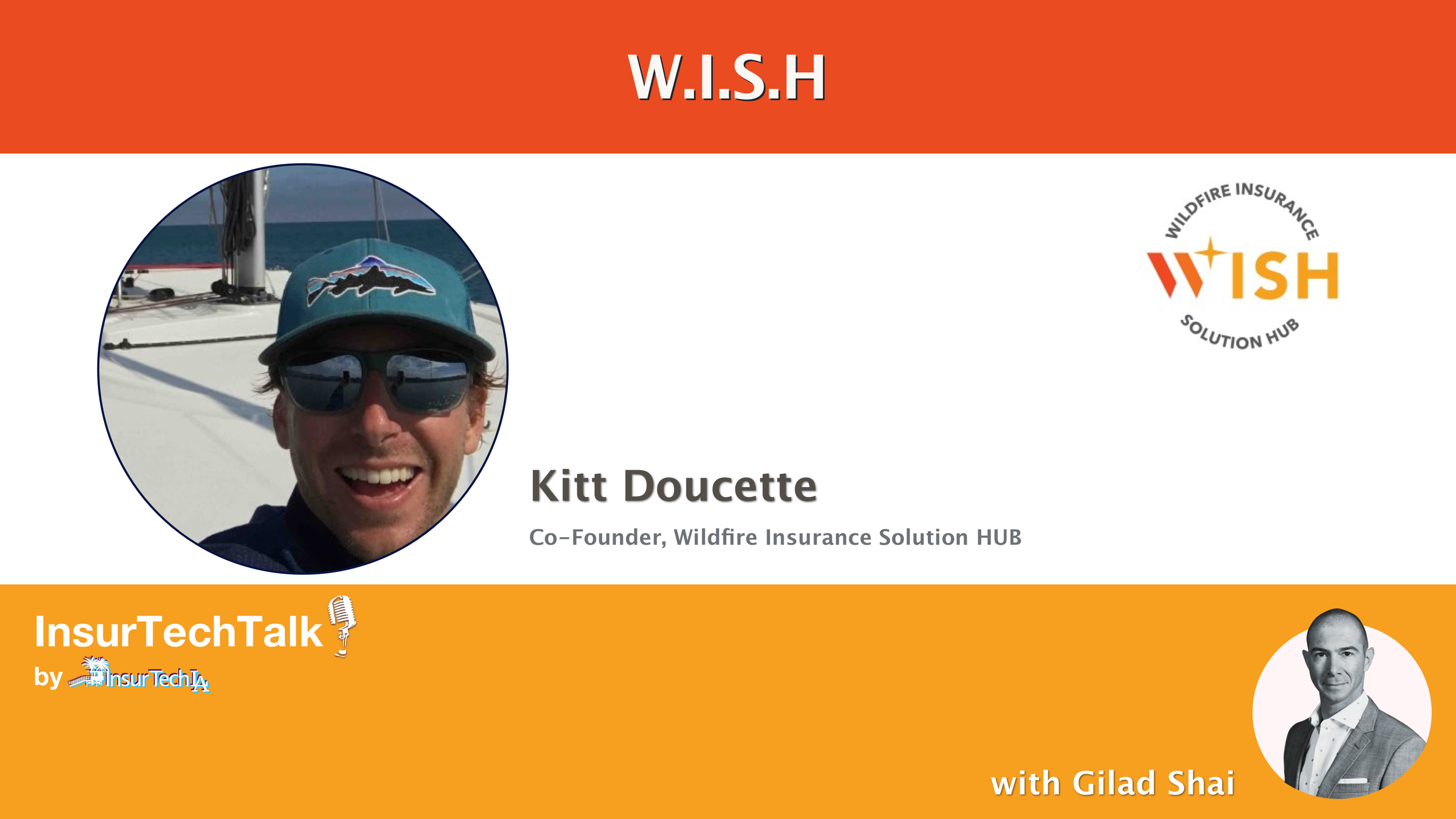
Wildfire Conflagration Is Its Own Peril — And Insurance Has Been Getting It Wrong
Learn how a fourth-generation insurance professional and adventure journalist is using technology, community resilience, and a single-peril approach to rebuild the broken wildfire insurance market in California and beyond.
About Kitt Doucette
Kitt Doucette is the Co-Founder of WISH — the Wildfire Insurance Solution Hub. He comes to insurance from an unusual direction: competitive skier, adventure journalist who embedded with hotshot crews covering wildfires in Idaho, and co-founder of an adventure travel company. He is also a fourth-generation insurance professional — his great-grandfather founded an insurance company in Wisconsin in 1914. His family's MGU in Hawaii, built around single-peril hurricane underwriting, became the foundation for WISH's approach to wildfire conflagration as a distinct and separately underwritten peril.
Understanding Wildfire Conflagration as a Distinct Peril
Most of the insurance industry treats wildfire conflagration the same way it treats a standard home fire or a forest wildfire. Kitt argues this is the root of the California crisis.
What Makes Conflagration Different?
Multiple simultaneous ignitions: Conflagration overwhelms fire resources by igniting many structures at once, making traditional suppression impossible
Structure-to-structure spread: The built environment becomes the fuel — fire moves home to home, not just through vegetation
Ember-driven ignition: Wind-carried embers enter vents, gutters, and crawl spaces, starting internal fires that firefighters cannot safely fight
Community-level risk: No home is an island — a hardened home surrounded by vulnerable neighbors carries far more risk than its own features suggest
The Failure of the Reactive Insurance Model
The industry's response to the wildfire crisis has been almost entirely reactive: non-renewals, zip code exclusions, rate increases where regulators allow, and silence where they don't. Kitt traces this back to a century-old DNA.
How Reactive Underwriting Created the California Crisis
Major carriers exiting the market, with midsize carriers following rather than risk adverse selection
The FAIR Plan absorbing over 700,000 policies — and visibly fracturing under the load
Independent agents losing commission on every non-renewal, rubber-stamping FAIR Plan placements just to retain the client relationship
Advanced wildfire modeling tools being used exclusively to cancel and non-renew, rather than to empower mitigation
Legacy package policies — designed 25 years ago — unable to price conflagration risk at the granularity it requires
What WISH Does
WISH is a technology platform and MGU that engages the wildfire insurance crisis on three levels: carriers, communities, and homeowners. The core product is the WRAP — Wildfire Risk Analysis Profile — a parcel-level, structure-level risk assessment that shares what the insurer sees with the homeowner, and models the before-and-after impact of specific mitigation actions.
The Three Levels of the WISH Platform
Carrier level: WISH runs risk analysis profiling across a carrier's book of addresses, helping small and midsize insurers understand their conflagration exposure without building an internal wildfire underwriting team
Community and neighborhood level: WISH identifies where limited mitigation resources have the highest impact — not trim every tree, but know where the fire is coming from and where to focus
Homeowner level: WRAPs put risk data directly in the consumer's hands, showing current risk, what specific actions reduce it, and by how much
FURA: Feature Underwriting and Rating Approach
WISH's underwriting methodology — developed originally in Hawaii for hurricane wind resilience — prices individual mitigation features rather than requiring all-or-nothing compliance. Low-cost, high-impact actions include:
Ember-resistant vents: 4mm mesh instead of 8mm dramatically reduces ember intrusion into attics and crawl spaces
Zone zero clearing: Removing combustible materials within the immediate home ignition zone
Non-combustible cladding: 12 inches of fire-resistant siding at the base of exterior walls
Gutter management: Removing debris that can catch and hold embers
Each feature earns a premium credit — creating a clear, quantifiable ROI for the homeowner and a better risk for the carrier.
Prevention's Core Problem — and How Technology Solves It
Prevention in insurance has always struggled with the same fundamental challenge: if it works, nothing happens. No claim, no data point, no visible proof of value.
Why Modeling Changes the Equation
Known fire events like the Camp Fire and Paradise Fire provide detailed records of exactly how conflagrations moved and which structures survived
Running hypothetical mitigation scenarios against those known fire models produces credible before-and-after risk profiles
A homeowner can see: "If you make these changes, your risk is reduced by 22.3% according to this model"
That before-and-after picture is the actuarial foundation the industry needs — without waiting 20 years for archival loss data on mitigated properties
The Case for Treating Wildfire Conflagration as Its Own Peril
This is WISH's most ambitious argument — and the one most likely to reshape the market if it gains regulatory traction.
Why Separation Makes Sense
Granular pricing: Conflagration risk can be priced accurately at parcel level without distorting or being distorted by home fire, smoke, and other bundled perils
Meaningful mitigation credits: When conflagration is its own line item, a 20% risk reduction from hardening translates into a 20% credit on that peril — not a rounding error on a package policy
Reinsurance fit: Conflagration is lower-frequency, higher-severity — a better structural fit for cat reinsurance than for a standard homeowners treaty
Consumer clarity: Homeowners understand what they are buying, what they can do to reduce the cost, and why
Regulatory precedent: Hawaii treats hurricane as a single peril; Nevada just passed a statute allowing carriers to carve out wildfire conflagration from homeowners policies
The Opt-Out Objection — and Why It Doesn't Hold
The concern that homeowners will opt out of standalone conflagration coverage — as many do with flood and earthquake — misses a critical constraint: no mortgage lender in wildfire-prone areas will accept a homeowners policy without conflagration coverage. The carve-out creates transparency and better pricing, not an escape hatch.
The Role of Independent Agents
Independent agents are losing commissions on every non-renewal. They are motivated to find coverage for their clients but have almost no tools to help those clients understand or reduce their risk.
How WISH Empowers the Agent Force
Agents can walk clients through a WRAP report — here is your risk, here is what you can do, here is what it saves you
Technology empowers agents rather than replacing them
Community-connected agents are the distribution layer that makes neighborhood-level resilience programs actually reach homeowners
Wholesalers play a critical education role in getting agents fluent in wildfire conflagration as a product category
Where WISH Is Headed
WISH currently operates an MGU in Hawaii and is building toward a primary carrier with its own policyholder surplus and a reinsurance panel structured specifically around conflagration risk.
Near-Term Targets
California: 20,000 policies depopulated from the FAIR Plan in the first two years, through participating homeowner policies that separately price conflagration risk; active engagement with the newly formed FAIR Plan depopulation clearing house committee
Nevada: Leverage the new single-peril statute to offer wildfire conflagration as a standalone endorsement or carve-out product
Regulatory outreach: Build consensus with California regulators, the scientific and research community, and capital markets around conflagration as a separately rated, separately reinsured peril
Key Takeaways
Wildfire conflagration is a distinct peril from wildfire and needs to be underwritten, rated, and reinsured as one
The insurance industry's advanced modeling tools exist and work — they are just being used to exit markets instead of empower mitigation
Parcel-level risk analysis creates genuine before-and-after prevention ROI, solving the phantom benefit problem that plagues all prevention technology
Specific low-cost home hardening features are well-researched and meaningfully reduce conflagration risk
The FAIR Plan's unchecked growth is as much a part of the California crisis as the fires themselves
Independent agents are an underutilized but essential force for wildfire resilience at the community level
Hawaii and Nevada provide the regulatory precedent for the single-peril approach WISH is advocating