
The Filing Cabinet Nobody Fixed — And the AI Liability Gap Nobody Is Talking About
Cheri Martinen never planned to sell.
She bought her family's agency in La Pine, Oregon — a fourth-generation insurance business — with every intention of staying until she was old. Her mother's first boss literally died in his chair. That was the job. You show up, you serve your clients, you live on the renewals.
But then she started getting the emails. One or two a week. Offers to buy the book, interest in the agency, all the usual approaches. She answered one every six months or so, mostly out of curiosity, and mostly walked away unimpressed. Too focused on the numbers. Not interested in the people.
And then she took a meeting that surprised her.
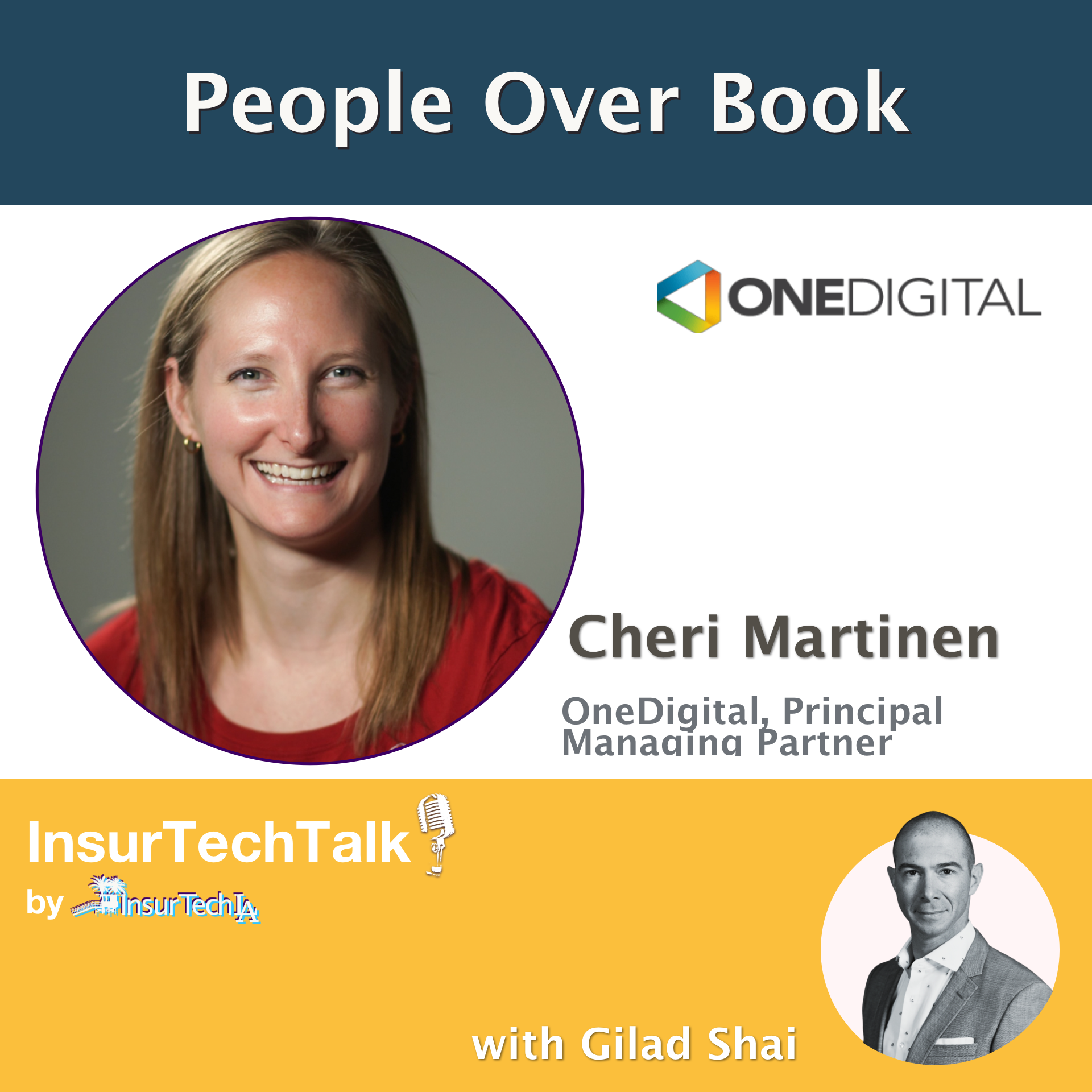
In Episode 161 of InsurTechTalk, Cheri — now Managing Principal and Equity Owner at OneDigital — walked me through what made that meeting different, how she ran a agency that was genuinely ready to be acquired, why wildland firefighter contractors and water utilities became her niches, and what she learned at a recent CIC class that should be alarming every agent and every business owner who uses AI to create content.
About Cheri Martinen
Cheri Martinen is a fourth-generation insurance professional, Certified Insurance Counselor (CIC), and Managing Principal and Equity Owner at OneDigital. She built and ran a boutique independent agency in La Pine, Oregon, specializing in niche commercial lines — wildland firefighter contractors and privately held water utilities among her core markets. She sold the agency to OneDigital and continues to operate out of the same office, growing the business with the expanded resources of a national platform while maintaining the community relationships that defined her agency from the start. She is active in multiple agent mastermind groups and has been a consistent voice for the role of the independent agent in an industry that keeps trying to disintermediate them.
Why She Sold — And Why It Was Not About the Money
The framing Cheri used for her decision to sell was simple and worth holding onto: she did not sell because she had to. She sold because it was the right outcome for three groups of people — and the order matters.
The Win-Win-Win
- Her employees: A smaller independent agency has limits. Career growth hits a ceiling. Expansion into adjacent lines is hard without scale. OneDigital gave her team paths that she could not have offered alone
- Her customers: More carriers, more products, more support — without losing the relationship they had built with Cheri and her team
- Her family: Her father, who had been part of the business, was finally able to mentally step back. Not just stop working — actually retire, mentally, in a way that is hard to do when your name is still on the building
What Made OneDigital Different
Every other approach she had received over the years followed the same pattern: show me the book, show me the retention, show me the numbers. The people were an afterthought.
OneDigital led with people. That was the tell. These were people she could see herself working alongside every day — people who seemed to actually care about getting it right for the clients and the employees, not just extracting value from the book. In an industry where culture is easy to claim and hard to demonstrate, that felt different.
How to Run an Agency That Is Ready to Be Acquired
Cheri's due diligence process was notably smooth — not because acquisitions are easy, but because she had been running her agency like it needed to justify itself every year.
What Made Her Ready
- Year-over-year P&L spreadsheets going back five to ten years — revenue by month, by carrier, by line
- Every carrier relationship documented, with commission rates and production volumes accessible at a click through AMS 360 and Insured Mine
- Average premium and commission per policy tracked by segment — not just top-line revenue but unit economics
- No surprises in the data room because the data had always been clean
Her advice for agents who might someday want the same outcome: join a mastermind. She was part of multiple smaller agent groups, watched peers go through acquisitions before her, and understood what the diligence process would look like before she ever sat in the room. The agents who struggle in diligence are almost always the ones who have been running on instinct and relationships rather than data. Both matter — but only data survives a spreadsheet.
The AMS Problem Nobody Has Solved
One of the most honest moments in the conversation was Cheri's answer to the question of what InsurTech has gotten right — and wrong.
The right: technology is genuinely removing manual friction from processes that used to eat hours. The tools are getting better. The direction is correct.
The wrong: the filing cabinet.
What She Means by the Filing Cabinet Problem
- Agency management systems have been the system of record in insurance since paper became digital
- Epic and Applied are the two gorillas — dominant, entrenched, and the center of almost every agency's operational universe
- Every tool that has come along since either has to talk to the AMS or operates completely separately — and for most of the history of these systems, they did not talk to anyone
- Even today, data entry is still largely manual. Downloads fail. A single mistyped letter in a name breaks the match. Agents spend meaningful time babysitting the sync between what carriers send and what the AMS receives
- No one has truly solved this. The filing cabinet is still running. It just lives in the cloud now
Her point is not that the AMS is bad — it is that it has become the infrastructure nobody questions and the problem nobody fixes, while the industry celebrates the tools that sit on top of it.
Niche Is Not a Limitation — It Is a Moat
Cheri's agency did not try to be everything to everyone. It became the best in the country at two very specific things.
Wildland Firefighter Contractors
- Contractors who work with the federal government to fight fires have highly specific insurance needs — liability exposures, equipment coverage, and workers comp dynamics that most generalist agents do not understand
- Cheri's agency became the go-to on the West Coast for this niche — not by accident, but by understanding the risks deeply enough that clients knew they could trust the coverage
- Word of mouth in a specialized community is more powerful than any advertising spend
Privately Held Water Utilities
- Another niche most agents would never think to pursue — small and mid-sized water systems that operate outside the municipal utility structure
- The risk profile is distinct and learnable. Once you have insured enough of them, you understand what matters and what does not
- The result: a segment of the market that comes to you, rather than one you have to fight for
Her philosophy: there is enough business for every agent who is genuinely good at something. The agents who feel like they are constantly fighting for every policy are usually the ones who have not picked their lane yet.
Prevention, Telematics, and the Agent's Role in Risk Reduction
The conversation moved into wildfire prevention — territory familiar to InsurTechTalk listeners after the Kitt Doucette episode (Episode 149) — and Cheri's perspective from an Oregon agent's chair was grounded and practical.
What Actually Works
- The first five feet around a structure are the most important mitigation factor in wildfire exposure — no combustible material, no wooden fences, no decorative planters, no firewood stacks
- After that, ladder fuels — plants that connect ground fuel to tree canopy — are the next priority
- The visual evidence from Talent, Oregon's fire: burned neighborhoods with single houses standing untouched, almost always because of defensible space decisions made years earlier
Technology's Role
- Sprinkler systems that trigger at heat thresholds, foaming technology, roof-mounted suppression — these exist and work, but are not yet standardized
- Telematics on the auto side is the clearest example of where technology has successfully changed underwriting behavior — good driver apps, usage-based pricing, meaningful discounts
- The barrier to adoption is always the same: customers do not want to trade privacy for savings, even when the savings are significant
The Agent as Communicator
Cheri's core argument about agents and prevention is not that they can stop fires. It is that they are the most effective channel for educating policyholders about what actually reduces risk — because they have the relationship and the trust that carriers and regulators do not.
The AI Liability Gap: The Most Important Insight in the Episode
This was the closing insight — and it is something every agent, every business owner, and every InsurTech founder needs to hear.
What Changed in April 2026
Cheri had just completed a CIC class on updated ACORD standards. Buried in the content was a disclosure that stopped her cold: AI-generated content is now being excluded from standard general liability coverage.
The implication, stated plainly:
- If your business publishes marketing materials, social posts, proposals, or any other content that was generated by AI — and a claim arises from that content — your GL policy may not cover it
- The coverage gap moves to cyber — but many cyber policies are not covering AI-generated content either
- Most business owners do not know this. Many agents do not know this either
- It went into effect in April 2026
Why This Matters Now
Almost every business is using AI to generate some form of content. Marketing copy, email templates, social media posts, client communications — the adoption curve for AI content tools has been nearly vertical. And the insurance coverage framework has quietly shifted underneath all of it without anyone sounding the alarm loudly enough.
Cheri mentioned that she had encountered new MGAs specifically launching AI liability products to fill this gap. They are in early states, limited footprints, working through fronting relationships. But the product is coming. The question is whether policyholders and their agents will know to ask for it before a claim proves the gap is real.
Key Takeaways
- Selling an agency is not just a financial transaction — the right buyer cares about employees and customers, not just the book of business
- Due diligence readiness is an operational discipline, not a transaction preparation — agents who run clean data year-round go through diligence smoothly
- Niche specialization is a moat, not a limitation — the agents who feel most competitive pressure are usually the ones who have not picked a lane
- The AMS filing cabinet problem has not been solved — manual data entry and download failures remain the unsexy, unsolved center of agency operations
- AI-generated content exclusions in standard GL policies went into effect in April 2026 — most business owners and agents do not know this gap exists
- The agent's role in risk communication and prevention is irreplaceable — technology can surface the data, but the relationship delivers the message