
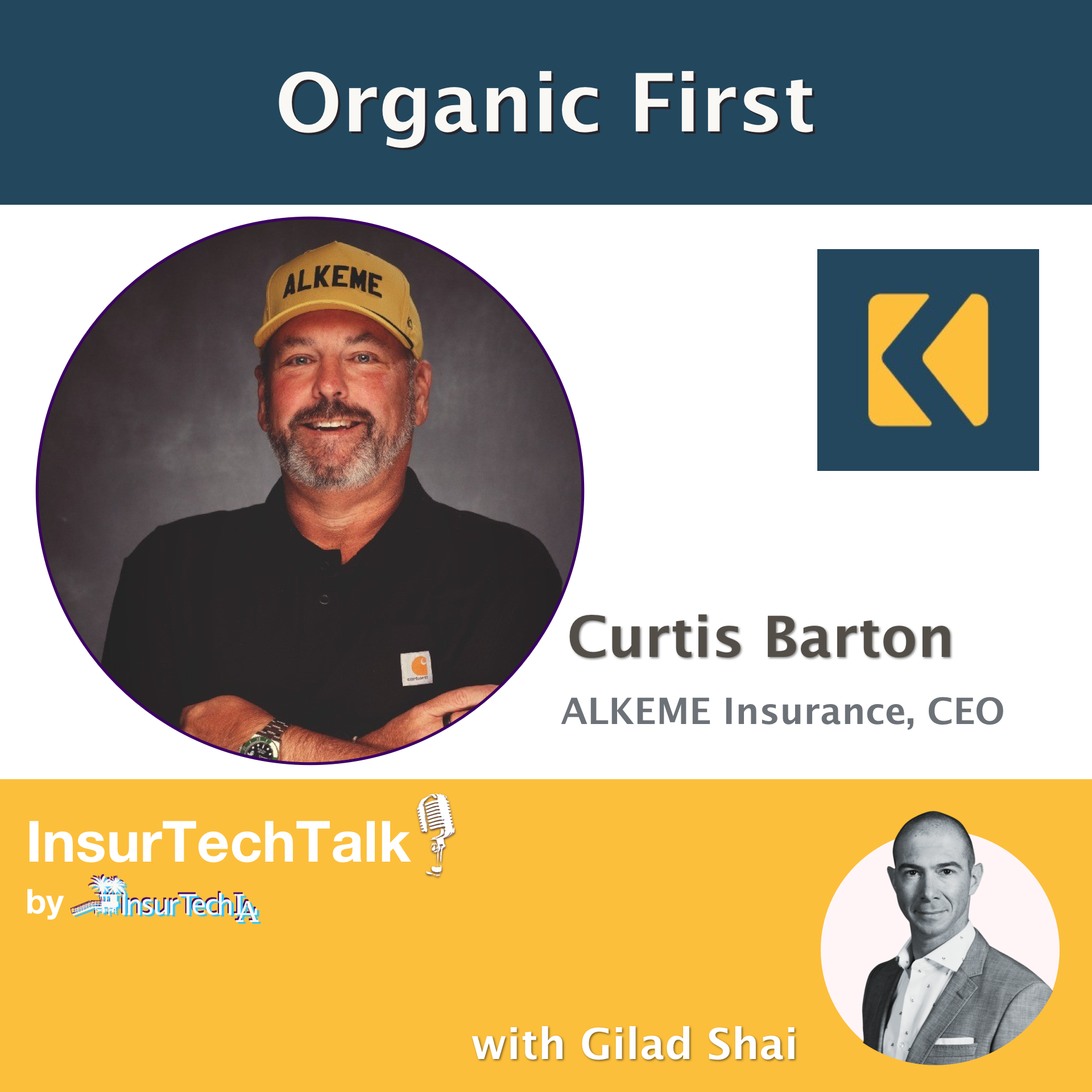
You Can't Play the M&A Game If You're Not Growing Organically First
Curtis Barton did not set out to build one of the fastest-growing insurance brokerage consolidators in the country. He set out to escape the ceiling of a lifestyle business.
In 2019, he looked around at a group of successful independent P&C agency owners — good books, good lives, no real path to generational wealth — and made a simple argument: the world is changing whether you want it to or not. You can sell to a publicly traded consolidator, stay independent and watch your asset depreciate, or you can build something together that actually compounds.
Six P&C shops and one wealth management firm said yes. They came together with about $25 million in combined revenue in October 2020 — in the middle of COVID, in the middle of a political shift, at what seemed like the worst possible time to launch a company.
Five years later, Alkeme has over $350 million in top-line revenue, operates in 35 states with more than 110 physical locations, has completed over 85 acquisitions, and counts GCP Capital and Apollo S3 among its backers. The University of Arizona's basketball arena now carries the Alkeme name.
In Episode 160 of InsurTechTalk, Curtis walked me through how he built it, what most consolidators are getting wrong, and why an insurance brokerage in 2025 has no choice but to become a software company.
About Curtis Barton
Curtis Barton is the CEO and founder of Alkeme, a PE-backed insurance brokerage consolidator headquartered in Southern California. He grew up in the insurance business — his father built an agency to $1 million in revenue, sold it, retired at 52, got bored, and asked Curtis to start something new with him. That partnership became Venture Pacific, which Curtis grew to over $11 million in revenue before founding Alkeme. The name came from the phonetic spelling of alchemy — the seemingly magical transformation of combining multiple metals into something harder and more formidable. Curtis was a freestyle mogul skier at the University of Colorado Boulder before transferring to the University of Arizona, where Alkeme now holds the naming rights to the basketball arena.
The Founding Thesis: Lifestyle Business to Wealth Creation Vehicle
The pitch Curtis made to the six founding agencies was not complicated. It did not need to be.
What He Said to Get Seven Agencies to Say Yes
- Every independent agency owner was watching consolidators buy up the market around them
- The choice was simple: sell to a publicly traded company or a financial engineer, stay independent and ride it out, or build something together with actual upside
- Insurance is a great lifestyle business — flexible, recurring revenue, relationship-driven — but it does not create generational wealth on its own if you are not building equity that compounds
- The model Curtis proposed: combine the books, put everyone on one platform, make decisions from data, grow organically at a high clip, and use that organic growth as fuel for inorganic acquisition
- He built a model to support the thesis — and by his own account, they knocked past every assumption they had made in the first five years
The Integration Playbook
Alkeme has done over 85 acquisitions. The integration approach is what separates it from the consolidators that buy everything and hope it works out.
How Alkeme Onboards an Acquired Agency
- Every acquisition starts with a departmental interview process — HR, IT, accounting, operations — where Alkeme's team sits down with the counterpart at the acquired agency to understand what exists and what needs to change
- Day one absolutes: treasury, payroll, and banking transfer to Alkeme immediately, no exceptions
- After that, the acquired agency enters a formal integration roadmap — a signed bilateral document that sets out exactly what changes, when, and in what sequence
- The goal is to eliminate surprise: every change is communicated in advance, agreed upon, and documented
- Beyond the institutional requirements, the philosophy is augmentative — come in, preserve the culture and the entrepreneurial energy that made the agency worth buying, and make it better with shared infrastructure
What to Look for in a Target
Alkeme uses a scorecard for every potential acquisition that evaluates:
- Adaptability to change
- Organic growth trajectory
- Niche or specialty focus
- Technology sophistication
- Speed of platform migration
The sweet spot: niche players who do something specific well that can be replicated across Alkeme's entire network.
Why Most Consolidators Are in Trouble
Curtis's read on the competitive landscape was direct and specific — and it maps closely to what anyone watching the insurance M&A space has been seeing play out in real time.
The Overleverage Problem
- During the low interest rate environment, consolidators were rewarded for hyperbolic inorganic growth — buy everything, stack it, the math works at zero rates
- Nobody asked about organic growth. Curtis was in those meetings. He confirmed: it simply was not part of the conversation
- When rates moved, the debt that had been layered onto these businesses became a trap — either freeze the company and watch it crater, or add more debt on top in the form of PIK instruments
- PIK preferred instruments (payment-in-kind) are often not counted as true debt in leverage calculations, meaning companies reporting seven times leverage may actually be running at ten
- The result: companies that cannot get liquidity to their partners, cannot recapitalize, and whose only exit options are a strategic buyer or a public market that is increasingly skeptical
The Organic Growth Illusion
Curtis also called out a practice he described as the "NIL of the insurance producer world" — poaching producers from other agencies, counting their existing book as organic growth before a single policy has actually moved.
- A producer with a $3 million book gets hired — and that $3 million gets counted as organic growth before the client relationships have transferred
- Companies are reporting 16–18% organic growth using this method, which inflates the picture significantly
- The producers know it, too: sign a five-year deal, collect the package, and at the end of year five, put your hand out again or walk
The Clean Alternative
Alkeme's structure is intentionally simple: one class of common shares, no PIK instruments, no complex waterfall structures. Curtis's view is that you cannot build a real company on a capital structure that obscures true leverage and dilutes partner returns.
Technology, AI, and the Brokerage as Software Company
This was the most forward-looking part of the conversation — and one of the most practically specific discussions of AI in the brokerage context I have had on the show.
The AI Governance Problem
- As AI tools proliferate, the risk is that employees go ad hoc — building their own tools, using shadow AI, creating processes that are not integrated or governed
- Alkeme solved this with a dedicated business intelligence team that takes employee ideas, builds them properly, and deploys them back within sometimes the same day
- Every AI deployment is reviewed against Alkeme's AI governance framework before it goes into production
- Employee manuals, contracts, and operational processes all need to be rethought in light of AI — and most companies are not thinking on that scale
How AI Is Changing the Brokerage Workflow
- Alkeme is building a prompt-based layer on top of its Epic AMS system — a chat-based interface that allows anyone in the organization to query anything across the entire network
- Practical example: a producer gets a referral for a hotel risk they have never written — instead of turning it down, they query the system, which surfaces which carriers write hotels, what the rating structure looks like, who the specialist broker is, and generates an introduction email — all without human intervention
- Workflows are being automated to run 75% of the way to completion overnight — arriving on an account manager's desk in the morning ready for the final quarter-mile of human judgment
- Curtis's vision: two people in a basement building a $5–8 million revenue brokerage with zero employees, running fully automated service and sales bots 24/7
The AMS Duopoly Is Vulnerable
One of the more provocative predictions in the conversation: Curtis sees the two dominant agency management systems losing ground within 18 to 24 months as the open-source movement and AI-native development tools make it feasible for organizations like Alkeme to build their own internal systems — continuously updated, prompt-driven, and integrated with their proprietary data.
Cybersecurity: The Risk Nobody Talks About Enough
As Alkeme acquires smaller agencies, one of the first things it has to address is cybersecurity infrastructure — because smaller shops simply do not have it.
The Acquisition Cybersecurity Problem
- Small agencies acquired in a rollup are immediately vulnerable — their systems are not hardened, their data is not secure, and announcing an acquisition can attract bad actors before the new owner has shored up the back end
- Alkeme does not announce acquisitions until systems are secured and migrated — a deliberate policy driven by real cybersecurity risk, not PR strategy
- The company uses a third-party firm called Bulletproof to manage its cybersecurity posture across the network as it grows
Organic Growth Is the Only Honest Metric
Curtis's closing argument — in response to the final question about organic growth versus rollups — was the sharpest summary of his philosophy.
The Bottom Line on Consolidation
- If you are not growing organically, you are not in the M&A game — organic growth is what funds inorganic capacity
- Every dollar of new organic revenue generates approximately seven dollars of acquisition capacity — the seesaw that makes the model work
- Rate increases have been masking weak organic growth at many consolidators — as the market softens, that gap will become visible quickly
- The future belongs to producers who use AI as a force multiplier — doing 12 times the work of a traditional producer, handling massive blocks of business with agents supporting them rather than armies of service staff
Key Takeaways
- The consolidation model only works if organic growth is the foundation — inorganic growth without organic lift is a debt trap waiting to spring
- Integration discipline is what separates acquirers that build value from those that create holding company chaos — Alkeme's signed bilateral roadmap and departmental interview process is a replicable model
- Most consolidators are more leveraged than they appear — PIK instruments, share class complexity, and producer poaching inflate the picture
- AI governance is not optional at scale — companies that let employees go ad hoc with AI tools will face compliance, data, and quality problems that compound over time
- The AMS duopoly is more vulnerable than it looks — open-source development and AI-native tools are lowering the bar for building proprietary systems
- Cybersecurity is a first-order problem in insurance M&A that almost nobody talks about publicly