
The Safety Net Your Claims Team Doesn't Know It Needs
Heather Wilson's 85-year-old mother won a golf match against a 30-year-old the morning of this recording. Four loads of laundry were done before 9 a.m. And somewhere in a claims system, a finger cut was quietly becoming an amputation — while nobody was looking.
That last part is not a metaphor. It is a real case. And it is the clearest illustration of what CLARA Analytics was built to prevent.
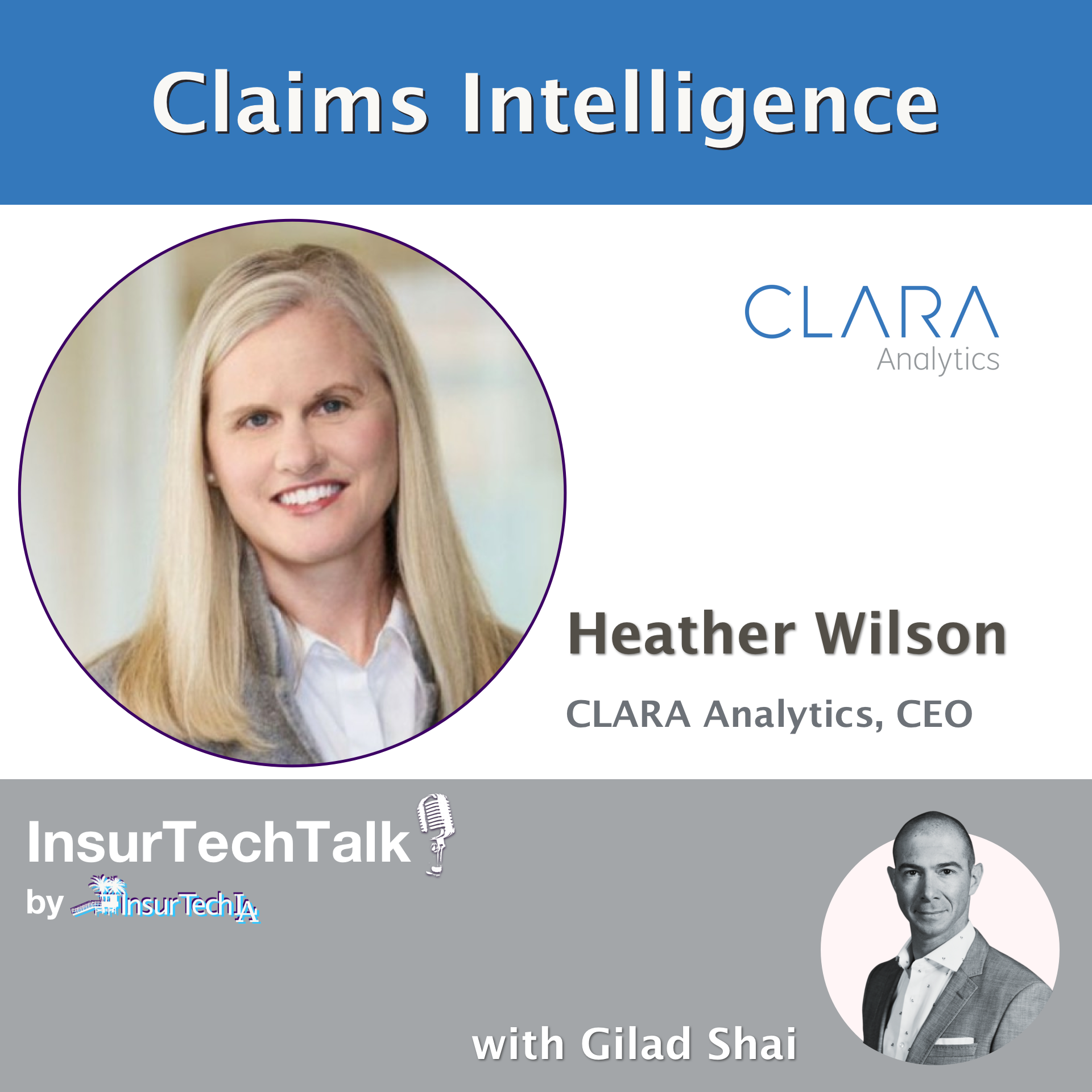
In Episode 159 of InsurTechTalk, Heather — CEO of CLARA Analytics and former Chief Data Officer at a major tier one carrier — walked me through what claims AI actually looks like when it is working, why the framing of "AI as replacement" is wrong and counterproductive, and what she wants to accomplish before she leaves this industry: connecting the claims intelligence that CLARA generates to the actuarial and policy intelligence that currently operates in a completely separate world.
About Heather Wilson
Heather Wilson is the CEO of CLARA Analytics, a claims AI platform that has been in market for nine years — incorporated as its own legal entity in 2017 after spinning out with its machine learning models from a prior organization in 2012. Before leading CLARA, Heather served as Chief Data Officer at a major tier one insurance carrier, giving her a rare view of the data problem from both sides: as the person who owned the data at a large carrier, and now as the person whose platform has to work with whatever data carriers actually have. CLARA has raised through a Series C financing round and works with carriers from tier one through tier six, TPAs, self-insured corporates, and brokers who white-label CLARA's capabilities for their own clients.
What CLARA Analytics Does
CLARA is a claims AI platform that operates after first notice of loss across workers comp, auto liability, and general liability. Its models — trained on approximately 10 million claims cases over a decade — surround every active file 24 hours a day, 7 days a week, looking for anything that could take a case off its optimal trajectory.
What the Platform Monitors
- Predicted treatment plan and predicted cost — benchmarked against how similar cases have resolved
- Trajectory deviation — anything that suggests a case is moving away from its expected path
- Opportunities to settle, close, or intervene earlier
- Subrogation and fraud indicators
- Litigation propensity
- Provider quality and appropriateness
- Reserve accuracy — flagging both over-reserving and under-reserving
The output is a continuous stream of alerts and triggers delivered to the claims professional — not decisions, but recommendations. The adjuster remains the driver. CLARA is the safety net.
The Finger Cut That Became an Amputation
This is the case that explains everything.
A workers comp claim came in. Finger cut. Low severity — a severity one file. The kind of case that gets logged and sits, because there is nothing urgent about a finger cut when you have 300 files on your desk.
Medical documentation kept coming in. CLARA's models kept reading it. The clinical trajectory was moving. What looked like a minor laceration was showing indicators of something more serious. The models flagged it — severity escalating, treatment path changing, reserve adjustment needed, litigation risk emerging.
A human adjuster who had not looked at the file in 90 days would not have caught this without the alert. By the time the next scheduled review came around, the case would have been materially worse and the reserve materially wrong.
The adjuster acted on the alert. The case was treated differently. The outcome was better — for the claimant and for the carrier.
That is what a safety net does. It catches what tired eyes miss — not because the adjuster is incompetent, but because nobody can read every file every day when they have hundreds of them.
The Right Framing: Augmented Intelligence, Not Replacement
One of the most important moments in this conversation was Heather's explanation of how CLARA manages the change management challenge with new clients — specifically with senior adjusters who have been doing this for 20 years and do not need a machine telling them what they already know.
How CLARA Handles the "I Already Knew That" Problem
- When a senior adjuster sees an alert and says "I knew that" — that is actually a good sign. It means the model is catching the right things
- The value is not in telling experienced adjusters what they already know. It is in catching the things they do not catch because they are human, because they are tired, because the file has been sitting for three months, because things are moving faster than they used to
- CLARA works with CEOs and Chief Claims Officers from the beginning of every engagement to set the right expectations: this is augmented intelligence, not automation, not replacement
- Task automation — generating a cover letter, producing a summary report, flagging a document — happens and is valuable. But the judgment call on the file stays with the person
- The goal is to make the claims professional faster, more accurate, and better informed — not to remove them from the equation
Why the Waze Analogy Works
Heather's analogy for CLARA is Waze. You know how to drive. You know your route. But Waze is watching things you cannot watch — traffic conditions three miles ahead, an accident on the highway you would not know about until you were in it, a faster route that just opened up. You still drive. Waze just gives you better information in real time.
That is exactly what CLARA does for a claims adjuster. The adjuster drives the case. CLARA watches everything else.
The Data Problem — and Why It Is Not a Dealbreaker
One of the most practically useful parts of this conversation was Heather's explanation of how CLARA actually works with insurance data — which, in most organizations, is fragmented, poorly structured, and inconsistently maintained.
Three Types of Claims Data
Every claims file has three types of data, and they are not equal:
- Structured field data: What adjusters enter into system fields — status codes, dates, amounts. Fill rates are often in the single digits. Not reliable as a primary data source
- Adjuster notes: Where adjusters actually tell the story of the case. Detailed, narrative, regularly updated. This is where 80 to 85 percent of the useful information lives
- Documents: Medical records, police reports, legal filings, invoices. Rich with clinical and legal detail that structured fields will never capture
CLARA's models were built to work primarily off notes and documents — not because structured data is unimportant, but because it is almost universally inadequate. This means CLARA can get to meaningful outputs even when a carrier's structured data is a mess.
Data Engineering as a Service
For cases where even notes and documents are not flowing correctly, CLARA operates as a data engineering layer — connecting to whatever systems a carrier has, normalizing the data, mapping it, and making it usable. Implementation takes longer when data quality is worse. But it is still faster than any carrier could do it internally, and CLARA does not move forward with an implementation until the data foundation is sufficient to produce reliable outputs.
The analogy Heather uses: like a doctor going into surgery, she does not know exactly what she will find — but she will not proceed until she has done enough discovery to know the intervention will work.
Selling Claims Improvement: The Hardest Pitch in Insurance
This was the most candid moment in the conversation about the commercial reality of what CLARA does.
Improving claims profitability is — objectively — one of the highest-ROI interventions available to a carrier or TPA. Closing cases faster, reducing medical costs, correcting over-reserving, catching litigation early: all of these flow directly to the bottom line.
And yet it is one of the hardest things to sell in insurance.
Why It Is Hard
- You are selling margin improvement, not revenue growth — and most buyers are conditioned to think about growth, not efficiency
- The ROI is real but delayed — CLARA targets 2 to 3 percent loss cost savings within 6 to 9 months, which means the contract pays for itself, but the timeline requires patience
- Getting CEO and Chief Claims Officer alignment is essential — without executive sponsorship, claims teams do not consistently act on alerts, and without consistent action on alerts, the financial outcomes do not materialize
- The political capital required to get an AI platform adopted across an adjusting team is significant, especially with senior adjusters who have earned their expertise and are skeptical of being second-guessed by a model
How CLARA Gets It Done
- Start with the right metrics aligned at the beginning of the engagement — not "this AI platform delivers analytics" but "here is the specific financial outcome we are targeting and here is how we will measure it"
- Get the CEO involved because claims improvement rolls up to a P&L outcome they own
- Show early wins — over-reserving corrections, severity catches, litigation flags — that demonstrate the model is working before the full ROI picture develops
- Build stickiness through workflow integration: CLARA does not sit outside the claims system, it integrates into the workflow so it cannot easily be turned off
The Multi-Tenant Data Advantage
One of CLARA's structural advantages is its multi-tenant data model — clients who contribute their data to the anonymized, aggregated industry database get access to industry-wide intelligence they could not generate on their own.
What Industry-Wide Data Makes Possible
- Litigation intelligence: if you have never litigated in Omaha, Nebraska, CLARA can surface the plaintiff and defendant patterns across its entire panel in that jurisdiction — so you walk in informed rather than blind
- Provider benchmarking: which medical providers produce better outcomes for specific injury types in specific geographies
- Industry scoring: benchmarks for reserving, litigation rates, and treatment costs across the full CLARA customer base
Ten years ago, carriers were apprehensive about contributing data to a shared model. The value of the industry intelligence has largely overcome that hesitation — because the benefit of knowing what is happening across the industry outweighs the discomfort of contributing anonymized data to get there.
The Vision: Closing the Loop Between Claims and Actuarial
Heather's closing answer to the standard InsurTechTalk question — what should the industry be talking about more — was the most ambitious idea in the conversation.
Right now, claims intelligence and actuarial intelligence operate in almost complete isolation from each other. A claim closes. The actuary does not know. The policy renews. The underwriter does not know what happened during the claim. The left hand and the right hand are running two separate businesses inside the same organization.
What Closing the Loop Would Look Like
- When a case closes, that information flows in real time to the actuarial model — updating loss projections, reserving assumptions, and pricing signals
- When a case escalates in severity, the policy model knows — so renewal pricing and coverage recommendations reflect actual loss experience, not last year's actuarial table
- The AI working on claims and the AI working on policy and actuarial are connected — sharing intelligence, updating each other, operating as one system rather than two siloed ones
This is not a product that exists yet at the scale Heather is describing. It is where she wants the industry to go before she leaves it. And it is probably the most important unsolved problem in insurance data architecture.
Key Takeaways
- Claims AI works best as a safety net — a 24/7 second set of eyes that catches severity escalations, reserve errors, and litigation risk that human adjusters miss not because they are bad at their jobs but because they are human
- The data problem in insurance is real but not a dealbreaker — CLARA's models run primarily off adjuster notes and documents, not structured field data, which means they work even when structured data quality is poor
- Selling claims improvement is the hardest pitch in insurance — the ROI is real, but it requires executive alignment, patience, and consistent adjuster adoption to materialize
- Senior adjuster buy-in is a change management challenge, not a technology challenge — the framing of augmented intelligence rather than replacement is essential
- The multi-tenant data model creates compounding value: industry-wide litigation, provider, and benchmarking intelligence that no single carrier could generate alone
- The biggest unsolved problem in insurance data: claims intelligence and actuarial intelligence do not talk to each other — closing that loop is the next frontier