Should Amazon sell insurance

This post is a reply to https://www.linkedin.com/nhome/updates?activity=6228120175070179328

Google discontinued its Google Compare service after a year. The decision, like most decisions at Google, was based on performance. According to public reports, Google enjoyed only 10% of the expected traffic in the four pilot states. Missing a goal by 90% seems a good reason to stop the service.

The launch announcement of Google Compare in 2015 alarmed many insurance agents. The shutdown, on the other hand, was noticed only by those who followed the technology news. Google is an amazing tech company. Many of my Googler friends define Google as "geeks heaven." I can only speculate to the true reason Google Compare failed.

For starters, let me remind you that Google's core business is selling ads and that Google search drives that traffic. Google's critics would like Google to improve on: user experience, customer service and promoting Google non-search products. The first two items are critical for insurance and financial services. Google has services, and can develop new B2B services for the insurance industry. e.g. tools for commercial lines underwriters.

Google Venture is investing in new InsurTech companies. e.g. Oscar and Lemonade, and partnering with insurance companies. e.g. Liberty Mutual and AXA. However, instead of building its own capability, Google is partnering up. It will be interesting to see Google, or another tech giant, acquiring a conservative insurance company and integrating it to Google's culture.

Amazon is a different story. When you think about Amazon what comes to mind? Superb supply chain management, distribution, AWS, Alexa, recommendation engine and the other Netflix, which is not Hulu. Amazon already exhibited its ability to penetrate a new industry. For example, today Amazon is a content creator that hires movie producers. Amazon has the ability to provide value also to the insurance industry. I argue that, if Amazon penetrates the insurance market,  it should not compete over personal lines as an insurance company. It should not act as a broker. It should offer infrastructure services (AWS). For example, power up insurance customer facing applications with AI and ML as a Service. The other thing that Amazon can do is to introduce its own insurance product - insurance for items. Amazon controls "points of payment," distribution, a drone fleet (future) and recommendation engines. It can be a valuable player in personal risk assessment and after catastrophe.

I will take this conversation one step further and argue that Target should also enter the insurance space. Target is known for its customer behavior patterns and prediction models. Insurance companies have a lot of data, however, they struggle to take an action because of various reasons. While the insurance companies build their personalization middleware and big data lakes, Target can offer them "Life Change Indicators System."


InsurTech - Innovation and Trends

On Tuesday, January 10th 2017, Daniel Schrier from Fjord, an Accenture company, joined the InsurTech Los Angeles Meetup group for a conversation about design thinking, innovation trends and opportunities from a design and creative perspective. Daniel's talk covered a lot of ground and left the audience with many questions that we hope to cover in our future events. 

Today, customer brand loyalty is low. One of the challenges companies face is meeting customer expectations. The reason is that companies assume that they meet customer expectation by measuring customer satisfaction, usually by extrapolating NPS and tNPS scores. It is hard to measure the gap between expectations and satisfaction. Where there is a challenge there is an opportunity. New InsurTech companies take on the challenge of meeting customer experience expectations. They do that by observing the popular non-insurance applications e.g. Uber and applying the UX principals to an insurance application.

Trends

Trends/Intelligent Automation   

Machines and Artificial Intelligence will be the newest recruits to the workforce, bringing new skills to help people do new jobs, and reinventing what's possible.

The first step, before we jump into the "smart" and the AI, is simple automation. I find that there are many opportunities to automate the tools and help the workforce. The insurance space is composed not only of agents, adjusters, underwriters, actuators and customer support but also of marketers, engineers, operations, IT support and much more. Products that can increase an agency efficiency, or call center turn around, will provide value to the industry.     

Trends/Liquid Workforce

Insurance companies must look at technology not only as a disrupter but also as an enabler. The technology will enable to transform the people, projects, and organization into a highly adaptable and change ready enterprise. 

Trends/Platform Economy

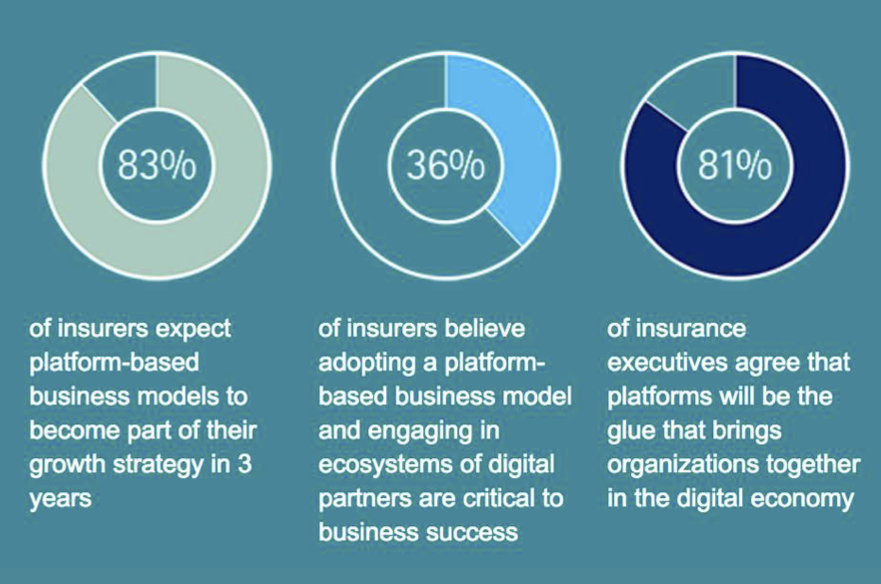
The strategic use of technology to create platform business models is driving growth opportunities is the rapidly expanding digital economy and for insurers. 

Trends/Predictable Disruption 

Fast emerging digital ecosystems create the foundation for the next big wave of enterprise disruption in insurance. 

Forward thinking insurance companies have the line of sight to redefine their role and positioning in the market. Today there is an opportunity, if not a need, to change how carriers create and deliver insurance products. In future posts, I will address the value over and position of the new InsurTech companies Lemonade, Trov and Metromile. 

The survey above raised several questions during our conversation with Daniel. One of the questions was "83% of insurers recognize that IoT will introduce change to the industry. Yet, only 51% of insurers plan to pursue digital initiatives with new partners. Are the insurers planning to grow IoT capacity in-house? Work with old partners? Or, ignore it completely?