
Week of May 10–16, 2026
$1.75B+ disclosed | 7 transactions | Largest capital week of 2026
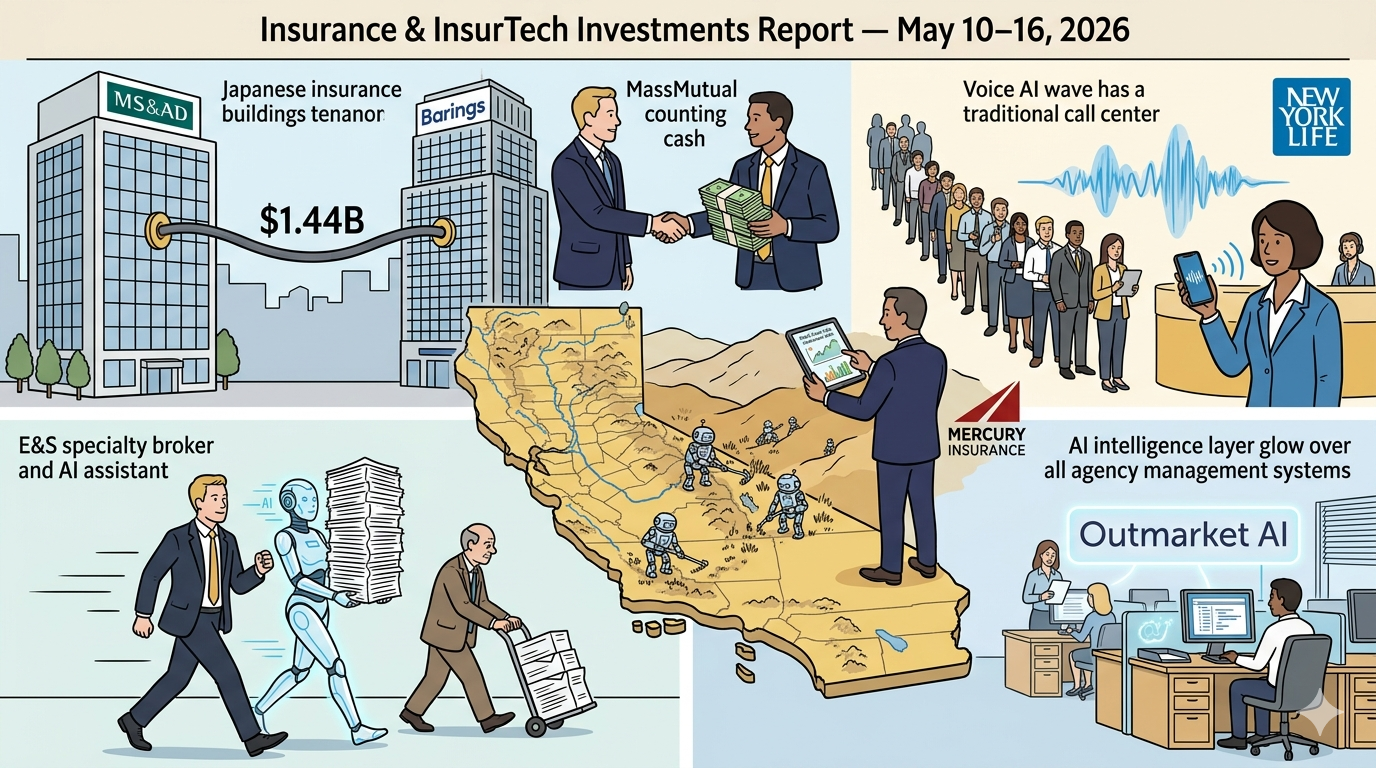
The week's headline number is $1.75 billion — but the composition is more important than the total. Three distinct capital themes converged simultaneously: AI is being embedded into the distribution layer of insurance (Novella, Outmarket AI, Vapi), carriers are moving upstream into physical risk reduction rather than just pricing for it (Mercury/BurnBot), and the global insurance-asset management convergence is producing its largest single transaction of the year (MS&AD/Barings). The brokerage consolidation machine continues in the background — Shepherd and ALPS both added scale quietly. This is not a week of isolated deals. It is a week where three structural shifts in insurance all moved at once.
1. MS&AD / Barings (Japan / USA)
$1.44B | Acquisition Close — 18% Stake in Barings from MassMutual
Date: May 14, 2026 (close; announced November 2025)
What Happened
Mitsui Sumitomo Insurance (MSI), the primary P&C subsidiary of MS&AD Insurance Group Holdings — Japan's largest insurance holding company — completed its previously announced acquisition of an 18% equity stake in Barings LLC, the global alternative asset management subsidiary of MassMutual. MassMutual receives approximately $1.44B in cash proceeds and retains an 82% stake with controlling governance rights. Barings will manage an increased share of MS&AD's general investment account, adding to its existing $427B+ AUM across credit, real assets, capital solutions, and emerging markets. Roger Crandall (Chairman, President and CEO of MassMutual) and Naoki Yanagida (President and CEO of MS&AD) structured the deal as a long-term strategic partnership, not a passive financial transaction. One MS&AD director joins Barings' board; MS&AD employees will be seconded into Barings teams across the firm.
- Acquirer: MS&AD Insurance Group Holdings / Mitsui Sumitomo Insurance
- Seller: MassMutual (retains 82% and controlling rights)
- Target: Barings LLC — global alternative asset manager, MassMutual subsidiary
Use of Funds
- MassMutual receives $1.44B in capital proceeds for deployment across its insurance and policyholder obligations
- Barings gains a long-term insurance capital partner to accelerate AUM growth in credit, real assets, and capital solutions
- MS&AD gains increased access to Barings' investment capabilities to strengthen its general account investment portfolio yield
Why This Deal
This is the insurance-asset management convergence thesis executing at scale. MS&AD is Japan's largest insurance holding company, managing a vast general investment account that needs to generate yield in an era of prolonged low Japanese interest rates. Barings — with deep capabilities in private credit, real assets, and capital solutions — is exactly the asset manager that solves that problem. By acquiring 18% and embedding Barings as its external investment manager, MS&AD buys both yield infrastructure and strategic alignment: Barings now has every incentive to deliver returns on MS&AD's capital because its equity holder is watching. MassMutual crystallizes $1.44B in value from Barings without losing operational control — a capital recycling move that funds policyholder obligations while retaining the asset management platform it built. The board seat and employee secondments signal that this is a working partnership, not a passive stake.
Why It Matters
- This is the largest single insurance capital transaction to close in 2026 — it signals that the structural convergence of insurance balance sheets with global asset management platforms is now executing at the $1B+ deal level, not just in strategy presentations
- MS&AD joins Allianz (Entrix), Tokio Marine (Cierpa), and Intact (Shepherd) in the pattern of major global carriers making strategic investments that compound their investment and underwriting advantage over time — the difference here is scale
- MassMutual's $1.44B proceeds with retained 82% control is a textbook capital-efficient monetization of an embedded asset — the model other mutual insurers with asset management subsidiaries will study
Market Consequences
Global insurance carriers managing large general accounts without equivalent access to proprietary alternative asset management platforms face widening investment yield disadvantages. MS&AD's arrangement gives it Barings' full capabilities across private credit, real assets, and emerging markets — asset classes generating 200–400bps above equivalent public market yields. Competitors relying on third-party external managers without equity alignment face higher fees and weaker alignment. For Barings, the MS&AD relationship adds a major insurance capital anchor that accelerates AUM growth without requiring retail distribution — the most capital-efficient growth path available. The Martello Re angle is worth noting: MassMutual's Bermuda-based reinsurer, whose assets are managed by Barings, benefits from a stronger, better-capitalized Barings with a Japanese insurance heavyweight on its board.
Bottom line: The world's largest insurance groups are not buying asset managers for financial returns. They are buying investment infrastructure to solve the yield problem on their balance sheets. MS&AD just paid $1.44B for that solution.
2. Vapi (USA)
$50M Series B at ~$500M Valuation | Enterprise Voice AI Infrastructure (New York Life Strategic)
Date: May 12, 2026
What Happened
Founded by Jordan Dearsley (CEO) and Nikhil Gupta (CTO), both University of Waterloo graduates who previously built a Y Combinator-backed productivity startup, Vapi is a San Francisco-based enterprise voice AI infrastructure platform. The company provides the middleware layer connecting AI language models to voice-to-text and text-to-voice engines, enabling businesses to deploy configurable, low-latency voice agents at scale. Vapi has handled more than 1 billion calls to date, grown to 1 million+ developers and 2.7 million unique agents built on its platform, and achieved 10x year-over-year enterprise ARR growth. Enterprise customers include Amazon Ring (100% of inbound call volume runs on Vapi), New York Life, Intuit, Kavak, and ServiceTitan.
- Lead investor: Peak XV Partners
- Participating investors: M12 (Microsoft's Venture Fund), Kleiner Perkins, Bessemer Venture Partners
- Strategic investor: New York Life Ventures (also a named enterprise customer)
- Total funding: $72M
Use of Funds
- Scale enterprise distribution and go-to-market
- Improve delivery: compress enterprise time-to-production
- Deepen core infrastructure: governance, predictable latency under load, call-level monitoring, escalation paths, and guardrails for high-stakes workflows
Why This Deal
New York Life Ventures is not a passive financial participant in this round — New York Life is a named enterprise customer running production voice AI workloads on the Vapi platform. The strategic investment follows the same procurement-as-investment pattern established this year by Liberty Mutual and Erie (Blitzy) and Mercury (BurnBot): the carrier evaluated the technology as a customer, concluded it works, and structured equity participation to capture upside from what it expects to become a standard infrastructure purchase across its industry. Vapi's architecture is the moat: it abstracts away the latency problem that kills voice AI in production — speech-to-text, LLM inference, text-to-speech, and telephony handoff all accumulate delay, and Vapi's middleware handles that stack in a way that competitors building on top of single model providers cannot match. The 1 billion calls milestone is not a vanity metric — it is evidence that the infrastructure holds at production scale. Peak XV's comparison of Vapi to Zapier and n8n positions it as the developer-first workflow platform for voice, not a point solution.
Why It Matters
- New York Life investing as an enterprise customer follows the pattern of carriers writing checks into the tools they intend to deploy at scale — this is strategic procurement with equity upside, not passive venture allocation
- 10x enterprise ARR growth with Amazon Ring, Intuit, and New York Life as named customers demonstrates that voice AI has crossed from pilot to production in regulated enterprise environments — the insurance customer acquisition cycle just became a reference sale
- 1 billion calls served and 1 million developers on the platform means Vapi has network effects: more developers build on it, more use cases emerge, more enterprise deployments follow
Market Consequences
Insurance carriers running call centers — every major P&C and life carrier — are operating a cost center that Vapi directly targets. Inbound customer service, claims first notice of loss, policy renewal calls, and outbound collections are all Vapi-addressable workflows. Traditional call center vendors (NICE inContact, Genesys, Avaya) face a challenger that replaces their IVR and routing infrastructure with AI agents capable of resolving calls entirely. Carriers that deploy Vapi-class voice AI will reduce call center headcount requirements, improve CSAT scores (Amazon Ring's data demonstrated improvement, not just parity), and compress cost per interaction. Competing voice AI infrastructure players — Sierra, Decagon, PolyAI, Bland, Retell — lack Vapi's billion-call production history, its developer community scale, and the New York Life reference sale that validates enterprise insurance deployment. For New York Life specifically, the investment positions it ahead of competitors still evaluating voice AI, giving it both the technology advantage and the equity return if voice AI adoption accelerates across insurance as expected.
Bottom line: New York Life invested in the company running its own phones. Every other carrier operating a call center just got a timeline for when their cost structure becomes uncompetitive.
3. Novella (USA / Israel)
$21M | AI-Native Wholesale E&S Broker
Date: May 14, 2026
What Happened
Founded in 2024 by Max Kane (CEO, former Lemonade executive), Michael Tsibelman (CTO, formerly at Microsoft, Gigya, and DoControl), and Alex Broome (Head of Brokerage, formerly at The Baldwin Group and ReShield), Novella is a New York-based AI-native wholesale insurance broker targeting the $150B U.S. Excess and Surplus (E&S) market. E&S covers hard-to-place risks that standard carriers decline — skyscrapers in hurricane zones, large infrastructure projects, complex commercial builders' risk. Novella's AI agents autonomously handle placement, binding, form comparison, policy review, subjectivity collection, inspections, billing, endorsements, and renewals. Producers focus entirely on relationship development. The company is licensed in all 50 states, appointed by nearly 100 specialty carriers and MGAs, and has 3,500+ retail agencies sending business through the platform. Offices in New York (HQ), Miami, Houston, and Southern California (Q2 2026). R&D facility in Tel Aviv.
- Lead investor: Brewer Lane Ventures
- Participating investors: Box Group, Crystal Venture Partners, SV Angel, Avid Ventures, Verissimo Ventures, Blank Ventures
- Strategic investor: Arch (global specialty insurer)
Use of Funds
- Recruit additional senior brokers across new regional offices
- Continue developing the proprietary AI platform and "super-producer" capabilities
- Open additional U.S. regional offices (Southern California next)
- Double Tel Aviv R&D team
Why This Deal
The E&S market is the right battlefield. It is the $150B segment of U.S. insurance that standard carriers systematically avoid — too complex, too bespoke, too manual to process efficiently on standard systems. That complexity is precisely where AI agents generate the most leverage: the workflows around specialty placement (form comparison across 100+ carrier submissions, subjectivity tracking, policy review) are exactly the back-office tasks that consume up to half a senior broker's time and that AI executes without degradation across volume. Arch's participation as a strategic investor is the market validation signal — one of the world's leading specialty insurers is betting that Novella's model produces better-quality submissions and faster placement, which matters to Arch as a capacity provider. Kane's Lemonade background provides technology DNA; Broome's Baldwin Group background provides the carrier relationship infrastructure. The combination — operator DNA plus insurance-native distribution expertise — is the founding team thesis for which Brewer Lane Ventures specifically looks.
Why It Matters
- Arch investing as a specialty carrier signals that Novella's AI-augmented wholesale model improves submission quality and placement speed — the capacity side of the market is endorsing the technology, not just the distribution side
- The E&S market's $150B premium base and structural complexity make it the highest-leverage application for AI wholesale infrastructure: the more complex the risk, the greater the productivity gain per AI agent deployed
- Novella's hybrid model (world-class AI plus world-class human producers, not replacement) positions it to attract the industry's best brokers who want the AI leverage — creating a talent flywheel that compounds alongside the technology advantage
Market Consequences
Traditional wholesale E&S brokers — Ryan Specialty, AmWINS, CRC Group, Burns & Wilcox — operate at scale but run on fundamentally manual placement workflows. Their competitive advantage is relationship depth and carrier access, both of which Novella is systematically building through appointments and its expanding producer network. As Novella's producers reach individual profitability in half the time of traditional brokerages (the company's stated target), it lowers the cost of growing headcount and accelerates the unit economics that PE-backed wholesale platforms need to justify scale investment. For retail agencies routing E&S business, Novella's frictionless submission platform reduces the placement cycle — a meaningful value proposition when the alternative is days of back-and-forth with a traditional wholesaler. The Lloyd's Lab participation gives Novella international carrier access alongside its U.S. expansion.
Bottom line: The E&S market is $150B, structurally manual, and entirely dependent on human relationships that AI can now amplify. Novella just raised the capital to prove it at scale.
4. Outmarket AI (USA)
$17M Series A | AI Operating Layer for Insurance Brokerages
Date: May 13, 2026
What Happened
Founded by Vishal Sankhla (CEO and Co-founder) and Anshu Jain (CTO and Co-founder), with a leadership team drawing from Uber, IBM, Ethos, and Meta alongside insurance-native expertise, Outmarket AI is a San Francisco-based AI platform purpose-built for insurance brokerages. The platform connects directly into agency management systems — Applied Epic, AMS360, HawkSoft, Nexsure — transforming fragmented brokerage data into a unified AI intelligence layer powering workflow automation across commercial lines, benefits, personal lines, and specialty. Launched March 2025; 5x ARR growth year-on-year; 250+ major insurance brokerages using the platform daily. Flagship product: Proposal Builder, launched December 2025, compresses multi-hour proposal creation to minutes. Enterprise-grade compliance: SOC 2 Type 2, ISO 27001, HIPAA. Chief Revenue Officer Alpesh Patel joins from Salesforce and DocuSign. Total funding: $21.7M.
- Lead investor: Permanent Capital Ventures
- Participating investors: SignalFire, Fika Ventures, TTV Capital, Dash Fund
- Strategic investors: Leading independent agency networks, agency owners, and senior industry executives
Use of Funds
- Accelerate development of new AI-driven workflow modules across commercial, benefits, personal lines, and specialty
- More than double platform capabilities in 2026
- Expand enterprise sales with Alpesh Patel leading go-to-market
Why This Deal
Outmarket and Cara (funded two weeks ago) are attacking the same brokerage workflow problem from slightly different angles — Cara from the operator-built, brokerage-native side; Outmarket from the data unification and enterprise intelligence layer side. What distinguishes Outmarket's approach is the AMS integration architecture: rather than sitting alongside existing systems, Outmarket connects into the agency management system and reads the brokerage's actual book of business data to power its workflows. That data grounding — real policy data, real client history, real loss runs — is what makes AI proposals and analysis accurate rather than generic. Permanent Capital Ventures leading signals the investors understand this is a category-definition play: the firm looks for companies building platform infrastructure that defines new categories, and Outmarket's claim is to become the intelligence operating layer for the entire insurance brokerage industry. The strategic investors — agency networks and executives — are both investors and distribution channels, providing immediate commercial validation and the sales pipeline that pure-VC funding cannot generate.
Why It Matters
- 5x ARR growth since March 2025 launch with 250+ active brokerage deployments demonstrates genuine pull from the market, not push from sales — insurance brokerages are adopting this because it solves a real problem at the cost of $17M in funding
- AMS-native integration (Applied Epic, AMS360, HawkSoft, Nexsure) means Outmarket reads actual brokerage data rather than starting from scratch — the AI workflows are grounded in reality, which is the barrier between useful AI and dangerous AI in insurance
- Strategic investor participation from agency networks creates a distribution flywheel: the networks that back Outmarket will route their member agencies to the platform, compressing the sales cycle and validating the product simultaneously
Market Consequences
Legacy AMS vendors — Vertafore (Applied Epic, AMS360), Hawksoft, Nexsure — now face an AI intelligence layer sitting between their software and the brokerage user, capturing the workflow value that AMS vendors charge for but do not fully deliver. This is the same pattern playing out across enterprise software: the AI layer that connects into existing systems gradually becomes more valuable to the user than the underlying system itself. Applied Epic and AMS360 are the workflow surfaces; Outmarket is the intelligence that makes those workflows faster and more accurate. For large brokerages building internal AI capabilities, Outmarket's 250+ agency deployment base and SOC 2/HIPAA compliance infrastructure makes it a faster and cheaper path than building internally. Cara and Outmarket will increasingly compete for the same agency management budget — the market is large enough for both, but consolidation is likely within 18 months.
Bottom line: Outmarket is building the intelligence layer that sits between brokerages and their management systems. The AMS vendor just became the data source. Outmarket is becoming the operating system.
5. Mercury Insurance / BurnBot (USA)
Undisclosed Strategic Investment | Wildfire Mitigation Robotics
Date: May 12, 2026
What Happened
Mercury Insurance (NYSE: MCY), a California-based P&C carrier with significant homeowners exposure in high-wildfire-risk communities, announced a strategic investment in BurnBot, a South San Francisco-based wildfire mitigation technology company. BurnBot CEO Anukool Lakhina leads the company, which develops and operates robotic, data-driven systems for hazardous fuels reduction and vegetation management — physically clearing the dry brush that fuels California wildfires — working with public agencies, utilities, and communities across the wildland-urban interface. BurnBot's platform generates real-time mapping, tracking, and analysis data on every fuel treatment it conducts, providing parcel-level, verifiable risk reduction data. Mercury is the first major California homeowners insurer to directly invest in wildfire mitigation technology. The partnership will initially focus on California communities where BurnBot already operates.
- Investor: Mercury Insurance (NYSE: MCY) — strategic minority
- Target: BurnBot — wildfire mitigation robotics and data platform
Use of Funds
- Expand BurnBot's robotic fuel reduction operations in California communities
- Develop community-level risk reduction strategies in partnership with Mercury
- Provide Mercury with parcel-level risk reduction data to support underwriting and rate differentiation
Why This Deal
Mercury is not investing in BurnBot for financial returns. It is investing to change the risk it underwrites. Every acre of brush cleared by BurnBot's robots around a community where Mercury writes policies reduces Mercury's expected loss — before a wildfire occurs, not after. The data layer is equally significant: BurnBot's real-time mapping generates the granular, parcel-level fuel treatment records that catastrophe models need to price wildfire risk accurately. With that data, Mercury can differentiate rates between a treated parcel and an untreated one in a way that standard industry models cannot currently support. This positions Mercury to expand its California homeowners book into communities its models currently price as too risky — not by accepting more risk, but by funding the reduction of the risk itself. The Tokio Marine/Cierpa and Allianz/Entrix pattern established over the past three weeks is now extending to physical risk infrastructure: carriers are not just buying data ecosystem access — they are investing in the physical world to change the underlying risk profile of the assets they insure.
Why It Matters
- Mercury is the first major California homeowners carrier to invest in wildfire mitigation technology — a strategic first-mover position in a regulatory environment (California's Sustainable Insurance Strategy) that is explicitly incentivizing carriers to support risk reduction, not just exit the market
- BurnBot's real-time fuel treatment data gives Mercury parcel-level risk differentiation capability that industry-standard catastrophe models cannot provide — a structural underwriting advantage in the hardest homeowners market in the U.S.
- The investment directly addresses the California homeowners insurance availability crisis: if Mercury can fund risk reduction in high-hazard communities, it can write policies in markets from which every other carrier is retreating
Market Consequences
California's homeowners insurance market is in structural crisis: State Farm, Allstate, Farmers, and AAA have all restricted or exited California homeowners business, leaving carriers like Mercury and Wawanesa as among the few private market options. Mercury's BurnBot investment signals a third path between "exit the market" and "accept catastrophic loss ratios": invest in the physical risk reduction that makes communities insurable again. Competitors that continue pricing for wildfire risk without investing in mitigation face ongoing exit pressure and market share loss to the California FAIR Plan — a state backstop with no equivalent technology investment program. For BurnBot competitors in the wildfire mitigation space (mechanical treatment firms, prescribed burn programs), Mercury's investment establishes a carrier-backed model for funding mitigation at scale that could attract similar strategic investments from other carriers facing California homeowners exposure.
Bottom line: Mercury just stopped pricing for wildfire risk and started paying to reduce it. That distinction will define which carriers remain in the California homeowners market over the next decade.
6. Shepherd Insurance / Arnold Insurance (USA)
Undisclosed | Brokerage M&A — Southwest Florida Independent Agency
Date: May 14, 2026
What Happened
Shepherd Insurance — one of the largest independent brokerage groups in the U.S., headquartered in Carmel, Indiana — acquired Arnold Insurance, a Southwest Florida independent agency. Terms undisclosed. The acquisition deepens Shepherd's regional presence in the Florida P&C market, one of the most complex and capacity-constrained insurance markets in the U.S. Shepherd's leadership has been active in executing a geographically targeted consolidation strategy.
- Acquirer: Shepherd Insurance
- Target: Arnold Insurance (Southwest Florida)
Use of Funds
- Deepen Shepherd's Florida regional distribution footprint
- Add Arnold's carrier relationships and local producer network
Why This Deal
Southwest Florida is not a routine acquisition geography. It is among the highest-catastrophe-exposure residential and commercial insurance markets in the U.S., with capacity constraints following Hurricane Ian (2022) that have not fully normalized. An independent agency with durable carrier relationships and established producer trust in that market is a defensible asset. Shepherd's acquisition strategy focuses on these entrenched, geographically specific positions — not commodity distribution books.
Why It Matters
- Florida independent agency acquisitions have become increasingly competitive as PE-backed consolidators and large regionals compete for the finite pool of established agencies with carrier access in capacity-constrained markets
- Southwest Florida's post-Hurricane Ian market dynamics make local carrier relationships and producer trust more valuable than in a normalized market
Market Consequences
Accelerates consolidation pressure on remaining independent agencies in Southwest Florida. Competing acquirers — Brown & Brown (Florida-headquartered), World Insurance Associates, Patriot Growth Insurance — will find fewer unacquired agencies with equivalent carrier access and community relationships available at reasonable multiples.
Bottom line: Southwest Florida independent agencies are scarce, defensible, and increasingly competed for. Shepherd moved first.
7. ALPS / Ohio Bar Liability Insurance (USA)
Undisclosed | Specialty Liability Book Acquisition
Date: May 11, 2026
What Happened
ALPS (Attorneys Liability Protection Society), a specialty insurer and leading provider of lawyers' professional liability insurance, agreed to acquire Ohio Bar Liability Insurance Company (OBLIC), the bar-association-affiliated lawyers' professional liability insurer operating in Ohio. Terms undisclosed. The acquisition expands ALPS's geographic footprint into the Midwest and adds OBLIC's Ohio book to ALPS's national lawyers' malpractice platform.
- Acquirer: ALPS
- Target: Ohio Bar Liability Insurance Company (OBLIC)
Use of Funds
- Geographic expansion of ALPS's lawyers' professional liability platform into Ohio and the Midwest
- Add OBLIC's bar association relationships and Ohio premium volume to ALPS's national book
Why This Deal
Bar-association-affiliated professional liability programs are among the most durable distribution channels in specialty insurance — the bar association relationship provides captive access to a defined professional population with mandatory coverage requirements. OBLIC's Ohio book is a defensible, low-churn asset. ALPS acquiring it is standard programmatic consolidation in a niche with limited available assets.
Why It Matters
- Bar-association-affiliated books are captive distribution — high retention, defined professional population, minimal price sensitivity
Market Consequences
ALPS becomes the dominant national provider of lawyers' professional liability. Competing program administrators in legal malpractice (Hanover Insurance, CNA's lawyers' program) face a consolidating competitor with growing bar association distribution across more states.
Bottom line: Specialty liability consolidation at the program level. ALPS is building a national franchise one bar association at a time.
Special Situation: SolvaPay — MS&AD Ventures $2.6M
$2.6M | AI Payment Rails for the Agentic Economy
Reported previously in April.
MS&AD Ventures — the corporate venture arm of MS&AD Insurance Group — invested $2.6M in SolvaPay, an AI payment infrastructure company building the financial rails for autonomous agent transactions. Not an insurance company. Notable for the same reason as Entrix (Allianz) and Cierpa (Tokio Marine): a major insurer is investing in adjacent infrastructure it expects to be operationally critical. As AI agents execute insurance workflows autonomously — claims settlement, premium collection, broker commissions — the payment infrastructure those agents use becomes as important as the AI itself. MS&AD, fresh from the $1.44B Barings close, is simultaneously writing a $2.6M seed check into the payment rails that will likely power the next generation of automated insurance transactions. One of these deals is transformative by size. The other may be more important by timing.