
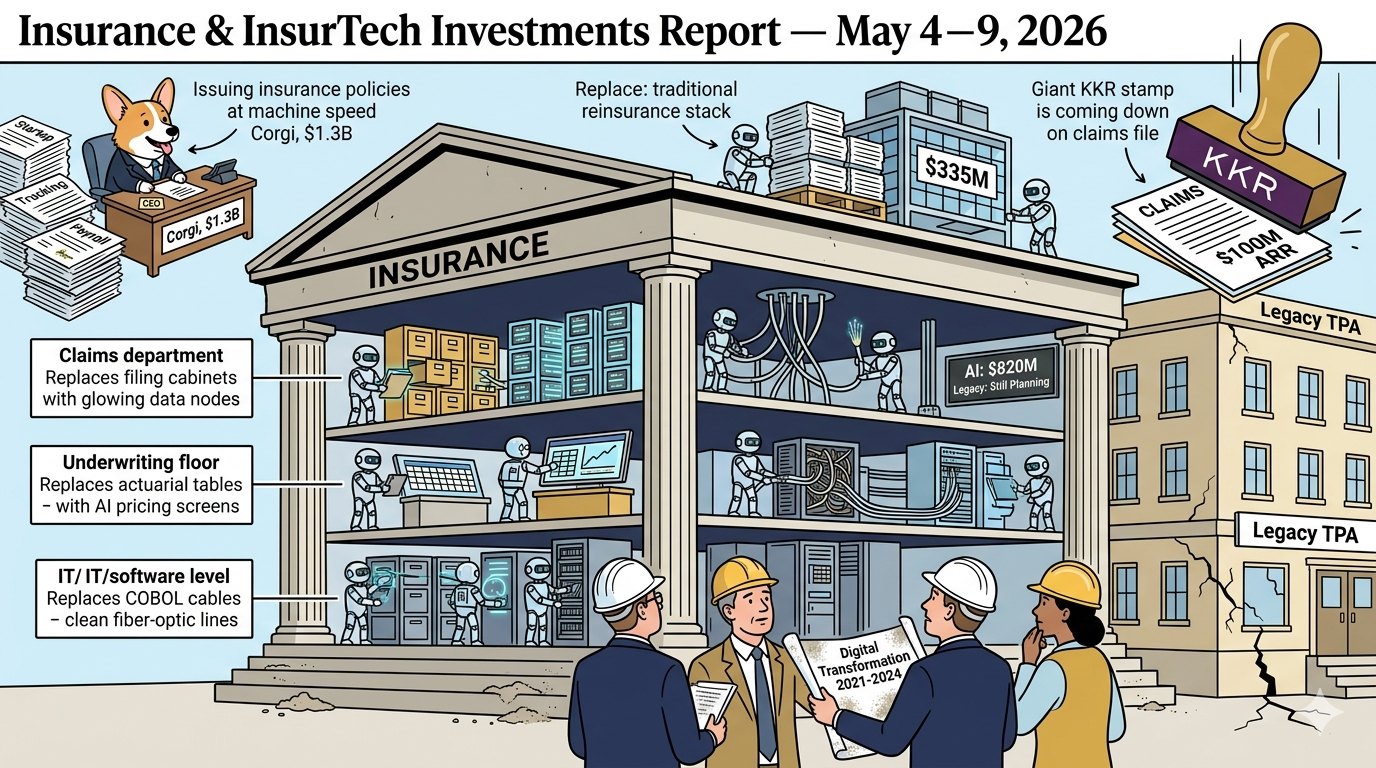
$820M disclosed | 4 transactions | Heaviest week of 2026 by capital deployed
Every deal this week is AI-native. Every deal attacks a different layer of the insurance infrastructure stack: claims administration, carrier underwriting, software modernization, and catastrophe capital. Gallagher Re's Q1 2026 report, released simultaneously, confirms the macro: global insurtech funding reached $1.63B in Q1, with AI-focused firms capturing 95% of all capital deployed. This week alone represents half of that quarterly total in five days. The insurance industry is not experimenting with AI. It is funding the companies that will make the current operating model obsolete.
1. Reserv (USA)
$125M Series C | AI-Native TPA & Claims Intelligence Platform Date: May 4, 2026
What Happened
Founded in 2022 by CJ Przybyl (CEO) and Martha Dreiling, Reserv is the P&C insurance industry's largest AI-native third-party administrator and claims intelligence provider. The platform serves nearly 200 insurers, corporate captives, MGAs, and brokers. It has reached $100M ARR, employs 500+ claims adjusters, and has more than doubled annual claims processing capacity every year since launch. Current capacity stands at 500,000 complex claims per year. Its core product — Reserv Glance™ — is a fully explainable AI claims system that centralizes historical and open claims into a single database and configures automation from fully hands-off simple claims to AI-augmented adjuster support for complex cases.
- Lead investor: KKR, via its Next Generation Technology Growth strategy
- Existing investors (follow-on): Bain Capital Ventures, Flourish Ventures
- Notable: KKR approached Reserv unsolicited
Use of Funds
- Scale annual complex claims processing capacity from 500,000 to 30 million within four years
- Expand research and engineering team
- Accelerate deployment across commercial lines
- Deepen automation across the full claims organization, not just individual workflow tools
Why This Deal
KKR did not respond to a fundraise — it initiated one. That distinction matters. Through Global Atlantic Financial Group, KKR operates one of the largest insurance balance sheets in the world. The investor is also the customer, and the due diligence for this investment was indistinguishable from an enterprise procurement evaluation. KKR concluded that Reserv's technology is operationally critical — not interesting, not promising, critical — and structured its participation accordingly through its insurance-specific investment strategy rather than a generalist growth fund. Reserv's $100M ARR in four years is not a growth metric; it is evidence that 200 insurance organizations have already made the same judgment. The moat is the data flywheel: every claim processed makes the next one cheaper and faster to handle, compounding a pricing and accuracy advantage that new entrants cannot acquire without years of production exposure.
Why It Matters
- $100M ARR from zero in four years, in an industry where technology adoption typically takes a decade — this is proven product-market fit across 200 live carrier relationships, not pilot-stage traction
- The 500,000-to-30-million capacity roadmap implies Reserv believes it can process a significant share of all non-field commercial P&C claims in the U.S. — that is a market structure claim, not a growth projection
- KKR's unsolicited approach and insurance-specific investment vehicle signals that Reserv has crossed from "interesting technology" to "operationally critical infrastructure" in institutional insurance capital's assessment
Market Consequences
Sedgwick, Gallagher Bassett, Crawford & Company, and York Risk Services — the four dominant traditional TPAs — face a platform that has doubled capacity every year, holds $100M ARR, and is now backed by a firm that owns a major insurance balance sheet and has every incentive to route its own claims volume through Reserv. The compliance objection that previously slowed AI adoption in claims — auditability, regulatory defensibility, explainability — is gone: Reserv Glance™ was built fully explainable from inception, not retrofitted. AI-native direct competitors (Snapsheet, Hi Marley) lack KKR's distribution network and institutional validation. Legacy claims management vendors (Majesco, Sapiens, Guidewire ClaimCenter) face a platform that doesn't require a multi-year implementation — it absorbs existing claim data and begins improving from day one. The traditional TPA model's structural advantage — scale and relationships — does not translate into a cost-per-claim defense against a system that gets cheaper with every claim it processes.
Bottom line: Claims is the most expensive and most broken workflow in P&C insurance. The largest AI-native TPA just raised $125M from the firm that owns one of the largest insurance balance sheets in the world. The traditional claims model's margin compression begins now.
2. Blitzy (USA)
$200M at $1.4B Valuation | Autonomous Enterprise Software Development (Liberty Mutual + Erie Strategic) Date: May 5, 2026
What Happened
Founded in 2023 by Brian Elliott (CEO, serial entrepreneur and former U.S. Army Ranger) and Sid Pardeshi (CTO, NVIDIA Master Inventor with 27+ neural network patents), Blitzy is a Cambridge, MA-based autonomous software development platform. It builds a dynamic knowledge graph of enterprise codebases — from 1 million to 100 million lines of code — and coordinates thousands of AI agents in parallel for days to weeks of uninterrupted inference, autonomously executing entire software projects including testing and quality validation. Claims a 5x engineering velocity improvement and holds a record-breaking 66.5% score on SWE-Bench Pro, the leading independent autonomous coding benchmark. Already deployed across dozens of Global 2000 enterprises in 10 industries. Approximately 85 employees; headcount more than doubled in six months.
- Lead investor: Northzone
- New investors: PSG, Battery Ventures, Jump Capital, Morgan Creek Digital, Defiant
- Existing investors: Flybridge, Link Ventures, NFX, Picus Capital, Venture Guides
- Strategic investors: Liberty Mutual Strategic Ventures, Erie Strategic Ventures, BAL Ventures
Use of Funds
- Expand research team advancing autonomous development capabilities
- Scale go-to-market into regulated industries, with insurance explicitly named
- Grow carrier partnership ecosystem
- Accelerate legacy system modernization deployments across insurance carriers
Why This Deal
Blitzy is not an insurance company. It is the answer to the insurance industry's most expensive problem: technology debt. The largest U.S. P&C carriers run on COBOL-based policy administration systems, mainframe claims infrastructure, and billing platforms built decades before cloud architecture existed. Modernizing those systems through traditional IT consulting costs hundreds of millions of dollars per carrier and takes years. Blitzy compresses that to months by ingesting the entire codebase into a knowledge graph and deploying thousands of parallel AI agents to execute the migration autonomously. Liberty Mutual Strategic Ventures and Erie Strategic Ventures did not invest as passive financial participants. They evaluated Blitzy as enterprise procurement — the same process they would use to approve a multi-hundred-million-dollar IT contract — and concluded the technology solves their problem. The venture return is a secondary benefit. The primary benefit is cheaper, faster modernization of their own systems. Pardeshi's NVIDIA background and Elliott's operational discipline (Army Ranger, serial founder) are not incidental to the thesis: the SWE-Bench Pro record score of 66.5% is independently validated, not self-reported, and removes the last technical objection that slows enterprise adoption.
Why It Matters
- Liberty Mutual and Erie investing as future customers means the due diligence process was an enterprise procurement evaluation — they have already concluded the technology works for their specific legacy infrastructure
- The addressable modernization cost for a single top-10 U.S. P&C carrier runs into hundreds of millions when executed through traditional IT consulting — Blitzy's autonomous approach directly attacks that budget line
- A record SWE-Bench Pro score of 66.5% is independently validated performance that competing platforms have not matched, eliminating the "unproven technology" objection that gatekeeps enterprise insurance adoption
Market Consequences
Insurance core system vendors — Guidewire, Duck Creek, Majesco — generate significant revenue from multi-year implementation and migration service contracts. An autonomous development platform that compresses those timelines from years to months removes a meaningful revenue stream from their partnerships without requiring carriers to replace the core systems themselves. Major IT consultancies — Accenture, IBM, Infosys — currently charge day rates on the exact legacy modernization work Blitzy autonomously executes. Those billable hours are the product being automated. Direct competitors in autonomous coding (GitHub Copilot, Cursor, Devin by Cognition AI) lack the insurance domain deployments, the carrier strategic validation, and the enterprise-scale knowledge graph architecture that makes Blitzy specifically relevant to insurance modernization at this complexity level. Carriers that adopt Blitzy early will modernize their technology stacks faster and cheaper than peers, compressing the technology gap that has historically protected legacy operating models from new entrant competition. Liberty Mutual and Erie won't be the last carriers in this cap table.
Bottom line: Two insurers just invested in the company that will automate their IT departments. That is not a hedge against disruption. That is a procurement decision with a venture return attached.
3. Corgi (USA)
$160M Series B at $1.3B Valuation | AI-Native Full-Stack Insurance Carrier Date: May 6, 2026
What Happened
Founded by Nico Laqua (CEO) and Emily Yuan (COO, former OpenAI product manager), Corgi Insurance Services is a San Francisco-based AI-native, full-stack insurance carrier. Y Combinator-backed. Corgi is a licensed carrier — it writes its own policies, underwrites its own risk, and handles its own claims. It is not an MGA sharing margin with a capacity partner and not a broker earning placement fees. Its AI underwriting layer compresses quote cycles from days to minutes. Initial focus: startup insurance covering property, liability, and D&O for early-stage technology companies. Now expanding into trucking, payroll, and small business. Prior funding: $108M across seed and Series A in January 2026 at a $630M valuation. Four months later, valuation doubled to $1.3B.
- Lead investor: TCV — growth-stage technology investor with category-defining portfolio including Spotify, Netflix, Airbnb, and Facebook
- Other investors: Oliver Jung, Leblon Capital, Kindred Ventures, Repeat VC, Zone 2 Ventures, Audeo Ventures, Quadri Ventures, Nordstar, Seven Stars Ventures, OurCrowd, Alumni Ventures, Global Growth Fund
Use of Funds
- Expand startup insurance coverage and distribution depth
- Deepen AI underwriting, claims, and policy operations infrastructure
- Fund entry into trucking insurance as first vertical extension
- Scale into payroll and small business insurance
- Continue building proprietary AI systems across the full insurance stack
Why This Deal
TCV's portfolio — Spotify, Netflix, Airbnb, Facebook — defines markets, it does not participate in them. When TCV leads a $160M round in an insurance company, it is not making an insurance investment. It is making an infrastructure investment that happens to be expressed through insurance. The full-stack carrier architecture is the thesis: unlike MGAs (which share underwriting margin with capacity partners) and brokers (which earn placement fees without touching the risk), Corgi writes its own policies, retains its own risk, handles its own claims, and owns all the underwriting data generated in the process. Every submission processed improves the model. No revenue sharing. No dependency on incumbent carrier pricing decisions. Emily Yuan's background as a former OpenAI product manager is not biographical detail — it signals a founding team that treats AI model development as a core engineering competency, not a vendor integration. The $630M-to-$1.3B valuation in four months is the market's verdict that this infrastructure transfers across commercial insurance verticals, not just startup coverage. Trucking is the first test of that thesis.
Why It Matters
- TCV leading a $160M insurance round is a category signal: this firm invests in companies that define markets — Corgi is being underwritten as the infrastructure layer for commercial insurance, not as a startup insurance product
- Full-stack carrier licensing means Corgi owns the risk, the data, the claims, and the full underwriting margin — competitors operating as MGAs or brokers share margin with incumbent carriers and accumulate no proprietary loss data at the carrier level
- The trucking expansion takes AI-native underwriting into one of the most complex, data-intensive, and historically loss-making commercial lines in the U.S. — if the model transfers, the full-stack carrier thesis across all commercial lines is validated
Market Consequences
Vouch Insurance, Next Insurance, and Embroker all operate on MGA or technology-layer models without full carrier licensing. They share underwriting margin with incumbent capacity providers and generate no proprietary loss data at the carrier level. Against a platform that owns the full stack and compounds its underwriting model with every submission, these competitors face a data flywheel disadvantage that widens every quarter. Traditional small business carriers — Chubb, The Hartford, Nationwide — face an AI-native competitor whose quote cycle is measured in minutes, not days, and whose pricing model improves continuously. Corgi's trucking expansion introduces direct competition with specialty commercial auto carriers (Progressive Commercial, Old Republic, Canal Insurance) and trucking-focused MGAs — a market where incumbent pricing has historically been punitive and loss ratios chronically difficult. If Corgi prices trucking risk accurately at scale using AI, it does not just win market share. It forces a repricing of the entire category. The four-month valuation doubling creates immediate pressure on every competing startup insurance platform to articulate a carrier licensing strategy or accept a permanent valuation discount.
Bottom line: Corgi isn't building a better startup insurance product. It's building the infrastructure to write any commercial line faster, cheaper, and more accurately than incumbents. Trucking is the first proof point. It won't be the last.
4. Kin Insurance (USA)
$335M Catastrophe Bond | Hestia Re Series 2026-1 Date: May 6, 2026
What Happened
Founded by Sean Harper (CEO) and Angel Conlin (CIO), Kin Insurance is a direct-to-consumer digital home insurance platform specializing in catastrophe-exposed states. AI-native risk selection and pricing model. This is Kin's fourth catastrophe bond issuance under the Hestia Re program, arranged by Howden Capital Markets & Advisory and Howden Re. Structure: Hestia Re Ltd. (Series 2026-1) — four tranches of fully-collateralized named storm reinsurance, indemnity trigger, per-occurrence basis. Upsized from initial $300M target to $335M on investor demand. Three of four tranches priced below initial guidance. Class D — the riskiest, first-loss tranche — upsized to $100M and priced at the low end of revised guidance at 5.75%. Record institutional investor participation for any Kin transaction.
- Investors: Institutional ILS investors (identities undisclosed per cat bond market convention; record participation across all four tranches)
- Arranger: Howden Capital Markets & Advisory, Howden Re
Use of Funds
- Multi-year named storm reinsurance protection for Kin's homeowners portfolio
- First-ever geographic extension beyond Florida: Alabama, Georgia, Louisiana, Mississippi, South Carolina, Tennessee, Texas, Virginia
- Inclusion of lower attachment layers providing first-loss protection in major storm events
- Diversification of reinsurance capital between ILS and traditional reinsurance markets
Why This Deal
Three things are happening simultaneously in this transaction that do not normally happen together. First, the deal was upsized — investors asked for more exposure, not less, in a year with 13+ forecast named Atlantic storms. Second, three of four tranches priced below initial guidance — the ILS market assigned Kin's portfolio a price discount relative to its own initial expectations. Third, the Class D tranche — the first-loss layer, the slice most exposed to storm losses, the slice that institutional cat bond investors most carefully underwrite — was oversubscribed and upsized. Each of these outcomes individually is notable. All three together are a financial statement: the most sophisticated catastrophe risk capital in the world has concluded that Kin's AI risk selection is better than the market average, and is pricing it accordingly. The geographic expansion beyond Florida is the strategic signal — Kin's underwriting model now has sufficient data confidence across enough non-Florida risk profiles to commit capital markets capacity nationally. That is not a distribution decision. That is an underwriting confidence decision.
Why It Matters
- Three of four tranches priced below initial guidance in a high-risk hurricane season — the ILS market is applying a measurable pricing discount to Kin's AI risk selection, a structural reinsurance cost advantage that compounds with every annual renewal
- First-ever geographic extension beyond Florida confirms Kin's underwriting model generalizes across a national catastrophe footprint — the capital markets structure follows the operating model's confidence
- Record participation at the Class D first-loss layer is the strongest possible institutional signal: the investors most exposed to catastrophe losses chose to take on more of Kin's risk, not less
Market Consequences
Lower reinsurance cost translates directly and compoundingly into competitive advantage: lower premium, better policyholder retention, and faster state-by-state expansion. Hippo, Branch, and Openly — DTC homeowners insurtechs without established ILS programs — pay market rates for equivalent reinsurance protection. Kin's fourth successful placement at record size and record pricing further widens that structural cost gap with every renewal cycle. Slide Insurance, which also accesses Bermuda cat bond markets, is the closest comparable — but Kin's pricing outcome this week sets a new benchmark. For traditional homeowners carriers in catastrophe-exposed states using only conventional reinsurance — State Farm, Allstate, and the regional carriers that have been exiting these markets — a DTC insurer with AI-native pricing and institutional-grade capital markets access is now competing with a structural cost advantage, not just a digital interface. The first-loss layer oversubscription is not routine behavior in a high-storm-forecast year. It is a vote of confidence in Kin's loss-modeling quality that no marketing claim can replicate.
Bottom line: Kin just got the capital markets to price its AI underwriting better than peers. Lower reinsurance cost compounds into lower premium, better retention, and faster expansion. This is what a structural competitive advantage looks like in catastrophe insurance.
Market Context: Gallagher Re Q1 2026 InsurTech Report
Released week of May 4, 2026
Gallagher Re's Q1 2026 insurtech funding report provides the macro frame for every deal above. Global insurtech funding reached $1.63B in Q1 2026, with AI-focused firms capturing 95% of all capital deployed — the highest AI concentration ever recorded in a single quarter. Life and health insurtech funding nearly doubled sequentially. Early-stage investment rose 36.1% from Q4 2025.
Why It Matters
- This week's $820M represents roughly half of Q1's entire quarterly total, deployed in five days — the pace of capital concentration into AI-native insurance infrastructure is accelerating, not plateauing
- The 95% AI share is not a label being applied loosely — it reflects a genuine structural shift: data-flywheel platforms, AI underwriting models, and autonomous claims infrastructure attract capital; distribution-only and interface-layer plays do not
- Early-stage investment rising 36.1% sequentially signals the next cohort of AI-native insurance companies is already in formation — this week's Series B and C rounds are the companies funded at seed in 2023 and 2024
Bottom line: 95% of insurtech capital is going to AI companies. This week's deals are what that looks like in practice.