
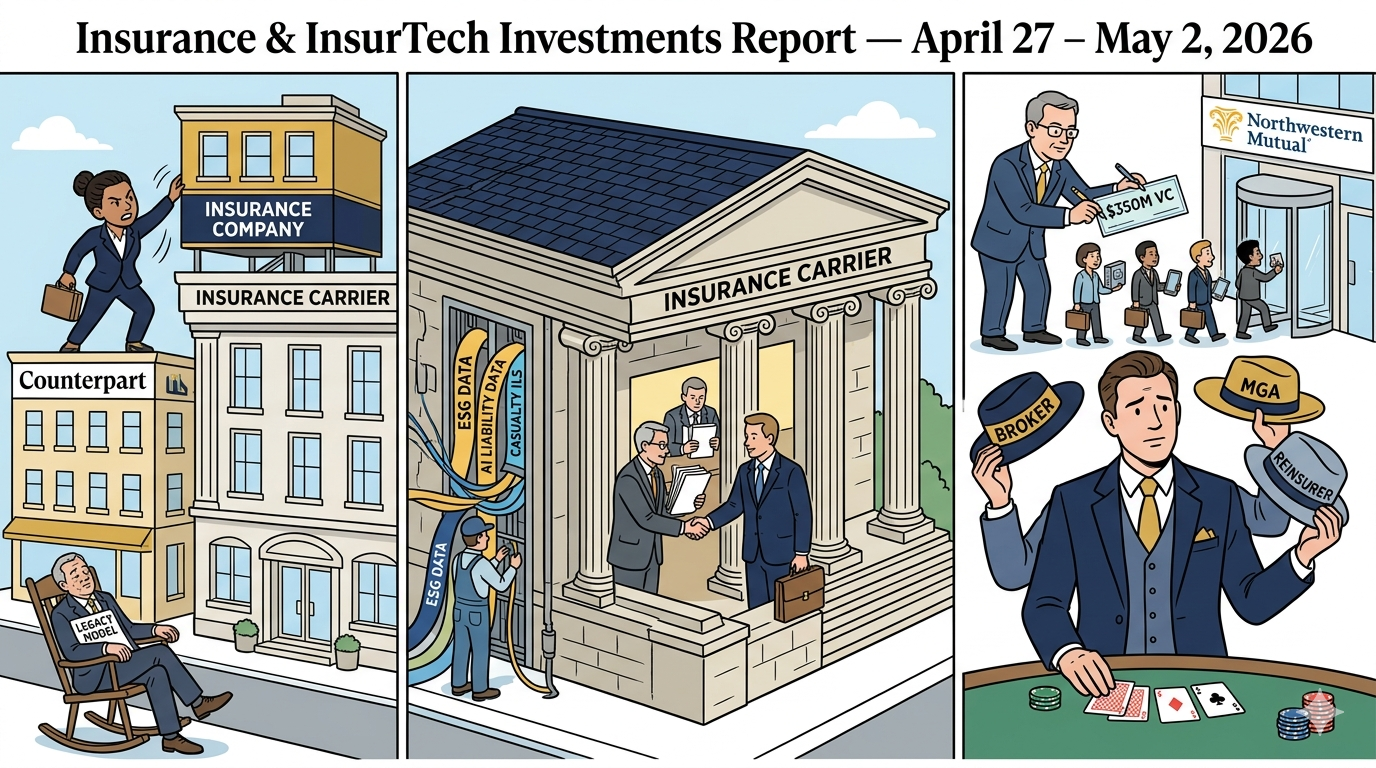
$253.4M in disclosed investment activity this week across 6 transactions spanning specialty commercial liability, ESG data infrastructure, personal lines MGA consolidation, and carrier-backed venture capital. Deal flow was strategically concentrated: fewer transactions, higher conviction, and tighter alignment between capital and distribution access. Corporate VC is now the dominant growth investor in insurance technology — with carriers writing checks that come with five million customers attached.
1. Counterpart (USA)
$50M Series C | Agentic Insurance Platform for AI-Era Liability
Date
- Announcement: April 29, 2026
- Execution: April 29, 2026
Investors & Target
- Target: Counterpart is a Los Angeles-based AI-native MGA and specialty insurance company, founded 2019 by Tanner Hackett. Pioneer of "Agentic Insurance™" — a continuously learning platform combining AI with underwriting, broker support, and claims expertise. Every submission, policy, and claim feeds the model. Backed by five A-rated capacity partners: Aspen, Markel, Westfield Specialty, and others. Has processed 250,000+ applications and issued 35,000+ policies through 2,800+ brokers. 130 employees; ~20% YoY growth. Total raised: $106M.
- Lead investors: Valor Equity Partners (lead; early investor in SpaceX and Tesla)
- Other investors: Vy Capital (existing, follow-on)
Amount of Funds
- $50M Series C (total funding: $106M)
Use of Funds
Launching new specialty insurance products; building industry-specific programs; expanding claims and risk management capabilities; capitalizing Counterpart Insurance Company — a proprietary risk-bearing entity enabling Counterpart to retain risk and align incentives directly with brokers and policyholders rather than capacity partners.
Strategic thesis:
Counterpart has spent five years building a proprietary data flywheel on AI-era management and professional liability. Now it's capitalizing its own insurance company to retain risk — shifting from fee-on-placement MGA to a risk-aligned carrier that bets its own balance sheet on its underwriting model. Every claim handled makes the next one cheaper to price. That compounding advantage is the moat.
Why it matters:
- The U.S. is in its most litigious period in decades: EEOC pre-litigation inquiries hit a 60-year record of nearly 270,000 in FY2025, with AI-related discrimination, hiring bias, and automated-decision claims growing fastest
- Fewer than 33% of SMBs carry management or professional liability — the coverage gap is the market, and Counterpart's platform serves businesses that legacy carriers have priced out or complexity-excluded
- Valor Equity Partners — early investor in SpaceX and Tesla — leading a specialty insurance Series C is a category signal: this is no longer a niche insurance bet, it is a platform thesis on where litigation risk concentrates in the AI economy
Competition
- Direct competitors: Tara Hill Insurance Services, Falcon Risk Services, Celerity Risk, Coalition (D&O/cyber overlap), Corvus (AI-driven specialty)
- Category competitors: Traditional E&O/D&O/EPL carriers (Chubb, AIG, Travelers, Hartford, CNA), broader specialty MGAs
- Emerging threat: AI-specific liability exclusions being challenged and re-drafted by incumbents — Chubb, AIG beginning to build affirmative AI coverage frameworks
Impact on Competition
The strategic inflection is Counterpart Insurance Company. Moving from pure MGA (fee-on-placement, no risk retained) to a risk-bearing entity means Counterpart will directly compete with its own capacity partners — Aspen, Markel, Westfield — for the underwriting margin that currently flows to them. This is defensible because Counterpart's data flywheel is the moat: five years of AI-era employment, professional, and management liability loss history that no new entrant can replicate. The EEOC fielded nearly 270,000 pre-litigation inquiries in FY2025 — a 60-year record — with AI-related discrimination, hiring bias, and automated-decision claims the fastest-growing new category. Fewer than 33% of SMBs carry management or professional liability. Legacy carriers underwrite these risks with 20-year-old frameworks. Counterpart's platform reprices them in minutes.
Bottom line:
- Counterpart is building the operating system for business risk in the AI era. This round is the moment it starts betting its own balance sheet on that thesis.
2. Northwestern Mutual Future Ventures – Fund III (USA)
$150M VC Fund III | Carrier-Backed Fintech/InsurTech Vehicle
Date
- Announcement: April 27/28, 2026
- Execution: April 27, 2026
Investors & Target
- Target: Northwestern Mutual Future Ventures (NMFV) is the corporate venture arm of Northwestern Mutual — $780B AUM life insurer, $40B+ revenue, 5M+ clients. Fund III is a $150M vehicle targeting emerging and growth-stage fintech and insurtech companies, bringing total NMFV allocation to $350M across 50+ portfolio companies since 2017 (Fund I: $50M, 2017; Fund II: $150M, 2019). Standout prior portfolio: Chime (IPO June 2025). Active portfolio includes Levitate (AI relationship-marketing for advisors, also backed by Harbert Growth Partners). Fund manager: Northwestern Mutual (self-funded; no external LPs disclosed)
Amount of Funds $150M (Fund III); total NMFV allocation now $350M
Use of Funds
Backing emerging and growth-stage fintech and insurtech companies; forging technology partnerships deployable within Northwestern Mutual's advisor and client network; providing follow-on capital for existing portfolio companies scaling and expanding marketing reach.
Strategic thesis: Northwestern Mutual commits its third and largest VC fund, bringing total venture capital to $350M. The thesis is not passive financial return — it is strategic deployment: portfolio companies gain access to 5M+ clients and a nationwide advisor network as a distribution and validation channel that no pure-VC competitor can replicate.
Why it matters:
- Carrier-backed VC is now the dominant growth investor in insurtech and fintech infrastructure per Gallagher Re's 2025 data — NMFV Fund III is the most visible single expression of that shift among life carriers
- NMFV's deployment advantage is proven, not theoretical: Levitate (AI relationship-marketing) was backed and piloted within Northwestern Mutual's own advisor force — a commercial channel Sand Hill Road simply cannot offer
- At $350M total, Northwestern Mutual now competes directly with dedicated insurtech VCs on check size and surpasses all of them on strategic value-add for distribution-dependent companies
Competition
- Competing corporate VC vehicles: Allianz X, MassMutual Ventures, Principal Financial Ventures, Nationwide Ventures, New York Life Ventures
- Pure-play insurtech VCs: Anthemis, F-Prime Capital, IA Capital, MTech Capital — all increasingly outcompeted at growth stage by carrier-backed funds offering capital plus deployment channel
Impact on Competition
NMFV's distinctive edge over every competing vehicle is its direct deployment channel: portfolio companies can pilot and deploy within Northwestern Mutual's 5M+ client base and nationwide advisor network — commercial validation and distribution access that Sand Hill Road capital cannot offer. Gallagher Re's 2025 data shows (re)insurers made more private technology investments in insurtech than any prior year on record. NMFV Fund III is the most visible expression of that structural shift among life carriers. The $350M total allocation places Northwestern Mutual among the most active carrier-led venture investors in the U.S., creating pressure on national carriers (MassMutual, Principal, Nationwide) to either match the commitment or risk losing access to the distribution and AI underwriting platforms that will reshape customer acquisition over the next decade.
Bottom line: Northwestern Mutual just announced it intends to be the distribution channel for the next generation of fintech and insurtech. That redefines what "strategic investment" means in this industry.
3. Baldwin Group / MultiStrat Re (USA/Bermuda)
Majority Stake Acquisition | Casualty ILS & Collateralized Reinsurance Platform
Date
- Announcement: April 28, 2026
- Execution: April 28, 2026
Investors & Target
- Target: MultiStrat Re is a Bermuda-based casualty ILS and total-return-focused collateralized reinsurance platform, founded 2012, led by Bob Forness. Has written $2B+ in gross premiums across casualty, specialty, and select non-cat property risks since 2014. Operates as a collateralized reinsurer — all obligations backed by letters of credit or trust structures from major banking institutions. Connects insurers, captives, MGAs, and institutional investors (hedge funds, pension funds). Active in U.S., Bermuda, UK, and Europe.
- Acquirer: The Baldwin Group (NASDAQ: BWIN) — leading independent U.S. insurance brokerage and advisory firm; $1.49B trailing revenue; recently merged with CAC Group (Jan 2026) to create $2B+ gross revenue platform
- Seller/Exiting: Canopius Group
Amount of Funds
Undisclosed (majority stake)
Use of Funds
Adds alternative reinsurance capital capabilities to Baldwin's Underwriting, Capacity & Technology Solutions segment; enables Baldwin to raise institutional capital (hedge funds, pension funds) directly for reinsurance contracts without routing through traditional reinsurers; provides deal flow from Baldwin's own MGA platform (Mainstreet Insurance Solutions); supports cedants and MGAs with access to non-correlated casualty ILS capital.
Strategic thesis:
Baldwin acquires Bermuda-based MultiStrat Re — $2B+ gross premium history, casualty ILS and collateralized reinsurance platform — completing a vertical stack that now spans retail brokerage, MGA underwriting, and direct alternative reinsurance capital. Canopius exits for the second consecutive week (Vave to Acrisure last week, MultiStrat to Baldwin this week), signaling active portfolio consolidation toward its core Lloyd's franchise.
Why it matters:
- Baldwin now controls the full value chain: origination (broker), underwriting (MGA), and capital (MultiStrat Re) — eliminating margin leakage to third-party reinsurers and capturing fee income at every layer of risk transfer
- MultiStrat's collateralized model enables Baldwin to raise institutional capital (hedge funds, pension funds) directly for reinsurance transactions — a capital-markets capability no comparable independent broker possesses
- The Baldwin-CAC Group merger completed in January already elevated Baldwin to $2B+ gross revenue; MultiStrat Re adds a capital dimension that converts scale into margin
Competition
- Direct competitors (casualty ILS): Nephila Capital (Markel), Elementum Advisors, Aeolus Capital Management
- Category competitors: Traditional casualty reinsurers (Munich Re, Swiss Re, Everest Re), PE-backed reinsurance sidecars, Lloyd's casualty syndicates
Impact on Competition
This is Baldwin's vertical integration completion: broker (Insurance Advisory Solutions) + MGA underwriting (Mainstreet Insurance Solutions) + reinsurance capital platform (MultiStrat Re). The full stack eliminates margin leakage at every layer of the risk-transfer chain. Baldwin can now originate risk through its brokerage, underwrite it through its MGA, and reinsure it through its own collateralized capital vehicle — capturing fee and margin income throughout. Canopius exiting MultiStrat Re follows last week's Canopius exit from Vave (acquired by Acrisure) — a pattern that signals active portfolio consolidation toward Canopius's core Lloyd's underwriting franchise. For stand-alone casualty ILS managers without a distribution anchor, Baldwin's acquisition raises the bar: institutional capital allocators will increasingly require integrated platforms with proprietary deal flow, not stand-alone managers.
Bottom line:
- Baldwin just assembled the most vertically integrated independent insurance platform in the U.S. The broker is now also the MGA, the reinsurer, and the capital vehicle. That is not incremental M&A. That is a business model transformation.
4. Newport Specialty Partners / Complex Coverage (USA)
PE-Backed MGA Platform Launch | NY Personal Lines Specialty
Date
- Announcement: April 27, 2026
- Execution: April 27, 2026
Investors & Target
- Target: Complex Coverage, Inc. (CCI), founded 1997, Huntington, New York. MGA focused on homeowners and personal lines coverage in New York — one of the most capacity-constrained, regulation-heavy personal lines markets in the U.S. Products: homeowners, dwelling fire, builder's risk, boat, umbrella, flood, related personal lines. Led by Michael Eigen (President). 29-year record of carrier relationships and underwriting expertise in the NY market.
- Acquirer/Investor: Newport Specialty Partners — newly formed specialty insurance platform backed by Lovell Minnick Partners (PE firm; $6B+ committed capital; 25+ years in financial services; 55+ platform companies; 230+ add-on acquisitions). Financial advisor: Houlihan Lokey.
- Seller: Existing ownership (founder/management partial exit)
Amount of Funds
Undisclosed majority stake (Newport's first platform acquisition)
Use of Funds
Expand CCI's carrier capacity; diversify product offerings; invest in operational infrastructure and service capabilities for producer partners; anchor Newport's broader acquisition strategy in specialty MGA and insurance distribution.
Strategic thesis:
Lovell Minnick backs newly formed Newport Specialty Partners to build a PE-driven specialty MGA aggregator, with Complex Coverage — a 29-year-old New York personal lines specialist — as its first platform acquisition. The playbook: identify founder-owned MGAs with entrenched market positions and genuine carrier relationships, provide institutional capital and operational infrastructure, and add more.
Why it matters:
- New York personal lines is one of the hardest U.S. insurance markets to enter and one of the most valuable to control: regulatory friction, major carrier exits, and elevated litigation risk create moats for entrenched specialists that cannot be replicated quickly
- Houlihan Lokey as financial advisor and Lovell Minnick's 230+ add-on acquisition track record signal this is a properly capitalized, systematically executed roll-up — not a one-off transaction
- Founder-owned specialty MGAs with complex underwriting positions and long carrier relationships are the most defensible insurance assets in the current PE landscape
Competition
- Direct competitors (NY personal lines MGAs): Burns & Wilcox, AmTrust Programs (NY homeowners), specialty E&S homeowners programs
- Category competitors: Direct insurers re-entering NY market, Lloyd's syndicates with NY homeowners appetite, national program administrators
- PE-backed MGA roll-ups competing for similar assets: Ryan Specialty, AmTrust Programs, Accelerate Insurance Holdings
Impact on Competition
New York personal lines is structurally the hardest U.S. personal insurance market to enter: regulatory complexity (Department of Financial Services), major carrier exits (Farmers, AAA departures), and elevated litigation risk create durable barriers for specialists who've survived them. CCI's 29-year carrier relationship history in this market cannot be bought on the open market — it can only be acquired. Newport's Lovell Minnick backing signals a systematic roll-up thesis: Complex Coverage is the anchor, not the destination. The playbook is established — PE capital plus operational leverage plus additional acquisitions — and the target market (founder-owned specialty MGAs with entrenched positions and undermanaged growth potential) remains deep. Founders of similar NY specialty MGAs operating as independent businesses should note: the window for premium multiples is open, but the competitive PE landscape for these assets is intensifying.
Bottom line:
- Newport just announced it's building the next PE-backed specialty MGA platform. Complex Coverage is the anchor. Expect more acquisitions.
5. Cierpa (Japan)
Series B (Tokio Marine Strategic) | ESG & Non-Financial Data Platform
Date
- Announcement: April 27, 2026
- Execution: April 27, 2026
Investors & Target
- Target: Cierpa & Co. is a Tokyo-based sustainability data platform, founded 2019. Develops "SmartESG" — covering ESG assessments, non-financial data management, supply chain sustainability analysis, and institutional investor engagement tools. Used by ~100 companies whose clients represent over ¥300 trillion in market capitalization. Prior investors: WiL (World Innovation Lab, lead in earlier round), Global Brain, ANA Holdings, Canon Marketing Japan, Mitsubishi UFJ Capital. Total funding ~¥1.5B+ across rounds.
- Lead investors: Tokio Marine & Nichido Fire Insurance (strategic, Series B tranche)
- Other investors: Prior round investors (follow-on, undisclosed in this tranche)
Amount of Funds
Undisclosed Series B (Tokio Marine strategic tranche)
Use of Funds
Expanding SmartESG platform capabilities; deepening the intersection of insurance expertise and ESG data infrastructure; developing new product opportunities at the junction of non-financial data and insurance underwriting; building data connectivity between investors, corporates, and financial institutions through standardized sustainability information.
Strategic thesis:
Tokio Marine invests in Cierpa, a Japanese ESG and sustainability data platform with ~100 corporate clients representing ¥300 trillion in market capitalization. This is not an ESG investment. It is Tokio Marine purchasing real-time non-financial intelligence — ESG performance, supply chain sustainability, governance signals — to build underwriting advantage in D&O, ESG-linked liability, and supply chain disruption coverage before competitors see the same data.
Why it matters:
- Two consecutive weeks, two top global carriers, same structural move: Allianz/Entrix (energy trading data, April 21) → Tokio Marine/Cierpa (ESG data, April 27). A pattern is now identifiable, not anecdotal
- ESG-linked insurance categories (D&O for ESG failures, climate-linked property, supply chain disruption) are among the fastest-growing new specialty lines — the carrier with the best forward-looking non-financial data underwrites them most accurately
- Cierpa's ¥300T client coverage gives Tokio Marine corporate-level ESG visibility that no industry database provides on a real-time basis
Competition
- Direct competitors: Sustainalytics (Morningstar), MSCI ESG, RepRisk, S&P Trucost, Clarity AI, SustainLab
- Category competitors: Bloomberg ESG data terminal, Workiva (ESG reporting), Diligent ESG
Impact on Competition
This is the second consecutive week in which a top global carrier has taken a strategic minority in an adjacent data ecosystem for underwriting advantage rather than financial return — Allianz invested in Entrix (energy trading data) the prior week. Tokio Marine's Cierpa investment follows precisely the same logic: real-time ESG and supply chain data at the corporate level gives the carrier forward-looking visibility into D&O liability risk, ESG-linked coverage exposures, and supply chain disruption claims — before that information is public or available to competing underwriters. Pure-play ESG data vendors (Sustainalytics, MSCI) lack the insurance domain context to convert non-financial data into pricing signal. Tokio Marine is building that bridge from the inside. Carriers underwriting ESG-linked liability without equivalent data access are competitively disadvantaged on a dimension that will matter more every year.
Bottom line:
- Week two of the same playbook from two different global carriers. The data advantage in insurance is being institutionalized through minority investments, not internal builds. Carriers without a data-ecosystem strategy are already competing with one hand tied.
6. ViteSicure (Italy)
€2.5M Series A First Tranche | Embedded Life & Protection InsurTech
Date
- Announcement: April 30, 2026
- Execution: April 30, 2026
Investors & Target
- Target: ViteSicure is an Italian insurtech founded in 2020, operating in the life and personal protection insurance segment. Targets younger generations through direct digital channels and a plug-and-play embedded insurance platform — claimed to be the only such platform for life and protection in Italy. Reached break-even and positive EBITDA by end of 2025. Existing investors include CDP Venture Capital (Rilancio Fund), Apside (Intesa Sanpaolo/Zest JV), Reale Group, and business angels. Alongside this tranche, €2M in SAFEs from 2023 were converted to equity.
- Lead investors: Ad4Ventures (Mediaset / MFE-MediaForEurope Group — media-for-equity plus cash), Net Insurance (Poste Vita group — strategic)
- Other investors: Existing shareholders (follow-on)
Amount of Funds
€2.5M (~$2.7M) first tranche; €2M in SAFE conversions (total equity injection: ~€4.5M)
Use of Funds
Italian market expansion; AI platform development; new life and protection product development; marketing and brand investment leveraging Ad4Ventures' large-scale Mediaset media channels for customer acquisition.
Strategic thesis:
Italian insurtech ViteSicure closes its Series A's first tranche with two strategically significant investors: Ad4Ventures (Mediaset), which provides media-for-equity exposure across Italy's largest TV and digital networks, and Net Insurance (Poste Vita group), which provides carrier validation from Italy's dominant postal insurance distribution network. Together they give ViteSicure both a customer acquisition engine and an incumbent distribution endorsement — the two things a digital life insurtech most needs at Series A.
Why it matters:
- ViteSicure reached break-even and positive EBITDA by end of 2025 before this round — unusual for a European insurtech at Series A stage and a signal of genuine unit economics, not VC-subsidized growth
- Ad4Ventures' media-for-equity structure provides CAC-efficient brand exposure at Mediaset's national scale — a structural advantage over cash-funded digital competitors paying market rates for the same channels
- Net Insurance (Poste Vita) investing in rather than competing against a digital life challenger reveals the Italian incumbent's strategy: back the digital-native platform and absorb distribution upside rather than build internally
Competition
- Direct competitors (Italian digital life): DeadHappy (UK comparable), Beagle Street (UK), local traditional life carriers entering digital (Generali, Poste Vita, Intesa Sanpaolo Vita)
- Category competitors: Embedded life insurance platforms across Europe, protection-focused insurtechs (YuLife, Alan in France)
Impact on Competition
Two strategic investors anchor this round, and both matter for different reasons. Ad4Ventures (Mediaset) provides media-for-equity exposure across one of Italy's largest TV and digital networks — a customer acquisition channel that cash-only insurtechs cannot buy at equivalent cost. Net Insurance (Poste Vita group) provides carrier validation from Italy's largest postal insurance distribution network: an incumbent choosing to invest in rather than compete against a digital native. That pattern — legacy carrier backing digital challenger rather than building internally — is the model for how Italian life insurance digitization will proceed. ViteSicure's break-even at the end of 2025, before this round, is unusual for a European insurtech at Series A stage and validates capital efficiency that most peers lack.
Bottom line:
- Small round, large strategic logic. ViteSicure didn't just raise €2.5M — it secured a media empire and Italy's largest postal insurer as distribution partners simultaneously. That's a different company than it was last week.
This week wasn’t about volume. It was about control.
Control of underwriting economics (Counterpart).
Control of distribution (Northwestern Mutual).
Control of capital (Baldwin).
Control of supply in constrained markets (Newport).
Control of data (Tokio Marine).
Control of customer acquisition (ViteSicure).
Insurance is no longer a linear value chain. It’s becoming a set of stacked advantages—data, distribution, capital, and product—owned by fewer, more integrated players.
The implication is straightforward:
The winners won’t be the best underwriters or the best distributors in isolation.
They’ll be the ones who collapse those roles into a single system.