
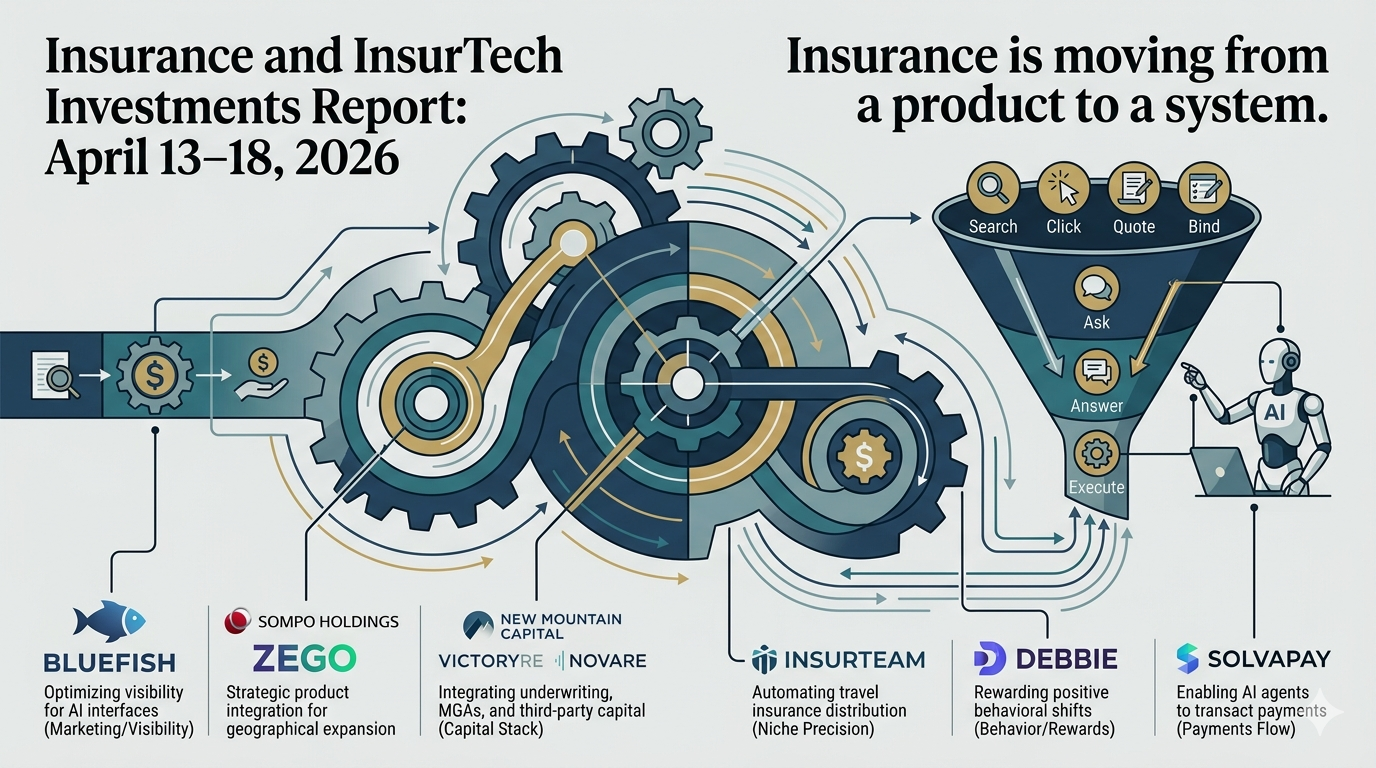
This week’s activity highlights a more nuanced phase in insurance and InsurTech investing—one where capital is not just chasing growth, but actively reshaping how products are built, distributed, and capitalized. From Sompo Holdings’s combined equity and product partnership with Zego, to New Mountain Capital launching VictoryRe alongside NovaRe, the throughline is clear: investors are aligning underwriting, distribution, and capital into integrated stacks. At the same time, smaller but targeted bets—such as Insurteam in embedded travel insurance and Debbie in behavioral finance—demonstrate that early-stage capital is still flowing, but with a sharper focus on specific inefficiencies and high-leverage use cases. Even adjacencies like Bluefish and SolvaPay reinforce that the insurance value chain is expanding beyond traditional boundaries, particularly as AI begins to influence distribution, payments, and customer interaction layers.
Sompo joins Zego’s $28m round and forms strategic digital motor partnership
Date
- Public announcement: 16 April 2026
- Execution: $28m funding round for Zego closed shortly before announcement; the strategic partnership for Japan is launched in conjunction with the round.
Investors and target
- Target: Zego, a UK‑based digital commercial motor insurer and insurTech focused on usage‑based, telematics‑driven cover for fleets, delivery, and gig‑economy drivers.
- Investors:
- Sompo Holdings (Japan) joins the round, combining its capital with strategic distribution and product‑development collaboration.
- Existing Zego investors (not fully enumerated in public articles) continue to back the company in this latest raise.
Amount of funds
- Round size: $28m.
- This adds to Zego’s prior funding base, further capitalizing its telematics and AI‑driven motor platform.
Use of funds
- Product: Co‑develop new digital auto insurance solutions for Japanese customers, blending Zego’s telematics, usage‑based pricing, and AI underwriting with Sompo’s local knowledge and licensing footprint.
- Market expansion: Use Sompo as a distribution and product partner to enter and scale in Japan, one of the world’s largest and most regulated motor insurance markets.
- Technology: Further investment in AI, telematics analytics, and digital policy/claims infrastructure to support multinational programmes.
Competition
- Domestic Japanese insurers: Tokio Marine, MS&AD, other Sompo peers that are also modernizing their motor books.
- Global and regional telematics and UBI (usage‑based insurance) players vying for OEM, fleet, and mobility partnerships.
Impact on competition
- Japan: Raises the standard for digital motor experiences and telematics‑driven underwriting, potentially forcing other Japanese carriers to either build capabilities quickly or seek comparable insurTech partnerships.
- Zego: Gains a powerful foothold in Japan and a validation of its business model by a major incumbent, which can help when negotiating future international partnerships.
- Broader signal: Demonstrates that large Japanese insurers are willing to combine equity (participation in the round) and strategic product collaboration with foreign insurTechs, rather than only running limited pilots.
Insurteam – ~US$1.3m for AI‑driven travel insurTech
Date
- Announcement: 16 April 2026; supporting references from venturelab/Instagram show earlier 2026 communications.
- Execution: Seed‑type round completed in early 2026.
Investors and target
- Target: Insurteam, a Switzerland‑based travel insurTech that uses automation and AI to help B2B partners (travel agencies, OTAs, etc.) sell and service travel insurance more efficiently.
- Investors: Spicehaus Partners, Next Patron and other early‑stage investors associated with venturelab and regional innovation programs.
Amount of funds
- Round size: Around $1.3m (USD equivalent).
Use of funds
- Product and tech: Enhance its AI‑driven travel insurance platform to automate quotes, policies and claims, reducing manual work and errors.
- Expansion: Scale across European markets, adding travel distribution partners and strengthening its B2B footprint.
Competition
- Traditional travel insurance MGAs and carrier products integrated with airlines, OTAs, and tour operators.
- Other travel‑insurTech platforms offering white‑label or embedded travel insurance solutions.
Impact on competition
- Demonstrates continued investor belief in niche, B2B verticalized insurTech plays even as overall funding volumes have dropped.
- If Insurteam’s automation materially lowers cost‑to‑serve and improves claims cycle times, incumbent travel partners may be incentivized to switch away from slower legacy providers.
Bluefish – $43m Series B to scale Agentic Marketing Platform (TIAA Ventures in syndicate)
Date
- Announcement: April 2026
- Execution: Series B round completed shortly before announcement.
Investors and target
- Target: Bluefish, an AI‑first marketing and presence‑management platform that helps brands manage how they appear in AI‑driven tools and agents such as ChatGPT, Google AI Overviews, Amazon Rufus, Perplexity, and other conversational or generative interfaces.
- Co‑leads: Threshold Ventures and NEA (New Enterprise Associates).
- Other investors: TIAA Ventures, Amex Ventures, Salesforce Ventures, and Bloomberg Beta, among others. (This list comes from further investor communications and social posts consolidating the round details.)
Amount of funds
- Series B: $43m.
- Total funding: This round brings Bluefish’s cumulative funding to $68m.
Use of funds
- Product: Further develop the Agentic Marketing Platform (AMP), enabling more granular control and measurement of how brands are interpreted and recommended by AI systems.
- Coverage: Expand coverage to additional AI assistants and surfaces, and deepen analytics around visibility and conversion.
- Go‑to‑market: Scale enterprise sales and customer success; the company reports that around 10% of the Fortune 500 already use the platform.
Competition
- AI‑native marketing and search‑optimization tools competing to help brands optimize presence in LLMs and conversational agents (beyond traditional SEO).
- Broader martech and analytics providers adding modules for generative‑AI surfaces.
Impact on competition and relevance to financial/insurance investors
- Defines “agentic marketing” as a discrete category: actively managing how AI agents and AI‑augmented search experiences talk about and recommend brands, not just how they rank in classic SERPs.
- The presence of TIAA Ventures and other financial/enterprise investors signals that large financial institutions and insurers recognize AI assistants as a critical future distribution and reputation channel, and want early influence over the tooling that shapes that channel.
VictoryRe and NovaRe – PE‑backed reinsurance platform and collateralized sidecar
Date
- Announcement: 15 April 2026
- Execution: New Mountain Capital formally launches VictoryRe, and establishes NovaRe, a collateralized reinsurance sidecar, at the same time.
Investors and target
- VictoryRe: A new reinsurance company created and backed by New Mountain Capital, consistent with its strategy of building scaled platforms in insurance and financial services.
- NovaRe: A collateralized reinsurance vehicle, structured as a sidecar to provide capital and capacity to Novacore, a specialty MGA platform, and potentially other MGAs over time.
Amount of funds
- Specific capitalization figures are not disclosed, but commentary emphasizes a significant capital commitment aligned with New Mountain’s broader AUM and platform‑build strategy.
Use of funds
- VictoryRe: Underwrite multi‑line reinsurance business with a focus on specialty lines, leveraging New Mountain’s analytical and operational capabilities.
- NovaRe: Provide collateralized reinsurance capacity to Novacore and potentially other MGAs, using a sidecar model that allows third‑party investors to participate in reinsurance risk.
Competition
- U.S. and Bermuda reinsurers, plus ILS‑backed fronts, that already partner with MGAs.
- Other PE‑backed integrated platforms that connect MGAs, carriers, reinsurers, and capital markets.
Impact on competition
- Adds another sophisticated entrant into the reinsurance + ILS/sidecar space, reinforcing the trend of alternative capital being tightly integrated with MGA origination.
- Increases competitive tension for attractive MGA partnerships, as VictoryRe/NovaRe can offer a more aligned capital stack and potentially more flexible structures.
Strategic and adjacent investments by insurance investors
Debbie – $5.3m round to launch “Rewards 2.0” (behavior‑based rewards)
Date
- Announcement: Mid‑April 2026
- Execution: $5.3m round closed shortly before the announcement; reveal synchronized with product launch.
Investors and target
- Target: Debbie, a rewards and loyalty platform that re‑designs points and cash‑back as incentives for positive financial behaviors rather than pure spending.
- Investors: Reseda Group, TruStage (via TruStage/TruStage Ventures), Zeal Capital Partners, One Way Ventures, Geek Ventures, 6igma Ventures, and GoodPaper Ventures.
Amount of funds
- Round size: $5.3m equity funding.
Use of funds
- Product: Scale “Rewards 2.0”, where consumers earn points or cash‑back for:
- Every dollar of debt payoff,
- Every dollar of savings, and
- Demonstrated better financial decisions and behaviors.
- Distribution: Integrate with credit unions, community banks, and other financial institutions that want to align incentives with member financial health.
- Product: Scale “Rewards 2.0”, where consumers earn points or cash‑back for:
Competition
- Traditional credit card rewards programs and bank loyalty schemes designed primarily to incentivize spend.
- Other mission‑driven fintechs and behavioral‑finance platforms that overlay rewards on saving or debt‑reduction.
Impact and relevance for insurance investors
- Creates a behavioral engagement layer that can eventually support insurance cross‑sell – e.g., rewarding building emergency savings, maintaining adequate coverage, or reducing risky financial behaviors.
- For TruStage and other financial investors, Debbie offers a new channel to improve member outcomes and, potentially, an on‑ramp to embed insurance products into broader financial‑health journeys.
SolvaPay – payment rails for AI agents (MS&AD Ventures involvement)
Date
- Announcement: 16 April 2026
Investors and target
- Investor: MS&AD Ventures, the corporate venture arm of MS&AD.
- Target: SolvaPay, which is building payment rails tailored for AI agents, enabling autonomous agents to initiate and settle transactions on behalf of users or enterprises.
Amount / use of funds
- Amount: Not publicly disclosed in retrieved sources.
- Use: Develop and scale transaction infrastructure that AI agents can call directly, potentially across multiple verticals including insurance, banking, and commerce.
Impact
- Strategically relevant to the future of embedded and agent‑based insurance, where AI agents may obtain quotes, bind cover, and pay premiums without a human in the loop.
- Positions MS&AD early in the value chain of AI‑native payments, which could ultimately shape how insurance premiums are collected and managed in highly automated environments.
Sompo–Zego partnership (product/market‑entry angle)
Beyond its role as an investor, Sompo’s agreement with Zego is explicitly about co‑developing digital motor products for the Japanese market.
- Sompo contributes local underwriting expertise, distribution and regulatory infrastructure.
- Zego contributes telematics, data science, and digital customer journeys.
- The partnership is intended to build new usage‑based propositions for individual and commercial customers in Japan, potentially extending to fleets and mobility platforms.
Sector and funding backdrop
- Global insurTech funding in March 2026: InsurTech funding fell sharply to roughly $237m across 10 deals, the lowest monthly total so far in 2026, following a much stronger February.
- Q1 2026 overall: Despite March’s slowdown, Q1 insurTech investments are up around 28% year‑on‑year, driven by a handful of large deals above $100m (e.g., Chapter’s $100m Series E earlier in April).
- Thematic capital flows:
- Strong narrative around AI‑related infrastructure, including data‑center risk: S&P and others estimate a $10bn+ premium opportunity in data‑center insurance as AI and cloud computing drive demand for more complex cover.
- Regulators and policymakers (e.g., APAC and NAIC themes) are increasingly steering insurer portfolios toward strategic sectors (infrastructure, climate, long‑term assets) and pushing for more robust capital frameworks, which shapes where insurance‑linked and PE capital goes.
The implication is that the market is increasingly converging around control points—who owns the data, the customer interface, and the risk capital. Strategic investors are no longer passive participants; they are co-building products, entering new geographies, and structuring capital (via sidecars, partnerships, and venture arms) to secure long-term positioning. As funding becomes more selective, winners will be those that can plug directly into these control points—whether through AI-enabled underwriting, embedded distribution, or capital-efficient risk transfer structures. In short, the next cycle of insurance innovation will not be defined by standalone disruption, but by how effectively players integrate technology, distribution, and balance sheet into a cohesive, defensible system.