
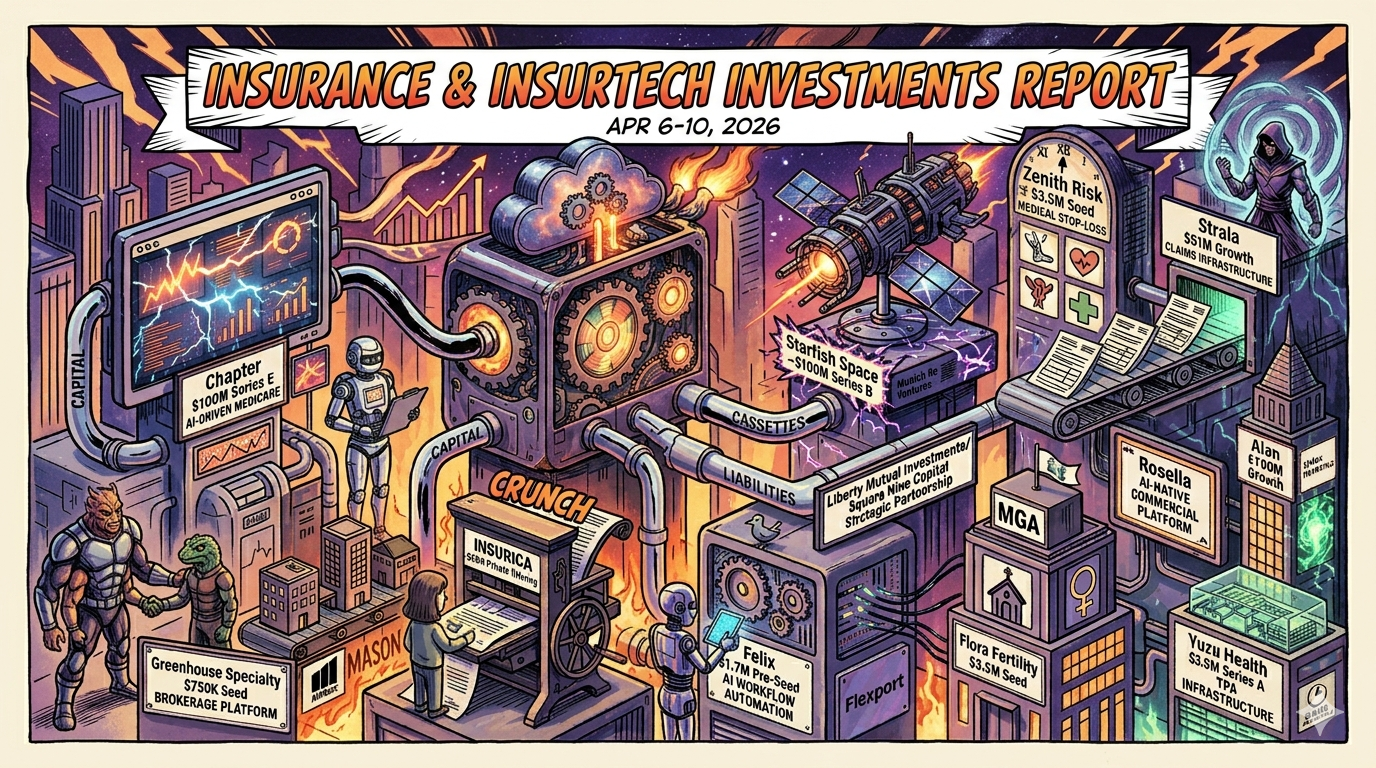
This week’s activity reinforces a clear shift in insurance investing: capital is concentrating around infrastructure, AI-enabled workflows, and distribution leverage, rather than front-end consumer plays. From Chapter’s scaled AI advisory platform to Strala and Yuzu modernizing claims and TPA rails, investors are backing systems that sit at the core of insurance operations. At the same time, traditional models are far from obsolete—INSURICA’s raise and Greenhouse’s carrier-aligned brokerage approach show that distribution, when tightly coupled with underwriting and technology, remains highly financeable. The result is a market where innovation is less about disintermediation and more about re-wiring the stack.
1. Greenhouse Specialty – $750K Seed for Specialty Brokerage Platform
Date Announcement: April 10, 2026 Execution: Closed or near-closed in early April 2026
Investors and Target Target: Greenhouse Specialty, a specialty insurance brokerage platform focused on niche commercial risks
Investors: Strategic partnership with Markel; additional investors not disclosed
Amount of Funds Total raise: $750,000
Use of Funds Grow a specialty brokerage platform and expand product lines in targeted niches Develop programs in collaboration with carrier partners such as Markel Build distribution capabilities aligned with underwriting capacity
Competition Specialty brokers and MGAs aligned with carriers such as Markel and Munich Re Independent niche brokers without direct carrier alignment
Impact on Competition Tightens the link between carrier and distribution at an early stage; competitors risk losing share in targeted niches if they cannot match integrated product and underwriting alignment
2. Chapter – $100M Series E for AI-Driven Medicare Platform
Date Announcement: April 9, 2026 Execution: Closed in early April 2026
Investors and Target Target: Chapter, an AI-driven Medicare and retirement platform optimizing plan selection and benefits navigation for seniors
Investors: Led by Generation Investment Management, with participation from Fifth Down Capital and 8VC; existing investors include Stripes, XYZ Venture Capital, Addition, Narya Capital, Susa Ventures, and Maverick Ventures
Amount of Funds Total raise: $100 million Total funding to date: ~$284 million
Use of Funds Expand AI-driven “trust layer” between seniors and technology Scale Medicare navigation and enrollment capabilities Deepen data platform and distribution partnerships
Competition Online Medicare comparison platforms and enrollment marketplaces Tech-enabled Medicare brokerages Traditional agent and call-center distribution models
Impact on Competition Raises expectations around AI-augmented advice and impartial recommendations; traditional brokers and call-center models face pressure to match Chapter’s data-driven personalization and compliance-friendly workflows
3. INSURICA – $25M Private Offering for Brokerage Expansion
Date Announcement: April 9, 2026 Execution: Early April 2026
Investors and Target Target: INSURICA, a top-50 U.S. insurance brokerage
Investors: Participants in a $25 million private offering; not disclosed
Amount of Funds Total raise: $25 million
Use of Funds Fund acquisitions of smaller agencies and expand geographic footprint Invest in digital tooling and producer hiring Support continued consolidation strategy
Competition Regional and national commercial brokers PE-backed aggregation platforms
Impact on Competition Adds fuel to the consolidation race; INSURICA can act more aggressively on acquisitions, forcing smaller independents and rival consolidators to respond on valuation and technology enablement
4. Starfish Space – ~$100M Series B with Insurance Strategic Participation
Date Announcement: April 8, 2026 Execution: Closed in early April 2026
Investors and Target Target: Starfish Space, a satellite-servicing company developing spacecraft capable of docking, maneuvering, and extending satellite life
Investors: Point72 Ventures, Activate Capital, Shield Capital; participation from Munich Re Ventures, Toyota Ventures, NFX, PSL Ventures, and others
Amount of Funds Total raise: ~$100–110 million
Use of Funds Scale satellite-servicing missions and fund initial commercial deployments Expand engineering, mission operations, and infrastructure capabilities
Competition On-orbit servicing and space-debris-removal companies From an insurance perspective, complementary to space-risk markets rather than direct competition
Impact on Competition Munich Re Ventures’ participation deepens integration into space-risk underwriting, positioning it to better understand and price emerging risks relative to other reinsurers
5. Liberty Mutual Investments – Strategic Partnership with Square Nine Capital
Date Announcement: April 7, 2026 Execution: Partnership signed in early April 2026
Investors and Target Parties: Liberty Mutual Investments and Square Nine Capital
Amount of Funds Not disclosed (strategic partnership, not a single financing round)
Use of Funds Deploy capital into alternative and credit opportunities sourced via Square Nine Enhance investment income generation tied to insurance liabilities
Competition Other insurer asset-management platforms Institutional allocators competing for private-market opportunities
Impact on Competition Tightens access to differentiated deal flow; peers may face pressure to secure comparable partnerships to avoid yield disadvantage
6. Felix – $1.7M Pre-Seed for AI Workflow Automation Platform
Date Announcement: April 7, 2026 Execution: Closed in early April 2026
Investors and Target Target: Felix, an AI workflow platform automating processes across insurance, legal, and finance
Investors: Led by XYZ Venture Capital, with angel investors from Amazon, Apple, Palantir, Flexport, Yelp, and Midjourney
Amount of Funds Total raise: $1.7 million
Use of Funds Expand product capabilities and AI automation features Scale go-to-market and enterprise adoption Extend platform across regulated industries
Competition Horizontal AI workflow and automation platforms Insurance-specific claims, underwriting, and admin automation tools
Impact on Competition Introduces a horizontal AI-first workflow layer that can encroach on insurance-specific vendors, forcing incumbents to differentiate on domain-specific depth
7. Zenith Risk Strategies – Launch of Medical Stop-Loss MGU
Date Announcement: April 7, 2026 Execution: Launch in early April 2026
Investors and Target Target: Zenith Risk Strategies, an Austin-based MGU focused on self-funded employers
Investors: Not disclosed
Amount of Funds Not disclosed
Use of Funds Operational focus on underwriting and distributing medical stop-loss coverage
Competition Stop-loss MGUs and carriers serving self-funded employers Benefits platforms and TPAs integrating underwriting capacity
Impact on Competition Adds capacity and flexibility in the self-funded ecosystem, creating opportunities for TPAs and benefits platforms to integrate with new underwriting sources
8. Strala – $51M Growth Round for Claims Infrastructure
Date Announcement: April 6, 2026 Execution: Closed in early April 2026
Investors and Target Target: Strala, a claims platform and BPO provider serving carriers and MGAs
Investors: Not disclosed
Amount of Funds Total raise: $51 million
Use of Funds Scale claims platform and expand customer base Deepen automation and analytics across the claims lifecycle Enhance end-to-end claims handling capabilities
Competition Claims TPAs and BPO providers InsurTech claims platforms offering automation plus human services
Impact on Competition With significant capital, Strala can raise expectations around speed, transparency, and cost efficiency in outsourced claims, pressuring both incumbents and newer platforms
9. Flora Fertility – $5M Seed for Fertility Insurance MGA
Date Announcement: April 6, 2026 Execution: Closed in early April 2026
Investors and Target Target: Flora Fertility, an MGA building an individually underwritten fertility insurance category
Investors: Led by ManchesterStory, with participation from Slauson & Co., BDC, Marathon Fund, Adara Venture Partners; returning investors include Highline Beta, Everywhere Ventures, Cartography Capital, and David Stern
Amount of Funds Total raise: $5 million
Use of Funds Build a dedicated fertility insurance category with proprietary underwriting Scale multi-channel distribution across D2C, SMBs, and healthcare providers Expand partnerships across the care delivery ecosystem
Competition Employer-based fertility benefit platforms Insurers offering fertility riders or add-ons Women’s health and family-planning InsurTechs
Impact on Competition Flora’s individual underwriting model challenges employer-based structures, potentially forcing incumbents to revisit pricing, product design, and distribution strategy
10. Rosella – A$3.7M Pre-Seed for AI-Native Commercial Insurance Platform
Date Announcement: April 5, 2026 Execution: Closed shortly before announcement
Investors and Target Target: Rosella, an AI-native commercial insurance platform
Investors: Led by Peak XV Partners and Intact Private Capital
Amount of Funds Total raise: A$3.7 million (~$2.5 million USD)
Use of Funds Build AI-native broking and placement workflows Automate submission and underwriting processes Develop next-generation commercial insurance infrastructure
Competition AI-enabled commercial brokers and placement platforms Traditional brokers lacking automation and real-time data integration
Impact on Competition Reinforces the shift toward AI-driven commercial distribution, particularly with carrier-backed capital supporting next-generation brokers
11. Yuzu Health – $35M Series A for TPA Infrastructure
Date Announcement: April 6–7, 2026 Execution: Closed in early April 2026
Investors and Target Target: Yuzu Health, a next-generation TPA infrastructure platform
Investors: Led by General Catalyst and Chemistry, with participation from Bain Ventures, Anthology Fund, and others
Amount of Funds Total raise: $35 million Total funding to date: ~$40 million
Use of Funds Expand engineering and scale platform nationally Automate claims adjudication, reconciliation, and reporting Modernize core administrative infrastructure
Competition Legacy TPAs and health-plan administrators Modern health-tech infrastructure platforms
Impact on Competition Reinforces the infrastructure thesis in health InsurTech, with capital flowing to backend platforms that modernize core administrative functions han a news summary).
Taken together, the week highlights a bifurcated but coherent market: scaled platforms with proven economics continue to attract large growth rounds, while early-stage capital is flowing into targeted, high-leverage entry points—AI layers, MGAs, and embedded distribution. Just as importantly, insurers themselves are becoming more sophisticated capital allocators, whether through venture participation (Munich Re Ventures), partnerships (Liberty Mutual), or structured exposure to new risk categories. The implication is straightforward: the next generation of winners will not just sell insurance better—they will own critical infrastructure, control data flows, and align closely with risk capital, creating defensible positions across the value chain.