
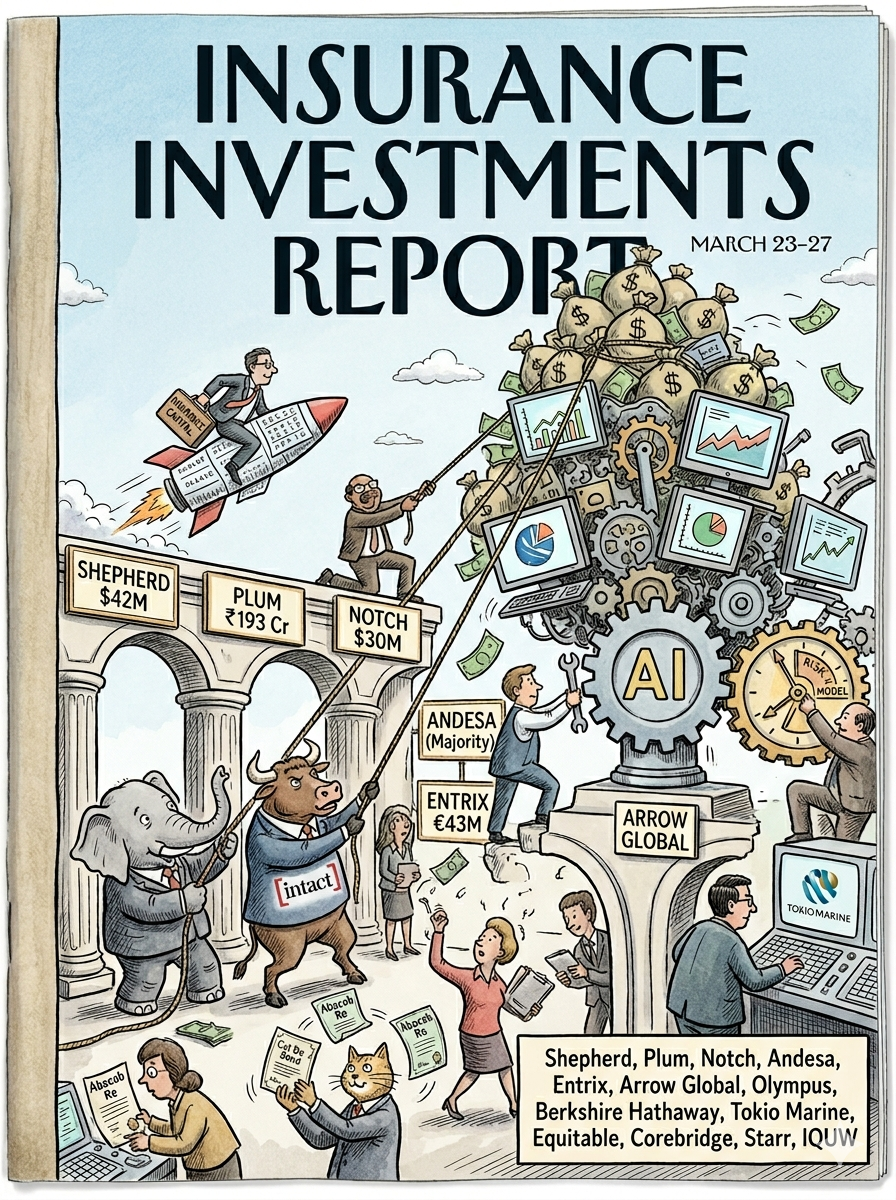
The week of March 23–27, 2026, offers a clear snapshot of where capital is actually moving across insurance and adjacent technology. Rather than broad, speculative bets, this period is defined by targeted investments into AI-driven underwriting, workflow automation, benefits platforms, and core infrastructure—alongside continued activity in specialty insurance capital and reinsurance markets.
The transactions below reflect a market that is shifting from experimentation to deployment, with capital concentrating around platforms that can directly influence risk selection, operational efficiency, and balance sheet strategy.
1. Shepherd – $42M Series B
$42M Series B | Announced March 24, 2026
Strategic thesis: Shepherd is building an AI-native commercial insurance platform focused on construction and emerging AI-infrastructure risks. The company’s core proposition is “autonomous underwriting”—using proprietary data pipelines and machine learning to compress underwriting timelines and improve risk selection in complex commercial environments.
Why it matters:
- Moves underwriting from human-led → machine-executed workflows
- Targets high-friction, data-heavy verticals (construction, infra)
- Signals shift toward minutes-level quoting expectations
- Reinforces that AI advantage = data + workflow ownership, not UI
Competitive impact:
- Pressures incumbents relying on manual underwriting processes
- Raises bar for data ingestion (project-level, real-time inputs)
- Competes with both MGAs and AI underwriting platforms
- Accelerates pricing and selection asymmetry across carriers
Bottom line: Shepherd isn’t improving underwriting—it’s compressing it into software, redefining speed and selection in commercial lines.
Founders & key investors: Intact Private Capital (lead), Spark Capital, Costanoa Ventures
2. Plum – ₹193 Cr (~$20M) Series B
₹193 Cr (~$20M) Series B | Announced March 25, 2026
Strategic thesis: Plum is scaling a full-stack employee benefits platform in India, combining insurance distribution with healthcare services. The company is doubling down on AI-driven claims automation and integrated care delivery, positioning itself beyond brokerage into a benefits operating system.
Why it matters:
- Validates profitability-first InsurTech models
- Shifts competition from price → experience (claims + care)
- Expands scope from insurance → healthcare ecosystem ownership
- Embeds deeper into HR and enterprise workflows
Competitive impact:
- Intensifies competition with Acko, Policybazaar, and digital brokers
- Forces differentiation via claims experience and healthcare stack
- Raises expectations for end-to-end benefits platforms
- Increases switching costs via integrations + service layer
Bottom line: Plum is turning benefits into a sticky platform business, not a transactional insurance product.
Founders & key investors: Peak XV Partners (lead), Tanglin Venture Partners, GMO Venture Partners
3. Notch – $30M Series A
$30M Series A | Announced March 25–26, 2026
Strategic thesis: Notch is building a governed AI operating system for regulated industries, starting with insurance. Its platform deploys production-grade AI agents capable of executing workflows end-to-end under strict compliance, auditability, and explainability constraints.
Why it matters:
- Solves the biggest blocker in insurance AI: governance, not capability
- Enables AI agents to operate in production, not just assist
- Bridges gap between LLMs and regulated environments
- Positions AI as infrastructure layer, not tooling layer
Competitive impact:
- Disadvantages generic AI tools lacking compliance frameworks
- Competes with internal automation teams and emerging agent platforms
- Raises bar for auditability and explainability in AI deployment
- Accelerates enterprise adoption of AI-driven workflows
Bottom line: Notch is defining the control layer for AI in insurance—whoever governs the agents, owns the workflow.
Founders & key investors: Headline (lead), Lightspeed, Jibe Ventures, Illuminate Financial, Phoenix Insurance
4. Andesa – Majority Investment by Terminus Capital Partners
Majority PE Investment | Announced March 26, 2026
Strategic thesis: Andesa provides policy and plan administration software for complex life and annuity products (BOLI, COLI, ICOLI, NQDC). Terminus Capital’s majority investment is aimed at modernizing this deeply embedded infrastructure layer.
Why it matters:
- Policy admin remains one of the most entrenched control points
- Focus on high-complexity, high-margin life products
- Signals continued PE interest in “boring but critical” systems
- Modernization unlocks speed-to-market and configurability
Competitive impact:
- Pressures legacy admin providers with slower innovation cycles
- Strengthens Andesa’s position in advanced markets segment
- Increases expectations for flexibility and scalability
- Reinforces value of deeply embedded enterprise software
Bottom line: Andesa proves again: the least visible layers in insurance often carry the most value.
Founders & key investors: Terminus Capital Partners (majority investor)
5. Entrix – €43M Growth Round (Allianz-backed)
€43M Growth Round | Announced March 24–25, 2026
Strategic thesis: Entrix operates an AI-driven energy trading and optimization platform for battery storage and grid flexibility. Allianz’s participation reflects a strategic push to gain data and insight exposure to energy-transition risks.
Why it matters:
- Expands insurer role into adjacent data ecosystems (energy)
- Enables better underwriting of new asset classes (battery storage)
- Creates feedback loop between real-world operations and risk models
- Signals convergence of insurance + climate tech + infrastructure data
Competitive impact:
- Gives Allianz informational advantage in energy risk underwriting
- Leaves competitors without similar partnerships at a disadvantage
- Increases importance of proprietary data access in emerging risks
- Blurs lines between insurer, investor, and data participant
Bottom line: The future of underwriting isn’t just better models—it’s better data access, and Entrix is exactly that.
Founders & key investors: Allianz, Junction Growth Investors, Korys
6. Arrow Global – Launch of Arrow Global Insurance (AGI)
Platform Launch | Announced March 26, 2026
Strategic thesis: Arrow Global launched AGI to deploy institutional capital across the specialty insurance value chain, including MGAs, carriers, and balance-sheet solutions, effectively creating a dedicated insurance investment platform.
Why it matters:
- Continues influx of private capital into insurance
- Expands competition for MGA and specialty assets
- Enables more complex, structured capital solutions
- Reinforces insurance as a capital allocation strategy
Competitive impact:
- Competes with ILS funds, PE firms, and reinsurers
- Drives valuation pressure across specialty assets
- Accelerates innovation in capital structures and partnerships
- Increases availability of non-traditional underwriting capacity
Bottom line: Insurance is no longer just about underwriting risk—it’s about who controls the capital behind it.
7. ILS & Reinsurance Capital Developments
7a. Olympus – Abacab Re 2026-1 Cat Bond
Cat Bond Issuance (Upsized) | Marketed March 2026
Strategic thesis: Olympus’ debut cat bond saw tightening price guidance and strong demand, reflecting continued investor appetite for well-structured catastrophe risk.
Why it matters:
- Confirms resilience of ILS market demand
- Supports additional capacity for insurers
- Demonstrates pricing power when risk is well-understood
Competitive impact:
- Encourages more issuers to tap capital markets
- Expands alternative capacity vs. traditional reinsurance
- Strengthens role of structured risk transfer products
Bottom line: Capital markets remain open and competitive for insurance risk—if structured correctly.
7b. AI-Linked Reinsurance Structures (Emerging Theme)
Market Commentary | Published March 2026
Strategic thesis: Emerging structures point toward AI-linked securities, integrating ILS with dynamic, AI-driven risk analytics and triggers.
Why it matters:
- Moves reinsurance toward real-time, model-driven capital structures
- Tightens integration between InsurTech and capital markets
- Enables more responsive and adaptive risk transfer
Competitive impact:
- Favors players with advanced modeling capabilities
- Raises complexity and sophistication of capital instruments
- Accelerates convergence of technology + reinsurance + capital
Bottom line: Reinsurance is evolving from static structures to intelligent capital systems.
8. Additional Strategic Transactions (Status Updates)
Berkshire Hathaway – ~$1.8B Stake in Tokio Marine
Strategic Equity Investment | Announced March 23, 2026
Strategic thesis: Deepens partnership via capital injection and reinsurance collaboration.
Why it matters:
- Strengthens global carrier alignment
- Reinforces long-term balance sheet partnerships
Bottom line: Strategic capital is being used to lock in distribution and risk partnerships.
Status: Announced; expected to close April 2026
Equitable – Corebridge ~$22B Merger
All-Stock Merger | Announced March 26, 2026
Strategic thesis: Combines two life platforms into a scaled retirement and insurance powerhouse.
Why it matters:
- Drives scale efficiencies in life insurance
- Enhances capital and distribution capabilities
Bottom line: Scale continues to be a defining advantage in life insurance.
Status: Announced; expected close by year-end 2026
Starr – Acquisition of IQUW Group (Completed)
Strategic Acquisition | Closed March 23, 2026
Strategic thesis: Expands Starr’s presence in specialty and Lloyd’s markets.
Why it matters:
- Strengthens underwriting footprint in specialty lines
- Enhances global distribution and capacity
Bottom line: Consolidation in specialty insurance continues to accelerate.
Status: Closed
Overall Takeaway
This week’s deals reinforce a single theme:
Insurance is being re-architected around workflows, data, and capital.
- AI is moving into decision-making layers
- Infrastructure players are capturing control points
- Private capital is reshaping balance sheets and distribution
The competitive edge is no longer distribution or brand.
It’s:
Who owns the workflow—and who controls the capital behind it.