

CIBC Innovation Banking

Insurance and InsurTech Investments Report: March 30 - April 4

Insurance and InsurTech Investments Report: March 30 - April 4

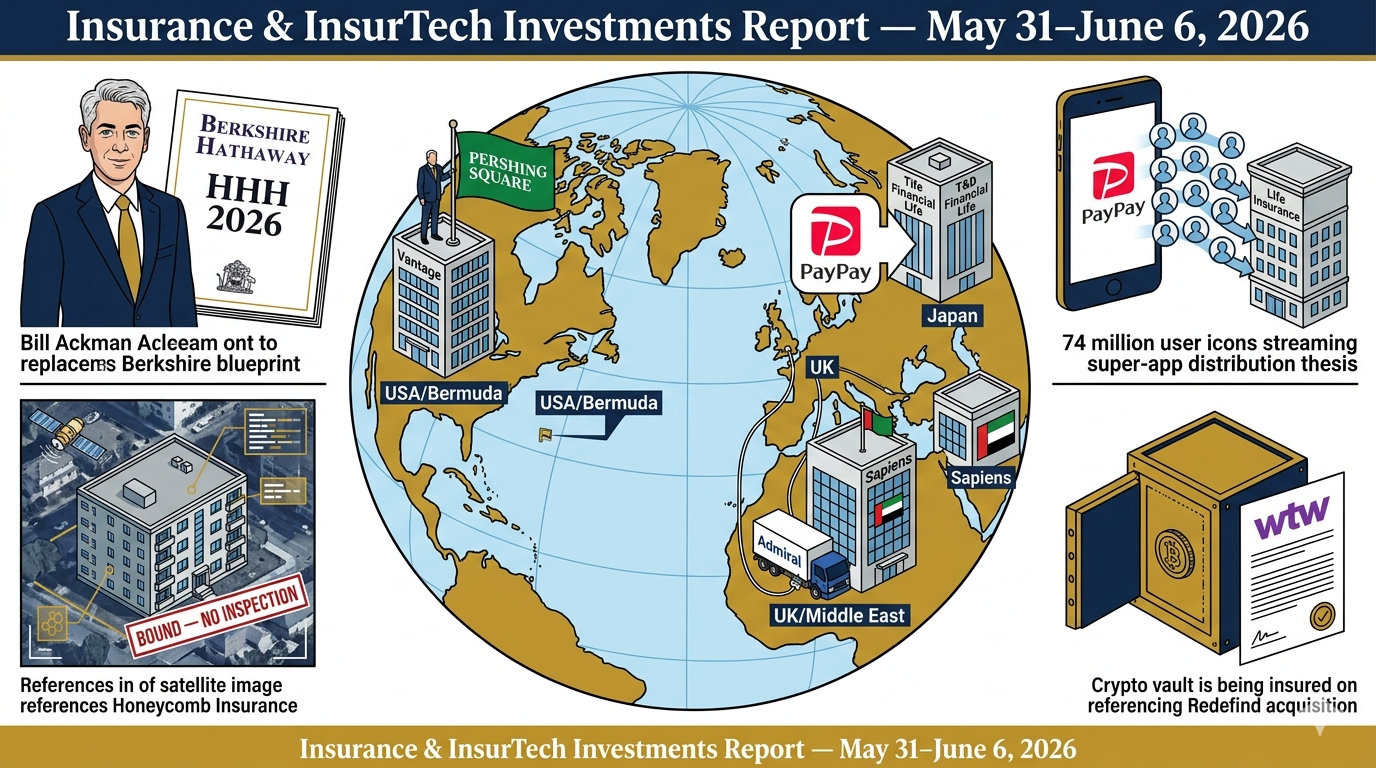
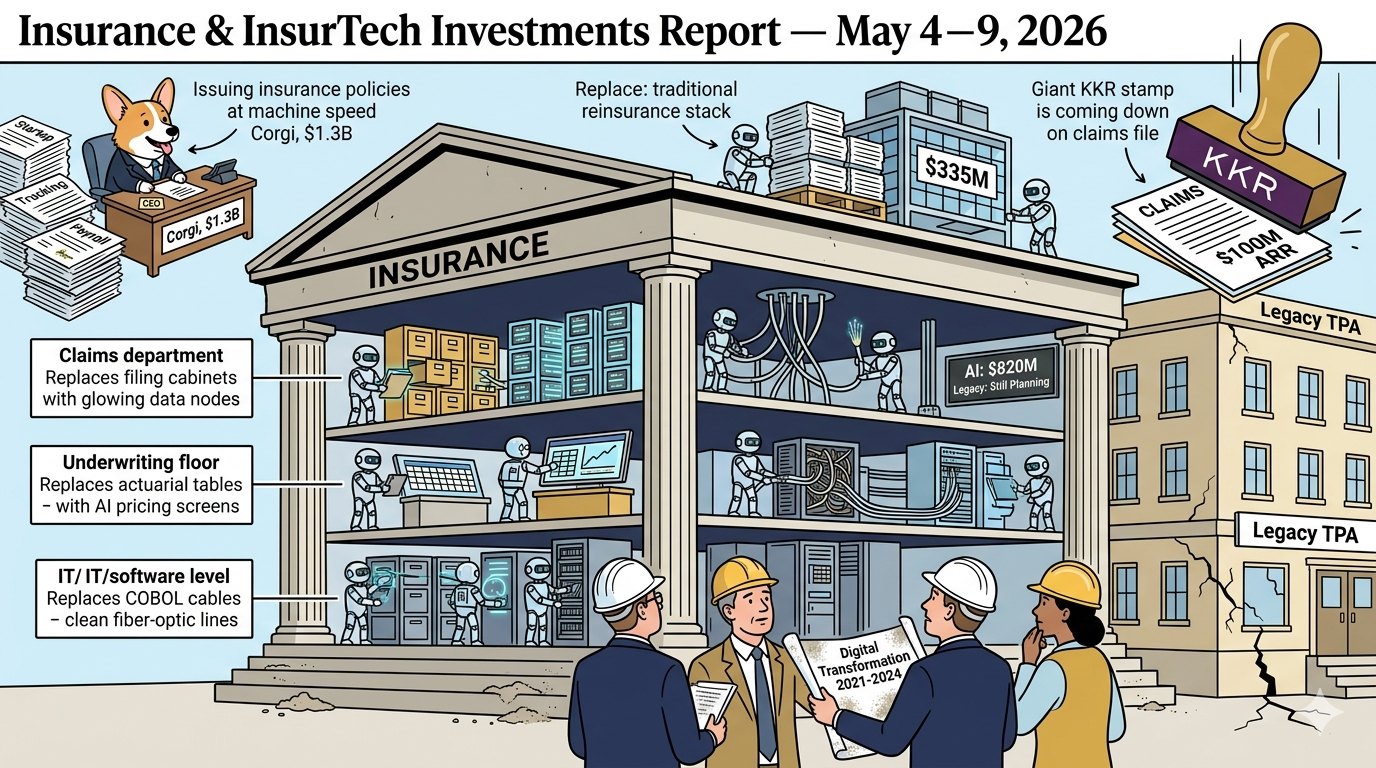
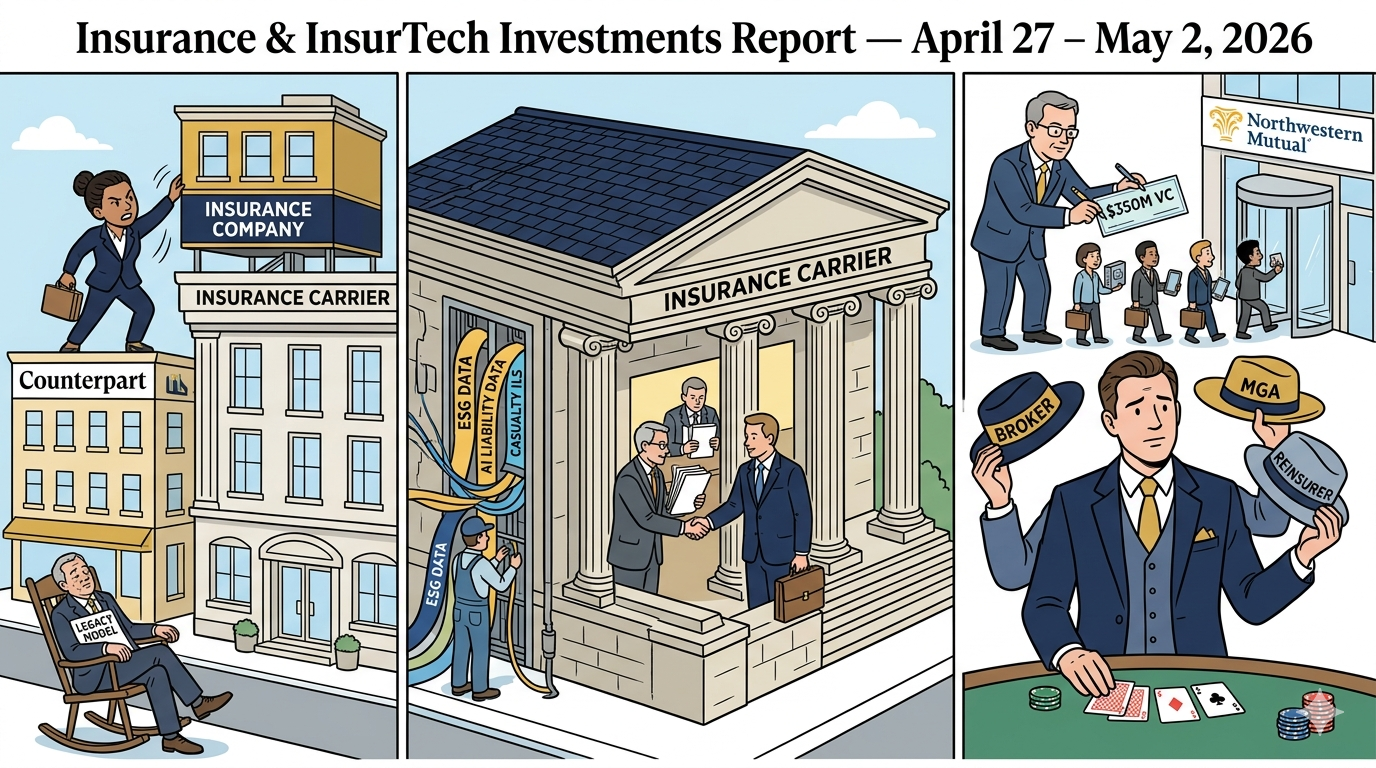
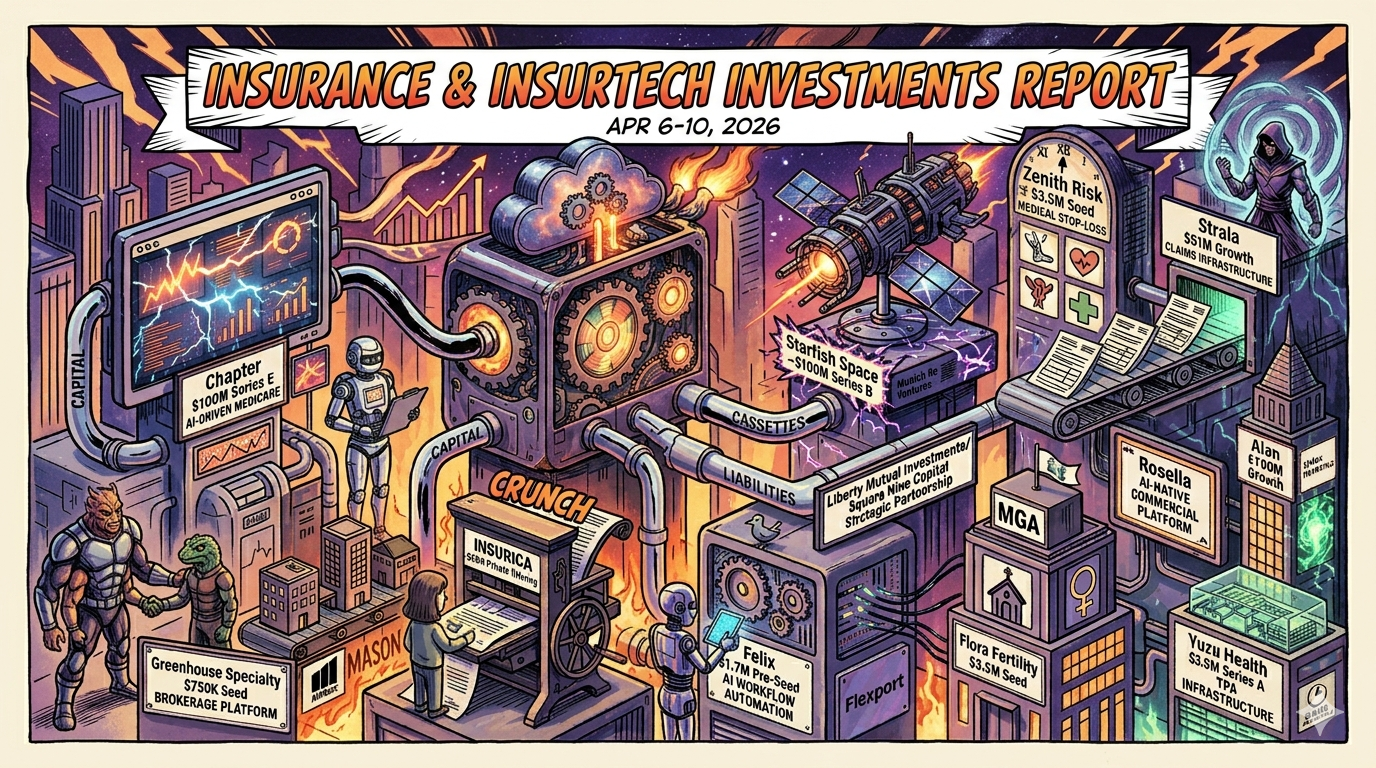
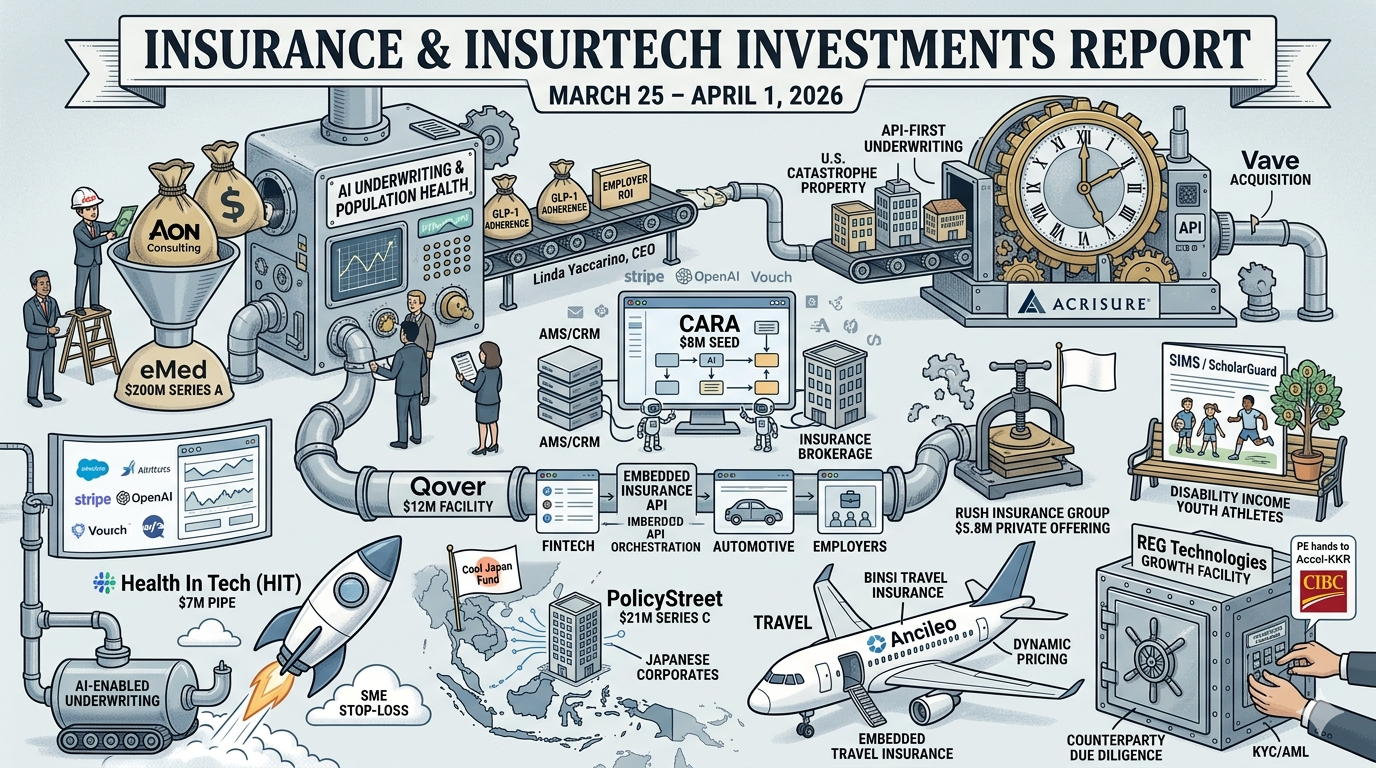
Generate a prompt to create a 16:9 editorial-style illustration for the article pasted below

Requirements:

* Style: Financial newspaper cartoon (Economist / FT style — but do NOT mention those names explicitly)

* Title:

  “Insurance & InsurTech Investments Report” + weekly dates

* Include visual references to:

  * Technology (AI, data, automation)

  * Capital (money flows, investors)

Subtly incorporate *logos or symbolic references** to key companies from that week

* Clean, sophisticated, editorial aesthetic

## eMed Population Health (USA)

$200M Series A at $2B+ Valuation | Employer GLP-1 & Population Health Platform

Date

Announcement: March 30, 2026

Execution: March 30, 2026

Investors & Target

Target: eMed is a Miami-based digital-first employer population health platform specializing in clinically supervised GLP-1 weight management programs. It combines at-home diagnostics, proctor-led screenings, clinician-guided prescribing, and AI-driven adherence coaching. Founded 2020; CEO Linda Yaccarino (former Twitter/X CEO). Originally launched selling at-home COVID tests before pivoting entirely to GLP-1 weight management and population health.

Lead investors: Aon Consulting

Other investors: Tom Brady (Founding Chief Wellness Officer & investor), Joe Lonsdale (8VC), Antonio Gracias (Valor Equity Partners), Tom Ricketts (Chicago Cubs Chairman), Jeff Aronin (Paragon Biosciences CEO)

Amount of Funds

$200M Series A at $2B+ valuation

Use of Funds

Advancing agentic AI platform for continuous personalized GLP-1 care; scaling employer distribution through Aon's consulting and broker network; global expansion; exploring adjacent peptide therapy programs beyond GLP-1.

Competition

Direct competitors: Noom Med, Ro, Hims & Hers (GLP-1 telehealth), Found, Alto Pharmacy

Category competitors: PBMs managing employer GLP-1 formularies (CVS Caremark, Express Scripts), employer wellness platforms (Virgin Pulse, Omada Health, Accolade)

Impact on Competition

Aon leading this round is not passive financial participation — it converts Aon's broker relationships with Fortune 500 employers directly into eMed's distribution pipeline. Every Aon benefits consultation now includes a population health product to recommend. Competing GLP-1 platforms must build employer relationships deal by deal without an equivalent distribution anchor. eMed's 90%+ medication adherence — independently validated by UCL across 8,000+ members, more than double the ~35% industry norm — reframes the employer ROI calculus. If that adherence holds at scale, PBMs' argument for managing GLP-1 as a formulary item rather than a clinical platform decision weakens structurally.

## Acrisure / Vave (USA) 

Acquisition Closed | Tech-Driven Cat Property MGA into Acrisure Underwriting

Date

Announcement: December 2025 (original)

Execution: April 1, 2026 (completed)

Investors & Target

Target: Vave is a technology-driven property MGA, founded 2019, headquartered Chicago. Uses API-driven underwriting and data science to deliver 10,000+ instantly bindable quotes per day across commercial, homeowners, flood, and earthquake E&S risks in the U.S.

Acquirer: Acrisure (via Acrisure Underwriting — now 12 MGAs in U.S. markets)

Seller: Canopius Group (retains multi-year capacity agreement)

Amount of Funds

Undisclosed

Use of Funds

Deepens Acrisure Underwriting's catastrophe property capabilities; extends Vave's California home and commercial product lines; accelerates commercial package product launch for cat-exposed markets.

Competition

Direct competitors: Hippo, Branch, Openly (homeowners E&S), Next Insurance (SME commercial)

Category competitors: Lloyd's syndicates writing U.S. cat property, other Acrisure Underwriting MGAs

Impact on Competition

Acrisure describes Vave as the "cornerstone" of its E&S property underwriting platform — the first time it has applied that designation to an acquisition. The API infrastructure (10,000 quotes/day, instantly bindable) is the acquired asset, not the book. Canopius retains capacity but surrenders distribution control — setting a structural template: technology platforms own the client relationship, traditional capacity follows on terms set by the platform. For standalone cat-property MGAs, scale and API-first infrastructure are increasingly prerequisites for viability and exit premium.

## Cara (USA) 

$8M Seed | AI Operating Layer for Insurance Brokerages

Date

Announcement: March 31, 2026

Execution: March 31, 2026

Investors & Target

Target: Cara is a New York-based AI-native platform built by former insurance operators (Vic Yeh, Nikhil Kansal, Jonathan Patel — previously Blend Labs, Stripe, Strategy&) who built and sold digital brokerage Oyster Technologies, then productized their internal tools into a commercial platform. Automates: coverage comparisons, proposal generation, COI issuance, ACORD/supplemental form fill, E&O review, and client communications via voice and email AI. Reached 7-figure ARR in 7 months. 80%+ of customers via word-of-mouth. Serves The McGowan Companies, Atlas Insurance Brokers, ISU Steadfast, Combined Agents of America, FirstChoice (MarshBerry).

Lead investors: Kearny Jackson

Other investors: Claire Hughes Johnson (Former COO, Stripe), Kevin Mahaffey (Founder, SNR), Sam Hodges (CEO, Vouch Insurance), Colin Evans (Startups & Partnerships, OpenAI)

Amount of Funds

$8M Seed

Use of Funds

Insurance-specific AI research and model development; deeper AMS/CRM integrations (HawkSoft, Applied Epic, Vertafore); expansion from task automation toward full operating layer capable of running up to 70% of an agent's daily workflow; team growth in San Francisco and New York.

Competition

Direct competitors: AgentSync, Vertafore, Applied Epic, EZLynx, HawkSoft

Category competitors: Generic AI assistants adapted for insurance, internal automation builds at large brokerages (Marsh, Gallagher, Aon), Salesforce Agentforce for insurance

Impact on Competition

Cara's investor syndicate is diagnostic: Stripe's former COO (payments infrastructure expertise), OpenAI's partnerships lead (frontier model access), and Vouch Insurance's CEO (insurance distribution depth) is a purpose-built coalition for redefining brokerage infrastructure. Attack vector is integration-first — Cara plugs into existing AMS/CRM rather than requiring rip-and-replace, lowering adoption friction. Agencies adopting this automation level will structurally reduce headcount per account, raising service expectations and compressing costs for early adopters relative to laggards.

## Qover (Belgium/USA)

$12M Growth Capital Facility | Embedded Insurance API Infrastructure

Date

Announcement: March 31, 2026

Execution: March 31, 2026

Investors & Target

Target: Qover is an API-first embedded insurance platform enabling brands, fintechs, and enterprises to integrate insurance products across channels and geographies through a single orchestration layer routing to multiple carriers. Active across automotive, fintech, and employer channels in Europe and North America.

Lead investors: CIBC Innovation Banking (growth capital facility — debt, not equity)

Other investors: Existing investors

Amount of Funds

$12M growth capital facility

Use of Funds

Scaling embedded insurance partnerships across Europe and North America; deepening multi-carrier, multi-product API orchestration; expanding distribution partner network.

Competition

Direct competitors: Cover Genius, Wrisk (auto embedded), Bsurance, Companjon

Category competitors: Traditional white-label insurance programs, insurer-direct API integrations

Impact on Competition

Debt facility (vs. equity) signals Qover is generating recurring revenue sufficient to service capital — a positive unit-economics signal in a category where many embedded platforms have struggled to demonstrate durable monetization. The orchestration layer position (between carriers and distribution partners) captures disproportionate value as embedded insurance becomes strategic rather than experimental. The platform with the broadest carrier-partner network builds network effects that compound.

## Rush Insurance Group (USA)

$5.8M Private Offering | Early-Stage Insurance Entity

Date

Announcement: April 1, 2026 (SEC filing)

Execution: April 1, 2026

Investors & Target

Target: Rush Insurance Group — early-stage insurance company (carrier or MGA in formation; limited public detail beyond SEC filing).

Lead investors: Undisclosed private offering

Other investors: Oak Investment Partners (placement agent; commissions $180K, finder's fees $4K — not equity investor)

Amount of Funds

$5.8M private offering

Use of Funds

Not publicly disclosed; inferred as formation capital for carrier buildout or MGA launch.

Competition

Category competitors: Early-stage MGAs and specialty carriers in formation

Impact on Competition

Limited at current stage. Notable as a continued signal of private placement capital formation in insurance structures, even as early-stage insurtech deal counts contract industrywide.

## SIMS / ScholarGuard (USA)

Undisclosed Equity | Disability Income for Youth Athletes

Date

Announcement: March 30, 2026

Execution: Undisclosed

Investors & Target

Target: Specialty Insurance Marketing Services (SIMS), formed 2019, markets ScholarGuard — an accident disability income product for youth athletes aged 6–21 (renewable to 26). Benefits triggered if qualifying injury prevents continued sport participation and forecloses scholarship-supported education. Permanent disability pays $100K upon college enrollment; scholarship loss coverage pays additional $100K. Currently available in 8 states; national expansion underway. Distributed through licensed life and health insurers. Led by Michael Fink (40+ years insurance industry experience).

Lead investors: Undisclosed

Other investors: Undisclosed

Amount of Funds

Undisclosed equity raise

Use of Funds

State-by-state regulatory approval and national ScholarGuard expansion; distribution buildout through licensed carrier partners.

Competition

Direct competitors: Petersen International Underwriters (athlete disability), A-G Specialty Insurance (student-athlete catastrophic), Exceptional Risk Advisors

Category competitors: NCAA/NAIA institutional catastrophic programs, supplemental health/accident products, NIL income protection platforms

Impact on Competition

Genuine white space: the intersection of youth sports injury risk and education financing exposure, with no dominant national product. First mover with state approval coverage establishes a regulatory moat that takes years to replicate. As NIL monetization accelerates financial stakes of youth athletic careers, scholarship-loss risk attached to injury grows in commercial significance. Product architecture (benefits tied to college enrollment eligibility, not just injury severity) is structurally distinct from existing catastrophic athlete programs.

## Health In Tech (USA)

$7M PIPE Financing | AI-Enabled Health Benefits & Stop-Loss InsurTech

Date  

Announcement: March 25, 2026  

Execution: March 27–28, 2026 (PIPE closing announced)

Investors & Target  

Target: Health In Tech, Inc. (Nasdaq: HIT) is a US InsurTech platform focused on level-funded and self-funded health plans, combining AI-driven underwriting, plan design, and administration for employers, TPAs, and brokers. It operates in the health benefits and stop-loss segment, offering digital quoting, risk modeling, and plan management tools. 

Lead investors: Not disclosed (PIPE placed with a group of institutional and accredited investors). 

Other investors: Additional unnamed institutional and accredited investors participating in the PIPE. 

Amount of Funds  

$7.0M gross proceeds via PIPE (Private Investment in Public Equity). 

Use of Funds  

Scaling US distribution across brokers, TPAs, and employer channels, with an emphasis on AI-driven underwriting and plan-optimization capabilities. 

Advancing the core technology stack (pricing engines, analytics, and platform integration), funding new product development in self-funded and level-funded solutions, and supporting general corporate purposes and working capital. 

Competition  

Direct competitors: Other SME-focused benefits and stop-loss InsurTech platforms (e.g., digital TPAs and AI-underwriting engines), as well as health benefits administrators offering automated quoting and plan management. 

Category competitors: Traditional TPAs, carrier-owned admin platforms, and benefits brokers relying on less automated, manual processes for plan design and stop-loss placement. 

Impact on Competition  

Health In Tech gains incremental balance-sheet flexibility to invest in AI underwriting and distribution without the dilution of a large marketed follow-on, strengthening its positioning versus private peers and smaller TPAs. 

Competitors that cannot match faster AI-assisted quoting and plan design will struggle to defend broker relationships as employers push for lower admin costs and more precise risk selection in self-funded plans. 

## PolicyStreet (Malaysia / Southeast Asia)

$21M Series C (First Close) | Asian Embedded & B2B2C InsurTech Infrastructure

Date  

Announcement: March 31–April 1, 2026  

Execution: March 2026 (first close of Series C completed prior to announcement)

Investors & Target  

Target: PolicyStreet is a Malaysia-based InsurTech building insurance infrastructure and distribution for SMEs, enterprises, and consumers across Southeast Asia. It operates across employee benefits, group and commercial coverage, and embedded insurance, working with more than 40 insurance and takaful partners and integrating directly into platforms and corporate workflows. 

Lead investors: Cool Japan Fund (Japanese government-backed strategic investment vehicle). 

Other investors: Altara Ventures, Gobi Partners, and additional unnamed investors participating in the first Series C close. 

Amount of Funds  

$21M Series C (first close; MYR 84M), with potential for additional closes. 

Use of Funds  

Scaling PolicyStreet’s infrastructure-led InsurTech platform across Southeast Asia, deepening its embedded and B2B2C capabilities for employers, platforms, and financial institutions. 

Expanding product lines in employee benefits and SME/group risk, enhancing technology and data capabilities, and accelerating geographic expansion and regulatory licensing across the region. 

Competition  

Direct competitors: Regional InsurTechs providing embedded distribution, SME platforms, or digital broking in Southeast Asia (including local aggregators and digital brokers). 

Category competitors: Traditional insurers and brokers that still sell via offline channels and lack end-to-end digital infrastructure, as well as global InsurTechs entering SEA with embedded or SME-focused models. 

Impact on Competition  

PolicyStreet stands out as a profitable InsurTech (reported >$1M profit in 2025) raising growth capital, which raises the bar for unprofitable regional peers still dependent on burn-heavy customer acquisition. 

Cool Japan Fund’s lead role creates a strategic bridge between Japan and Southeast Asia, positioning PolicyStreet as a regional infrastructure partner for Japanese corporates and insurers — a distribution and capital advantage that smaller or single-market InsurTechs will find hard to replicate. 

## MSIG Asia / Ancileo (APAC)

Undisclosed Strategic Equity & Partnership | Embedded Travel Insurance Platform

Date  

Announcement: March 25–26, 2026  

Execution: March 2026 (strategic equity investment and partnership completed prior to public announcement)

Investors & Target  

Target: Ancileo is a travel-focused InsurTech platform that embeds travel insurance into airline, OTA, and travel ecosystem booking flows, enabling dynamic pricing, personalization, and real-time offers at checkout. 

Lead investors: MSIG Asia (Mitsui Sumitomo Insurance) via a strategic equity investment. 

Other investors: Not disclosed; transaction presented primarily as a bilateral strategic deal between MSIG and Ancileo. 

Amount of Funds  

Undisclosed strategic equity stake. 

Use of Funds  

Scaling Ancileo’s embedded travel insurance capabilities across MSIG’s airline, OTA, and travel distribution partners in Asia, including deeper integration into booking engines and post-booking journeys. 

Enhancing product personalization, pricing sophistication, and digital claims/assistance workflows to support MSIG’s travel portfolio. 

Competition  

Direct competitors: Other embedded travel-insurance engines that integrate into airline and OTA checkout processes, as well as global travel InsurTechs offering similar capabilities. 

Category competitors: Traditional standalone travel insurance channels (agents, carrier sites) and generic white-label travel insurance providers not deeply embedded in booking flows. 

Impact on Competition  

MSIG’s strategic stake effectively bundles carrier balance sheet, product, and embedded technology into one offering for travel partners, creating a tighter moat versus carriers that still rely on simple white-label products or third-party aggregators. 

For competing travel-insurance InsurTechs, MSIG’s move removes a key regional carrier from the “neutral” partner pool and may force them to look to second-tier carriers or non-insurance travel brands to fill distribution gaps. 

## REG Technologies (UK)

Undisclosed Growth Capital Facility | Compliance & Regulatory Risk Platform for Insurance

Date  

Announcement: March 31, 2026  

Execution: March 2026 (growth financing facility agreed and in place at time of announcement)

Investors & Target  

Target: REG Technologies is a London-based compliance and regulatory risk platform serving insurance and financial services, including brokers, MGAs, carriers, and networks. Its SaaS platform automates counterparty due diligence, onboarding, KYC/AML, and regulatory monitoring for trading partners. 

Lead investors: CIBC Innovation Banking (growth capital facility). 

Other investors: Private equity firm Accel-KKR (majority shareholder following a prior control transaction); existing shareholders retain stakes. 

Amount of Funds  

Undisclosed growth financing facility from CIBC Innovation Banking. 

Use of Funds  

Accelerating product innovation in regulatory and compliance automation for insurance and adjacent financial sectors, including enhanced data integrations and workflow tools. 

Supporting commercial expansion in the UK and internationally, including deeper penetration into broker networks, MGAs, and carrier groups. 

Competition  

Direct competitors: Other regtech platforms focused on broker/carrier onboarding and compliance, plus specialist tools used by insurers for counterparty vetting and regulatory monitoring. 

Category competitors: In-house compliance teams using spreadsheets and generic workflow tools, legacy GRC platforms not tailored to insurance distribution. 

Impact on Competition  

Back-to-back support from a PE majority owner (Accel-KKR) and a specialist lender (CIBC Innovation Banking) gives REG the balance-sheet firepower to consolidate functionality and market share in insurance compliance, making it harder for small, single-feature regtechs to survive standalone. 

As brokers and carriers rationalize vendors, a scaled, PE-backed platform with fresh growth capital is well-positioned to become a default choice, pushing manual or lightly-automated processes to the margins.