
Last weekend I got punched in the face -- twice

Last weekend I got punched in the face. Twice. Karate practice has been a great source for insights and life lessons. In one of my recent posts I wrote about changing the kata and the mindset as a company re-positions itself in the market. Today I want to tell you about the lessons I learned over the weekend. 

Ducktape - a karateka's best friend. [Shotokan Karate of America - CalTech special training 2016]

Ducktape - a karateka's best friend. [Shotokan Karate of America - CalTech special training 2016]

A major part of the SKA practice includes winter and summer special training events. Special training is a long weekend of intense training that pushes you to the edge of your abilities and usually your toughest opponent is you. No, I didn't punch myself.

One of the benefits of special training is to practice and face karatekas from other dojos. In sanbon-kumite (three strikes sparring) I faced another black belt. Both of us ranked as nidan. Quick estimation - I am a head taller than him, at least 10 years older than him and he has a well groomed big mustache. We bowed, and before I managed to move in, his fist found my chin. Since I was working on getting-in (irimi) I decided to try getting-in again and stretched myself tall so his fist would need to travel longer to its destination. He moved, I moved, and his fist found my nose. No worries - only blood, nothing broken. Sanbon-kumite is a three continuous strikes engagement, my opponent managed to hit me and cause pain. Yet, he didn't knocked me out and I was able to navigate successfully his other two consecutive strikes and counter attack. One of the seniors that observed the engagement commented: "try to block." I didn't want to change my internal goal for the practice, but I didn't want to get hit in the face for the third time. So, I adapted my internal goals to meet the threat. 

Lessons for the insurance companies:

  1. Don't under estimate InsurTech startups. Some of them are hipsters that can respond to your customers faster and better than you can.
  2. Playing "big company" against a small startup may draw blood, from you.
  3. Most of the time the startup has only the first punch to play with.
  4. Adjust your internal objectives and incentives to support your external goals.
  5. Adjust your modus operandi base on the external threat. If you need to block, block! It doesn't matter that blocking is a simple technique and less elegant than Irimi.   
  6. Think M&A

Lessons for InsurTech startups:

  1. Be fast!
  2. Have a long reach than perceived.
  3. Create an awesome diversion. Grow a mustache if you can pull it off. 
  4. Hit where it hurts.
  5. Think M&A


Frictionless Customer Experience

Frictionless customer experience is the future of insurance customer engagement. Today, the interaction with insurance comes at the cost of mental effort, and sometimes pain. Insurance companies that manage to smooth the customer's interaction gain a new 'value proposition' that they can offer to the customers. The customer journey doesn't start from the "search for insurance policy", it starts from understanding the risk and reason for purchasing an insurance policy. One journy ends after a customer purchases a policy, another journey ends after the customer recovers her loss.

This technology is not going to replace the human insurance agent. In the next couple of decades the number of the insurance agents will decrease as the Millennials matures, Gen-X retires, demand changes and the technology evolves. However, today's artificial intelligence (AI) can not, yet, provide a warm shoulder, a hug and an empathy. 

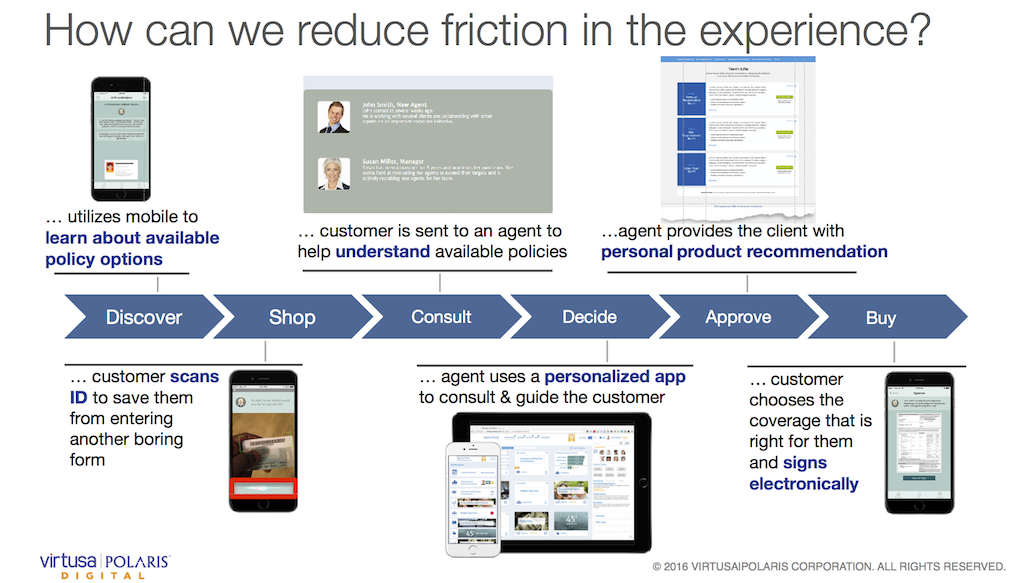
Adam Gabrault, VP at VirtusaPolairs, talked with the InsurTech Los Angeles meetup about the technology that powers the frictionless user experience and mapped the journey that a customer takes to purchase an insurance policy.

Everything is going mobile

The frictionless customer experience is crafting the digital paradigm. E-Commerce, social networks and media had cracked the code - one tap to buy, one swipe for love and recommended content is a scroll-down away from you. Although it has been 10 years since the mobile revolution, the financial institutions and insurance companies have a mobile presence because "everyone else has an app". Luckily there are FinTech and InsurTech that act as path finders and introduce a mobile first with less friction service as Mint, Lemonade, Acorns and Trov. 

What the insurance companies need to do to be mobile?

I will start with the disruptive concept that demands restructuring of insurance carrier product lines and IT infrastructure and that is - shift from policy-centric to customer-centric approach. Instead of selling the insurance product that you have, sell what the customer wants and needs.

During his talk at the InsurTech Los Angeles meetup Adam pointed seven additional actions:

  • Reduce time to quote & cover improves conversion rates
  • Digital natives demand a frictionless experience
  • Expanded DIY servicing options enhances customer retention
  • Digital engagement is replacing & augmenting physical channels
  • AI & IoT open new markets including driverless cars, usage based policies etc
  • Collaboration between carriers & InsurTech will accelerate innovation
  • Agent experience must be enhanced to maintain relevancy 


It starts by creating personas and addressing their needs. Let's take John as an example:


Let's reimagine the buying experience

Discover

Migrate the discovery from searching the web to an optimized mobile experience. There are opportunities here for InsurTech startups to develop services that can recommend customized coverage for the user.

Shop

Instead of filling a form and waiting for a sales representative to call you back and then repeat the form's questions, integrate identification systems and allow the customer to scan her/his ID card.  

Consult

An agent will consult the customer on the best policy for him. Does the agent need to be a human or can it be an AI? For companies that positioned themselves as a premium service and use agents as the main distribution channel it will be a human that utilizes AI apps for efficiency. 

Decide

Instead of the website, or the agent, try to up-sell and cross-sell other products to the user, a personalized app or agent will guide the customer.

Approve and buy

Move from endless paper forms to readable language (less legal) and e-signature.

Let's make insurance frictionless

We can make it by reducing the friction in various points of engagement. It is not important to address the side of the insurer as well and provide customer service and the insurance agents effective tools to make their work productive and helpful.

Should Amazon sell insurance

This post is a reply to https://www.linkedin.com/nhome/updates?activity=6228120175070179328

Google discontinued its Google Compare service after a year. The decision, like most decisions at Google, was based on performance. According to public reports, Google enjoyed only 10% of the expected traffic in the four pilot states. Missing a goal by 90% seems a good reason to stop the service.

The launch announcement of Google Compare in 2015 alarmed many insurance agents. The shutdown, on the other hand, was noticed only by those who followed the technology news. Google is an amazing tech company. Many of my Googler friends define Google as "geeks heaven." I can only speculate to the true reason Google Compare failed.

For starters, let me remind you that Google's core business is selling ads and that Google search drives that traffic. Google's critics would like Google to improve on: user experience, customer service and promoting Google non-search products. The first two items are critical for insurance and financial services. Google has services, and can develop new B2B services for the insurance industry. e.g. tools for commercial lines underwriters.

Google Venture is investing in new InsurTech companies. e.g. Oscar and Lemonade, and partnering with insurance companies. e.g. Liberty Mutual and AXA. However, instead of building its own capability, Google is partnering up. It will be interesting to see Google, or another tech giant, acquiring a conservative insurance company and integrating it to Google's culture.

Amazon is a different story. When you think about Amazon what comes to mind? Superb supply chain management, distribution, AWS, Alexa, recommendation engine and the other Netflix, which is not Hulu. Amazon already exhibited its ability to penetrate a new industry. For example, today Amazon is a content creator that hires movie producers. Amazon has the ability to provide value also to the insurance industry. I argue that, if Amazon penetrates the insurance market,  it should not compete over personal lines as an insurance company. It should not act as a broker. It should offer infrastructure services (AWS). For example, power up insurance customer facing applications with AI and ML as a Service. The other thing that Amazon can do is to introduce its own insurance product - insurance for items. Amazon controls "points of payment," distribution, a drone fleet (future) and recommendation engines. It can be a valuable player in personal risk assessment and after catastrophe.

I will take this conversation one step further and argue that Target should also enter the insurance space. Target is known for its customer behavior patterns and prediction models. Insurance companies have a lot of data, however, they struggle to take an action because of various reasons. While the insurance companies build their personalization middleware and big data lakes, Target can offer them "Life Change Indicators System."


InsurTech - Innovation and Trends

On Tuesday, January 10th 2017, Daniel Schrier from Fjord, an Accenture company, joined the InsurTech Los Angeles Meetup group for a conversation about design thinking, innovation trends and opportunities from a design and creative perspective. Daniel's talk covered a lot of ground and left the audience with many questions that we hope to cover in our future events. 

Today, customer brand loyalty is low. One of the challenges companies face is meeting customer expectations. The reason is that companies assume that they meet customer expectation by measuring customer satisfaction, usually by extrapolating NPS and tNPS scores. It is hard to measure the gap between expectations and satisfaction. Where there is a challenge there is an opportunity. New InsurTech companies take on the challenge of meeting customer experience expectations. They do that by observing the popular non-insurance applications e.g. Uber and applying the UX principals to an insurance application.

Trends

Trends/Intelligent Automation   

Machines and Artificial Intelligence will be the newest recruits to the workforce, bringing new skills to help people do new jobs, and reinventing what's possible.

The first step, before we jump into the "smart" and the AI, is simple automation. I find that there are many opportunities to automate the tools and help the workforce. The insurance space is composed not only of agents, adjusters, underwriters, actuators and customer support but also of marketers, engineers, operations, IT support and much more. Products that can increase an agency efficiency, or call center turn around, will provide value to the industry.     

Trends/Liquid Workforce

Insurance companies must look at technology not only as a disrupter but also as an enabler. The technology will enable to transform the people, projects, and organization into a highly adaptable and change ready enterprise. 

Trends/Platform Economy

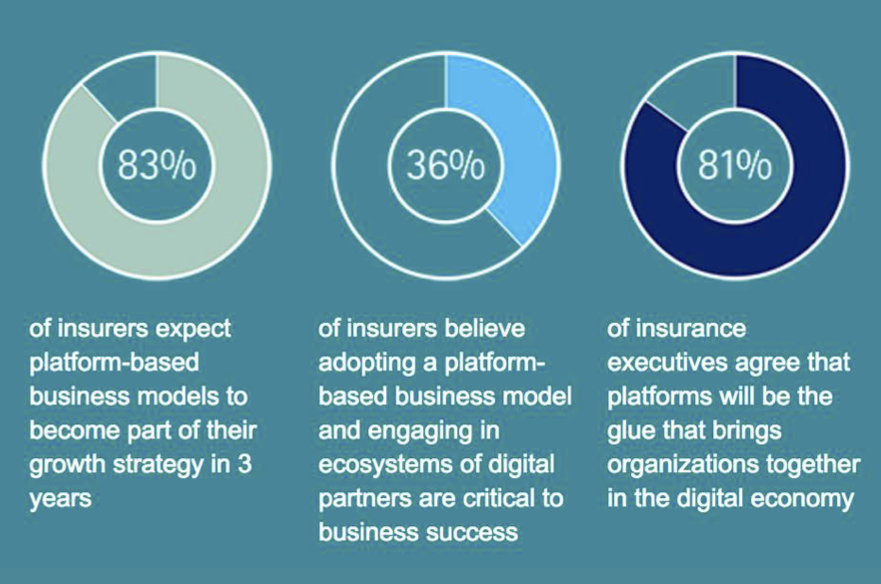
The strategic use of technology to create platform business models is driving growth opportunities is the rapidly expanding digital economy and for insurers. 

Trends/Predictable Disruption 

Fast emerging digital ecosystems create the foundation for the next big wave of enterprise disruption in insurance. 

Forward thinking insurance companies have the line of sight to redefine their role and positioning in the market. Today there is an opportunity, if not a need, to change how carriers create and deliver insurance products. In future posts, I will address the value over and position of the new InsurTech companies Lemonade, Trov and Metromile. 

The survey above raised several questions during our conversation with Daniel. One of the questions was "83% of insurers recognize that IoT will introduce change to the industry. Yet, only 51% of insurers plan to pursue digital initiatives with new partners. Are the insurers planning to grow IoT capacity in-house? Work with old partners? Or, ignore it completely?