
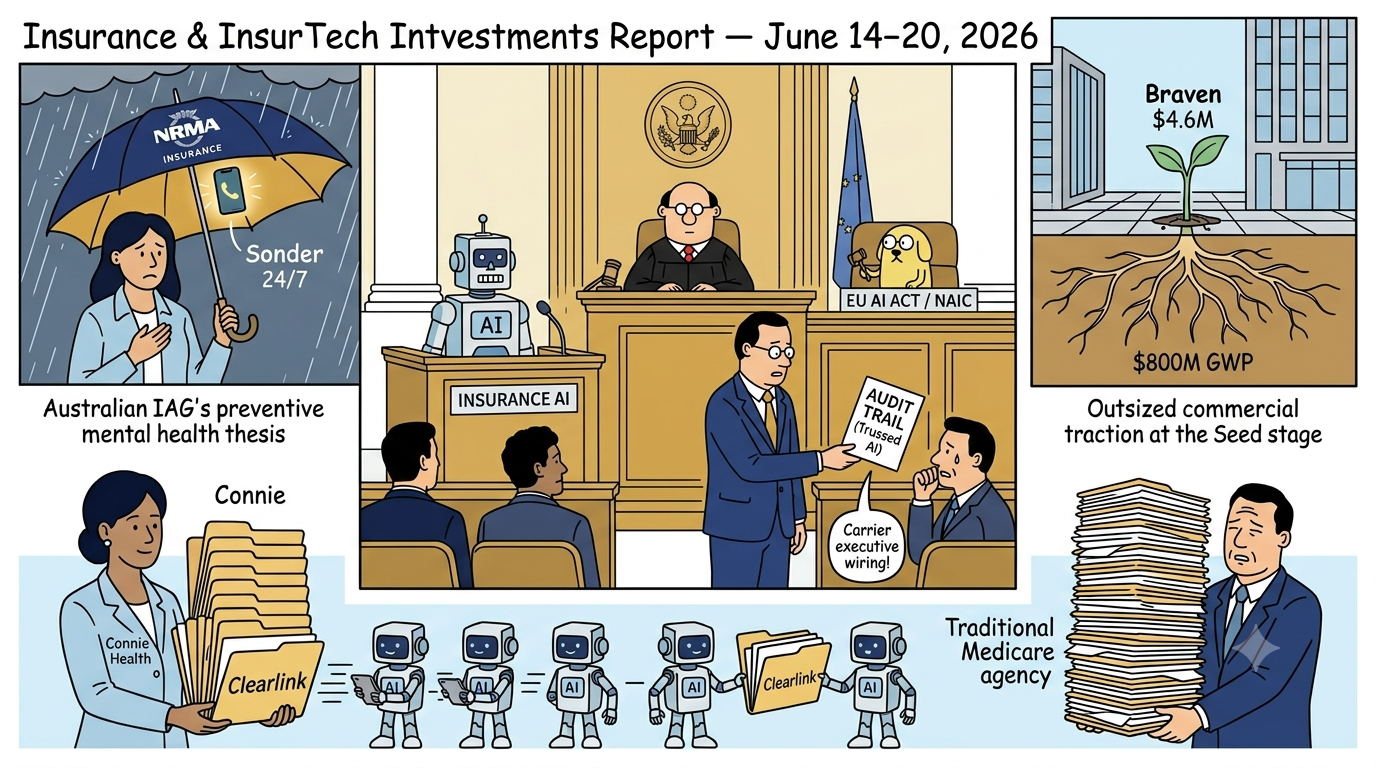
$109.6M+ in disclosed capital | 4 primary transactions + 1 special situation | The AI governance reckoning arrives — and the funnel entrance gets funded
After three consecutive weeks of transactions measured in billions — HHH/Vantage, PayPay/T&D, Nationwide/MassMutual, DB Insurance/Fortegra, ICEYE, Poetic — this week's capital volumes are smaller by an order of magnitude. But the strategic themes are sharper than any week since May. Four primary deals answer the same converging question: as AI becomes embedded in insurance operations at scale, who controls it, who audits it, who is liable for it, and who pays when it fails? Nassau Financial invested in AI governance infrastructure. IAG invested in mental health prevention before claims arrive. Connie Health bought a Medicare book and raised $40M to prove AI-native roll-ups outperform human-led ones. Braven raised $4.6M to rebuild the infrastructure layer beneath insurance operations — not the UI on top of it. And in a Special Situation: PruVen Capital's participation in Gradial's $65M Series C surfaces an emerging pattern that the industry has not yet named — capital flowing into the technology that controls the top of the deal flow funnel, where the next generation of insurance distribution advantage is being built.
1. Connie Health (USA)
$40M Series B + Clearlink Medicare Acquisition | AI-Native Medicare Navigation — 10th Acquisition Date: June 18, 2026
What Happened
Founded by Oded Eran (CEO), Boston-based Connie Health announced simultaneous completion of its $40 million Series B financing and the acquisition and integration of Clearlink Insurance Agency's Medicare business — the company's tenth completed acquisition. Connie Health operates the nation's leading AI-native Medicare navigation platform, combining proprietary AI, intelligent automation, and a network of local agents to help seniors find, enroll in, and maintain optimal Medicare coverage. The Clearlink acquisition adds a large book of Medicare Advantage business with existing agent relationships and policyholder base, fully integrated into Connie Health's platform. Total funding to date: $85 million. The company is also expanding its role as a technology partner to Accountable Care Organizations, health systems, and risk-bearing provider groups — using its AI to connect Medicare beneficiaries to optimal health plans earlier, improving member attribution and quality metrics for value-based care partners.
- Lead investor (Series B): HealthQuest Capital
- Participating investors: JSL Capital, Khosla Ventures (existing), aMoon (existing), Pitango HealthTech (existing)
Use of Funds
- Continue acquisitions — Clearlink is the tenth; further consolidation planned
- Expand AI-driven technology platform and agent network
- Deepen partnerships with ACOs, health systems, and value-based care organizations
- Scale nationally beyond current geographic footprint
Strategic Thesis
Connie Health is executing the Medicare distribution roll-up thesis with a critical differentiator: an AI platform that makes integration cheaper, faster, and more scalable than human-led acquisitions. Ten acquisitions in a company's history at $85 million in total capital — in a category where traditional roll-ups require significant operational headcount to absorb each new book — implies that Connie's AI platform is genuinely compressing the cost of acquisition integration. Oded Eran's framing is precise: "The infrastructure we've built makes Clearlink's scale a perfect fit." That sentence is the investment thesis. Traditional Medicare agencies integrate acquisitions by retraining human agents, rebuilding broker relationships, and migrating policyholder records manually. Connie Health's AI handles the matching, navigation, and enrollment logic — the acquisition becomes a data ingestion event, not an operational rebuild. HealthQuest Capital's lead is strategically significant: the firm's prior portfolio includes HealthEquity, the HSA infrastructure company that scaled from private to a $7B+ public company. The analogical investment thesis — back the infrastructure layer for a new account-based benefits category — is being replicated here in Medicare navigation.
Why It Matters
- Ten completed acquisitions at $85M in total capital demonstrates that AI-native integration genuinely changes the unit economics of Medicare agency roll-ups — this is not a claim, it is an operating history
- HealthQuest Capital's HealthEquity track record is the most relevant prior investment for validating the Medicare navigation infrastructure thesis — the managing partners understand how infrastructure companies in regulated health markets compound in value
- The ACO/health system partnership expansion moves Connie Health from consumer Medicare navigation into B2B2C value-based care infrastructure — a much larger addressable market than direct-to-consumer Medicare alone
Competition
- Direct competitors: Chapter (Medicare advisory platform, founded by ex-Tempus execs), SelectQuote Medicare, GoHealth, eHealth — all operating agent-based or hybrid Medicare distribution
- Category competitors: Traditional Medicare brokerages, carrier direct enrollment platforms, SHIP counselors
- Emerging dynamic: AI-native Medicare navigation is an explicitly contested category — Chapter and Connie Health are the two best-capitalized pure-play platforms; carrier direct enrollment capabilities (UnitedHealth's digital tools, Humana's agent network) represent the structural incumbency
Market Consequences
Traditional Medicare agencies — and larger roll-ups like SelectQuote and GoHealth — face a competitor whose integration costs per acquisition are structurally lower. As Connie Health absorbs more books, its AI models improve on more enrollment data, which compounds the platform's recommendation accuracy and plan-matching precision. Carriers in the Medicare Advantage market face an indirect but real dynamic: as AI-native platforms route more seniors toward optimal plans, adverse selection in less competitive plans (lower star ratings, narrower networks, weaker formularies) accelerates. The carriers with the strongest MA plans benefit from AI-native navigation; those with weaker offerings see accelerated churn.
Bottom line: Ten acquisitions. $85M raised. An AI platform that turns a book of business into a data ingestion event instead of an operational rebuild. Connie Health is proving that AI-native roll-ups outperform human-led ones in Medicare distribution — and HealthQuest Capital, which backed HealthEquity from private to $7B+, just validated the thesis with $40M.
2. IAG Firemark Ventures / Sonder (Australia)
Undisclosed Strategic Investment | Mental Health and Safety Platform — Carrier-as-Prevention Thesis Date: June 15, 2026
What Happened
Insurance Australia Group (ASX: IAG) — Australia's largest general insurer, operating under brands including NRMA Insurance, CGU, WFI, and ROLLiN' — made a strategic minority investment in Sonder through its corporate venture arm IAG Firemark Ventures, led by General Partner Scott Gunther. Sonder is an Australian platform providing 24/7 access to mental health, medical, and safety support through a single mobile-first app — combining GPS-based safety tools, live human responders, and navigation to appropriate care. Founded by Craig Cowdrey (CEO) and co-founders, Sonder previously served primarily corporate clients managing workforce wellbeing. The IAG investment extends Sonder's capability to IAG's policyholders during high-risk moments — specifically, catastrophic weather events and major incidents where psychological harm follows physical damage. The investment is supported by research commissioned by NRMA Insurance in partnership with Lifeline Australia, finding that 61% of Australians reported feeling anxious about extreme weather, and that 42% said weather-related stress affects their daily lives. Amount not disclosed.
- Investor: IAG Firemark Ventures (IAG's corporate venture arm)
- Target: Sonder — 24/7 mental health, medical, and safety platform
- Existing investors: Blackbird Ventures (previous lead), SEEK, Hostplus Super, MA Growth Ventures
Use of Funds
- Extend Sonder's platform to IAG's insurance customers during major weather events and personal crises
- Expand capability from workforce wellbeing (existing B2B model) to policyholder support (new B2B2C channel)
- Deepen the research and data infrastructure linking early mental health intervention to claim outcomes
Strategic Thesis
IAG is making the most direct statement in the insurance industry about what "prevention" actually means when taken seriously. The conventional insurance prevention thesis is physical: sprinkler systems, deadbolts, earthquake retrofits. IAG's Sonder investment argues that psychological intervention at the moment of a catastrophic weather event is equally legitimate prevention — and that an insurer uniquely positioned to deploy that intervention at scale (through its policyholder base) can reduce both the severity and duration of downstream claims. Christine Stasi, IAG Group Executive, stated: "It signals IAG's intent to move beyond claims response towards earlier intervention and prevention. Earlier support in these moments can improve mental health outcomes, helping reduce the broader cost of harm to individuals and communities." The research baseline is specific and actionable: 61% of Australians anxious about extreme weather, 53% making major life changes due to weather stress. As climate-driven events increase in frequency and severity in Australia, the policyholder mental health burden becomes a direct driver of claims severity and duration — and IAG is investing in the infrastructure to intervene before that severity compounds.
Why It Matters
- IAG's Sonder investment is the first major carrier investment in policyholder mental health intervention as a claims prevention tool — establishing a new category of carrier-prevention investment that goes beyond physical risk mitigation
- The research commission (Extreme Weather and Suicidality Report, NRMA/Lifeline) gives IAG proprietary data connecting weather event anxiety to major life decisions — an underwriting intelligence asset that informs prevention strategy and risk selection simultaneously
- The timing is deliberate: Australia is entering an El Niño weather pattern, and IAG is deploying a mental health intervention capability before the next major weather season — not in response to it
Competition
- Direct competitors (Australian mental health/wellbeing platforms): Wellbeing One, Calm (enterprise), Headspace Health Australia — none with IAG-scale insurance distribution
- Category competitors: Employee Assistance Programs (EAPs) used in workers' compensation contexts, clinical psychology networks used post-claim
- Emerging dynamic: The carrier-as-prevention thesis (Mercury/BurnBot in wildfire, IAG/Sonder in mental health, Tomorrow.io/Harel in weather intelligence) is now a global pattern — carriers investing in the infrastructure of harm reduction before claims arrive, not after
Market Consequences
Other Australian general insurers — Suncorp, Allianz Australia, QBE Australia — now face a competitor that offers policyholder mental health support during catastrophic events as a product differentiator. For mass-market policyholders choosing between carriers in a commoditized home and motor insurance market, the availability of 24/7 mental health support during a flood or bushfire is a tangible product difference. If IAG's data shows that early Sonder intervention reduces claims severity or duration, the ROI case for the investment closes quickly and the competitive response from other carriers becomes unavoidable. The deeper strategic signal: IAG is building a data relationship between weather events, policyholder mental health status, and claim outcomes — a longitudinal dataset that no traditional carrier has, and that could inform underwriting, pricing, and risk selection in ways competitors without the data cannot replicate.
Bottom line: IAG just invested in the mental health intervention layer for Australian policyholders facing extreme weather — before the claim arrives, not after. If the data shows it reduces claim severity, every other Australian carrier will follow within 24 months.
3. Braven (USA / UK)
$4.6M Seed | Insurance Operations Infrastructure — $800M GWP on Platform at Seed Stage Date: June 16, 2026
What Happened
Formerly known as Sytrex, San Francisco-based Braven closed a $4.6 million Seed round and simultaneously rebranded, reflecting a shift in strategic positioning from a submissions-process tool to a full infrastructure layer for insurance operations. Founded by Carlos Chávez (CEO, Colombian-born and based), Braven provides an AI-powered infrastructure platform for brokers, MGAs, and reinsurers — automating operational processes inside delegated authority arrangements including data extraction, validation against binder terms, and bordereaux generation. More than $800 million in gross written premium currently flows through Braven's platform across clients in seven countries across three continents. The company is opening a London office — its first international expansion — targeting the UK's delegated authority and specialty insurance markets specifically. Angel investor Matthias Weber, a former global reinsurance executive, participated alongside the VC round.
- Lead investor: Collide Capital
- Participating investors: Fiat Ventures, MGV, Carao Ventures, Angeles VC, Broom Ventures
- Strategic angel: Matthias Weber (former global reinsurance executive)
Use of Funds
- Launch London office — first international expansion; two commercial hires already in place
- Accelerate product development for autonomous AI agent architecture
- Expand operations across Latin America and the United States
Strategic Thesis
Carlos Chávez's founding statement is the sharpest diagnosis of where the insurance industry's AI investment has been misdirected: "The industry does not have a product innovation problem — it has an infrastructure problem. As long as the public conversation remains centred on digitisation, we are simply putting a fresh coat of paint on a broken process." The delegated authority market — where MGAs, coverholders, and binding authorities write business on behalf of carriers through contractual arrangements — is one of the most operationally complex and data-intensive segments in global insurance. It is also one of the most under-served by modern technology. Bordereaux management, binder compliance, and capital flow between counterparties still run largely on spreadsheets and email in most delegated authority operations. Braven is building the infrastructure layer that replaces that process — not with a UI improvement, but with an autonomous AI agent architecture that operates with real-time traceability and intelligent capital flow. $800M in GWP flowing through the platform at Seed stage is the most important data point in the announcement: at that premium volume, with a platform founded by a Colombian team and serving seven countries, Braven has demonstrated that the product works across geographies and carrier structures before raising its first institutional round.
Why It Matters
- $800M in gross written premium on a Seed-stage platform is an extraordinary commercial traction figure — it means Braven's product has been validated at real insurance scale before institutional capital arrived, not after
- The London market is the correct first international expansion target: Lloyd's delegated authority business is the largest and most complex delegated authority ecosystem in the world, and the one where infrastructure problems are most acute and most expensive
- Matthias Weber's participation as a reinsurance angel investor provides both validation and distribution access — a former global reinsurance executive with carrier relationships across the markets Braven is targeting
Competition
- Direct competitors (delegated authority / bordereaux management): Relay (bordereaux management platform), Whitespace (London market digital placement), Ki Insurance (AI-native Lloyd's syndicate)
- Category competitors: Legacy TPA software, spreadsheet-based bordereaux processes, carrier proprietary data management systems
- Emerging dynamic: The London specialty market's Blueprint Two digitization initiative creates institutional demand for infrastructure platforms that can connect to market-wide digital systems — Braven's timing for the London office is deliberate
Market Consequences
Brokers, MGAs, and reinsurers operating in delegated authority markets face a growing compliance and data quality burden as carriers and regulators demand better visibility into binding authority operations. Braven's real-time traceability architecture directly addresses that demand — and at $800M of GWP already on the platform, it has the reference clients to compete for Lloyd's market adoption. Traditional bordereaux management processes — mostly manual, spreadsheet-based, and error-prone — face disruption from a platform that validates against binder terms automatically and generates regulatory reporting without human intervention. For the Latin American insurance markets where Braven was originally built, the London expansion creates a two-way network effect: London market standards applied to LatAm operations, and LatAm operational experience applied to London market digitisation.
Bottom line: $800M in GWP. Seven countries. Seed stage. Braven didn't raise money to build a product — it raised money to scale one that's already working. The London insurance market just got a Colombian-built infrastructure company as its newest competitor.
4. Nassau Financial Group / Trussed AI (USA)
Undisclosed Strategic Investment | AI Governance and Compliance for Regulated Enterprises Date: June 17, 2026
What Happened
Nassau Financial Group — Hartford, Connecticut-based insurance and asset management company with $24.8B in assets under management — made a direct equity investment in Trussed AI through its Nassau Reimagine program, the company's insurtech investment vehicle. Trussed AI, founded in 2023 by Ajay Dankar (CEO), is a Saratoga, California-based AI governance and compliance platform serving regulated enterprises in insurance, financial services, and healthcare. The platform provides visibility, control, and auditability across AI systems — helping organizations manage AI risk, ensure regulatory alignment, and operationalize AI governance frameworks at scale. This is Nassau Reimagine's third direct equity investment, following stakes in Quorus Inc. (Westport, CT) and Kadance Inc. (Alabama) earlier in 2026. Nassau Reimagine has supported more than 100 startups since 2019 and committed $10 million in direct investment capital in 2025. Amount undisclosed.
- Investor: Nassau Financial Group (via Nassau Reimagine)
- Target: Trussed AI — AI governance and compliance platform
- Nassau Reimagine program: $10M committed for direct equity in early/mid-stage Insurtech, Fintech, Retiretech startups
Use of Funds (Nassau Reimagine standard structure)
- Expand Trussed AI's operations and product development
- Accelerate penetration into insurance, healthcare, and financial services verticals
- Build regulatory alignment frameworks as AI governance requirements formalize
Strategic Thesis
Nassau Financial's investment in Trussed AI is the most forward-looking deal of the week — and possibly of the month. Every insurer deploying AI in underwriting, claims, fraud detection, and customer service faces a governance problem that is only beginning to be regulated but will become a compliance obligation within 12–24 months. The EU AI Act's requirements for high-risk AI systems — including insurance underwriting and claims — are creating a new category of regulatory exposure that insurers cannot address with existing compliance infrastructure. Trussed AI's platform provides the auditability, explainability, and control layer that regulators will require: who made the AI decision, on what inputs, under what governance framework, with what human oversight. Nassau is not investing in Trussed AI because it currently needs the product. It is investing because it knows it will need the product, and because being an early customer and investor provides both capability access and competitive intelligence on where AI governance regulation is heading. Ajay Dankar's framing — "regulated enterprises face mounting pressure to deploy AI responsibly while meeting evolving compliance and risk management requirements" — is the understatement of the week. The pressure is not evolving. It is arriving.
Why It Matters
- Nassau's investment signals that forward-thinking insurance carriers are already planning for AI governance compliance obligations that have not yet formally arrived in the U.S. — a 12–24 month leading indicator of where insurance AI regulation is heading
- Every insurer deploying AI in underwriting or claims without an audit trail faces regulatory exposure — Trussed AI's platform is the infrastructure that converts that exposure into a managed compliance posture
- Nassau Reimagine's $10M direct investment program — with 100+ startup relationships and now three direct equity investments in 2026 — is emerging as one of the most active carrier-CVC vehicles in the mid-market, below the scale of Allianz X or PruVen but more systematically organized than most carrier innovation programs
Competition
- Direct competitors (AI governance platforms): Holistic AI, Credo AI, Arthur AI, Monitaur (insurance-specific AI governance)
- Category competitors: Big Four consulting firms building AI governance practices (Deloitte, PwC AI Trust frameworks), regulatory compliance software vendors extending into AI
- Emerging dynamic: As EU AI Act implementation accelerates and U.S. state-level AI regulation emerges (Colorado, California leading), insurance-specific AI governance will move from optional best practice to mandatory compliance infrastructure within 24 months
Market Consequences
Every insurer currently deploying AI in high-risk decision categories — underwriting, claims, fraud, pricing — without a structured governance framework is accumulating regulatory exposure that compounds as regulatory frameworks formalize. Trussed AI's platform, backed by an insurance carrier with $24.8B in AUM and strong regulatory relationships, has a natural distribution channel through Nassau's network and a credibility signal that pure-VC-backed AI governance startups cannot replicate. For competing AI governance platforms without insurance-specific backing, Nassau's investment in Trussed AI creates a reference customer and strategic validator in the exact vertical where governance requirements are most acute. For insurers still treating AI governance as a future consideration, Nassau's investment is a leading indicator: the carriers thinking about this today will have audit-ready AI infrastructure when regulators ask. The ones that don't will be explaining their AI governance posture under adverse regulatory conditions.
Bottom line: Nassau just backed the audit trail that regulators will require every insurer to have for AI underwriting and claims decisions. The EU AI Act is already in force. U.S. state regulation is 12–24 months behind it. The insurers investing in AI governance infrastructure now are buying time. The ones that don't are buying risk.
⭐ Special Situation: Gradial / PruVen Capital (USA)
$65M Series C at $675M Valuation | Agentic Marketing AI — The Deal Flow Funnel Thesis Date: June 17–18, 2026
(Note: Gradial is an enterprise marketing AI platform, not an insurance company. Included as a Special Situation because PruVen Capital — the multi-carrier insurance CVC syndicate on the weekly watchlist — participated alongside Insight Partners. More importantly, Gradial represents an emerging investment pattern with direct implications for insurance distribution economics: capital flowing into the technology that controls the top of the deal flow funnel.)
What Happened
Seattle-based Gradial (formally Panorama Artificial Intelligence Corp.) closed a $65 million Series C at a $675 million valuation, led by Insight Partners. Existing investors VMG Partners, Madrona, and PruVen Capital participated. Gradial builds an agentic AI operating system for enterprise marketing — deploying AI agents that autonomously manage the entire content supply chain across tools including Adobe Experience Manager, Salesforce, ServiceNow, and Databricks. Named enterprise customers include AWS, Prudential, T-Mobile, Vanguard, Kaiser Permanente, and US Bank. ARR grew more than 10x in the past 12 months. The company has raised over $110 million in 16 months across Seed, Series A ($13M, March 2025, Madrona), Series B ($35M, December 2025, VMG), and now Series C.
Why PruVen's Participation Here Is Strategically Interesting
PruVen Capital is a multi-carrier insurance CVC syndicate — its LPs include Prudential, TIAA, Lincoln Financial, Mutual of Omaha, Nippon Life, Generali, and WTW. Its investments are typically in insurtech, fintech, and adjacent enterprise infrastructure. Gradial is none of those things in the traditional sense. But Prudential is a named Gradial customer — and PruVen's investment in a company that automates content operations across Prudential's marketing stack reflects a thesis that the insurance industry has not yet articulated clearly but is beginning to act on: the companies that control how insurance is discovered, explained, and converted at the top of the funnel determine who wins the underlying risk.
The Emerging Pattern: Investing in the Funnel Entrance
Gradial is not an isolated data point. It is the clearest expression yet of a capital allocation pattern that has been quietly building across insurance for 18 months: investment flowing into the technology layer that determines how insurance products are found, marketed, and converted — before underwriting, before pricing, before the policy is bound.
The pattern has three distinct expressions:
1. Agentic marketing operations (Gradial) Gradial's AI agents don't just generate content — they run the compliance review, brand validation, accessibility check, asset tagging, and publication workflow autonomously. For an insurer like Prudential managing thousands of product variants across multiple distribution channels and regulatory jurisdictions, the content supply chain is operationally as complex as claims processing. Gradial compresses the cycle time from brief to live from weeks to minutes. At 10x ARR growth in 12 months, the market is validating the thesis.
The insurance implication is deeper than operational efficiency. Generative engine optimization — Gradial's term for the new SEO — describes the shift from Google search rankings to AI search answers. When a consumer asks Claude or ChatGPT "what's the best health insurance for a small business with 12 employees," the answer is shaped by the content that AI systems have indexed, not by which company paid more for a keyword. Insurers that control their AI-indexed content at scale will appear in those answers. Those that don't will not be in consideration at the moment the purchase decision forms.
2. Media-for-equity (Ad4Ventures / ViteSicure) In April 2026, Italian life insurtech ViteSicure raised €2.5M in its Series A first tranche with Ad4Ventures — the venture capital arm of MFE-MediaForEurope (Mediaset) — as a lead investor. Ad4Ventures' model is explicit: it takes equity stakes in B2C companies with high growth potential and provides media inventory across Italy's and Spain's largest television and digital networks as the primary value contribution alongside cash. For ViteSicure, the investment means CAC-efficient brand exposure across Mediaset's national broadcast and digital reach — access that cash-funded digital competitors pay market rates to approximate.
This is the media-for-equity model applied to insurance distribution: a fund takes equity in the insurer in exchange for the distribution channel itself. The insurer gets a structural customer acquisition advantage; the media company gets equity upside in a growing consumer brand. The parallel to insurance float investing is conceptually sharp — instead of investing premiums to generate returns, the media company invests distribution capacity to generate equity. The return comes not from investment income but from brand value and market share growth in the portfolio company.
3. AI-native distribution platforms (Connie Health, Outmarket AI, Pace) Connie Health, covered above, is the most advanced version of this thesis: an AI platform that routes Medicare beneficiaries to optimal health plans is simultaneously a distribution infrastructure company and an underwriting intelligence asset. The data generated by routing 40,000+ seniors through plan selection informs which plans have the best outcomes for which demographic profiles — a feedback loop that compounds the platform's recommendation accuracy and, eventually, its ability to inform carrier underwriting.
Outmarket AI (Week 20) and Pace (Week 22) represent the same pattern at the agency and carrier operations layer: AI tools that improve how brokers and carriers identify, qualify, and convert prospects generate proprietary data about what customer and risk profiles convert most successfully — data that flows back into underwriting and pricing decisions.
The Thesis in One Paragraph
The insurance industry has historically separated distribution (who finds the customer) from underwriting (who prices the risk). Those functions are converging. The companies that control the top of the funnel — through AI-native content operations (Gradial), media-for-equity distribution (Ad4Ventures/ViteSicure), or AI-native navigation platforms (Connie Health) — are generating data about customer intent, acquisition economics, and risk profile at the moment of first contact. That data, compounded over millions of interactions, becomes a proprietary underwriting asset. The carriers and platforms that own the funnel entrance will price risk more accurately than those that buy leads from intermediaries and never see the behavioral data generated upstream.
PruVen Capital investing in Gradial is a small signal of this larger convergence. The insurance carriers that understand it will stop treating marketing and underwriting as separate budget lines. The ones that don't will pay customer acquisition costs to platforms that own the funnel data they need.
Bottom line: PruVen backed an enterprise marketing AI because Prudential is already using it — and because the company that controls how insurance is discovered in an AI-search world controls something more valuable than a distribution channel. It controls the moment a customer decides they want coverage at all.