
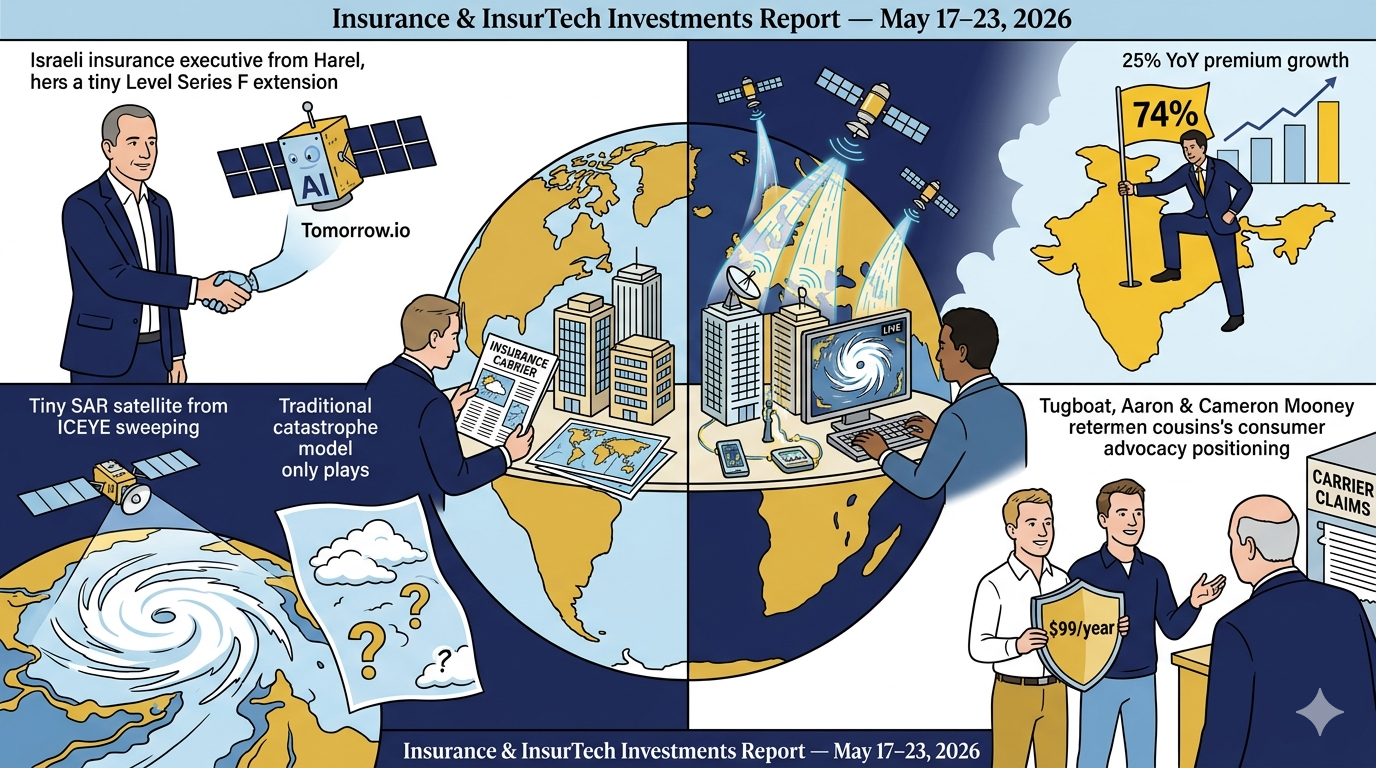
$370M+ in disclosed investment activity | 4 transactions | Space, satellites, and India dominate
A quieter week by deal count — but not by strategic significance. Three of this week's four transactions involve insurance carriers investing in or committing capital to data and intelligence infrastructure they do not build internally: satellite-based catastrophe monitoring, AI weather intelligence, and a deepening equity commitment in one of the world's fastest-growing insurance markets. The fourth is a small but sharp consumer advocacy play attacking the same claims dysfunction that Reserv is automating from the carrier side. The through-line: insurance's competitive frontier is increasingly defined by who controls the data that flows into underwriting and claims decisions. This week, two global carriers made that bet with real capital.
1. Tomorrow.io (USA / Israel)
$35M Series F Extension | AI Weather Intelligence & Resilience Platform (Harel Insurance Strategic) Date: May 18, 2026
What Happened
Founded by Shimon Elkabetz (CEO) and Rei Goffer (President), Boston-based Tomorrow.io is the world's leading AI weather intelligence and resilience platform, operating a proprietary constellation of microwave sounder satellites (Gen1: 11 satellites at global 60-minute revisit rate) alongside its generative AI forecasting engine. The company announced a $35M extension to its Series F, bringing the total round to $210M. The Series F was originally announced at $175M earlier in 2026, led by Stonecourt Capital and HarbourVest Partners, and was raised to support deployment of DeepSky — described as the world's first AI-native weather satellite constellation. The $35M extension comes from existing investor Pitango (Israel's largest VC fund, $3B+ AUM across 13 funds, 91 exits/IPOs) and its partner Harel Insurance — one of Israel's largest insurance and financial services groups, participating as a strategic investor alongside Pitango's continued conviction.
- Lead (extension): Pitango (existing investor, follow-on)
- Strategic investor: Harel Insurance (new, strategic minority via Pitango partnership)
- Existing Series F investors: Stonecourt Capital, HarbourVest Partners
- Total Series F: $210M
Use of Funds
- Accelerate AI capabilities across the platform
- Expand the DeepSky space-based observation network
- Advance development of Tomorrow.io's agentic resilience platform — converting real-time weather and atmospheric data into autonomous operational guidance
Strategic Thesis
Harel Insurance is not investing in a weather company. It is investing in the data infrastructure that will define catastrophe underwriting accuracy for the next decade. Tomorrow.io's proprietary satellite constellation generates atmospheric data that no commercial weather service provides — real-time, high-resolution, and available regardless of cloud cover or time of day. For a carrier underwriting property, agricultural, energy, or logistics risk, access to that data layer before it becomes an industry standard is a structural underwriting advantage. This is the fourth consecutive week in which a global insurer has taken a strategic minority position in an adjacent data infrastructure company — Allianz/Entrix (energy data), Tokio Marine/Cierpa (ESG data), Mercury/BurnBot (wildfire physical data), and now Harel/Tomorrow.io (weather intelligence). The pattern is no longer emerging. It is a defined carrier strategy.
Why It Matters
- Harel Insurance's participation through Pitango gives it access to Tomorrow.io's proprietary weather intelligence platform at a moment when AI-native satellite constellations are still early — the data advantage compounds from the point of investment forward
- Tomorrow.io's DeepSky constellation, once fully deployed, will provide atmospheric observation capabilities that existing industry models (NOAA, European Centre, commercial reinsurer cat models) cannot match on latency or resolution
- The agentic platform development signals Tomorrow.io's ambition to move from data provider to autonomous decision support — an AI layer that doesn't just inform insurance underwriting but executes operational responses to weather events in real time
Competition
- Direct competitors (weather intelligence): The Weather Company (IBM), DTN, ClimaCell predecessors, Meteomatics, Understory
- Category competitors: Cat modeling firms (RMS, AIR Worldwide/Verisk, KCC), reinsurer proprietary models, government weather services (NOAA, ECMWF)
- Emerging dynamic: Satellite-native weather intelligence (Planet Labs, Spire Global) competing for the proprietary constellation data layer
Market Consequences
Traditional catastrophe modeling firms — RMS (Moody's), AIR Worldwide (Verisk), and KCC — sell their models to carriers as licensed black boxes. Tomorrow.io's architecture inverts that model: proprietary satellite observations feed an AI platform that provides real-time, observed data rather than modeled estimates. Carriers accessing Tomorrow.io's data make underwriting decisions based on what is actually happening in the atmosphere, not what a simulation says should be happening. Harel's strategic investment accelerates Tomorrow.io's commercial relationships within the insurance vertical, which already includes reinsurers and specialty carriers as clients. For carriers underwriting climate-exposed risk without equivalent data partnerships, the gap between modeled and observed catastrophe intelligence — and its impact on pricing accuracy — will widen every year as Tomorrow.io's constellation grows.
Bottom line: Harel Insurance just bought early access to the data layer that will define catastrophe underwriting accuracy for a generation. Every carrier still relying on licensed cat models for climate-exposed risk is pricing with yesterday's tools.
2. Liberty Mutual / Liberty General Insurance (USA / India)
Stake Increase to 74% | India P&C Market Expansion Date: May 18, 2026
What Happened
Liberty Mutual Insurance announced it has increased its shareholding in Liberty General Insurance Limited (LGI) to 74%, held through its subsidiary Summit Asia Investments Holdings Pte. Ltd. This follows a prior increase from 49% to 55.40% in September 2025 — two significant equity increases in eight months. The remaining 26% is held by Enam Securities. LGI was originally founded in 2013 as a joint venture with the Videocon Group (renamed Liberty Videocon General Insurance), transitioned to its current structure after Videocon's exit and DP Jindal Group's involvement, and now operates as India's leading independent P&C insurer with 1,300+ employees, presence in 95+ locations across 28 states and Union Territories, 6,500+ hospital partners, and 6,100+ auto service centers. In FY2026, LGI's gross direct premium underwritten rose 25.31% year-on-year to ₹2,814.82 crore — nearly 3.2x the general insurance industry's 8% YoY growth rate in the same period.
- Acquirer: Liberty Mutual Insurance (via Summit Asia Investments Holdings Pte. Ltd.)
- Sellers: DP Jindal-owned Diamond Dealtrade and other existing minority holders (exiting)
- Matthew Jackson, President, Liberty International Insurance APAC, led the transaction
Use of Funds
- Proceeds to exiting minority shareholders
- Capital commitment signals acceleration of LGI's distribution expansion across retail and commercial lines in India
- Deepens Liberty Mutual's direct operational control over a market growing at 3x industry rate
Strategic Thesis
This is a direct and deliberate response to India's Insurance Laws (Amendment) Act, 2025 — which took effect February 5, 2026, raising the FDI cap in Indian insurance companies from 49% to 100% under the automatic route. Liberty Mutual moved immediately: from 55.40% in September 2025 to 74% in May 2026. The FDI regulatory change effectively converted India's insurance market into a fully contestable foreign investment arena overnight. Liberty Mutual's speed — two stake increases in eight months, now at the new ceiling before competitors have completed their own analysis — signals that it views India not as a developing market investment but as a core strategic growth market for APAC. LGI's 25.31% premium growth in FY2026, at a time when the Indian general insurance industry grew 8%, validates the operating model.
Why It Matters
- India's general insurance market is structurally underpenetrated — insurance penetration sits at approximately 1% of GDP versus a global average of approximately 3.8% — the headroom for growth is generational, not cyclical
- LGI's 25.31% FY2026 premium growth at 3x industry rate demonstrates that the platform is already outperforming, not just theoretically positioned
- Liberty Mutual is taking this position at 74% before competitors complete their FDI regulatory analysis — first-mover equity control in a 100% FDI-permitted market is a durable strategic advantage
Competition
- Direct competitors (India P&C): New India Assurance (state-owned market leader), ICICI Lombard, Bajaj Allianz General Insurance, HDFC ERGO, Tata AIG
- Incoming foreign competitors: Zurich, Chubb, AXA, and Allianz all evaluating India equity increases under the new 100% FDI framework
- Structural dynamic: Public sector insurers (New India, United India, Oriental, National) retain distribution advantages but face growing private sector competition in commercial and retail lines
Market Consequences
The 100% FDI notification is the starting gun for a foreign carrier equity race in Indian insurance. Liberty Mutual, already operational and growing at 3x industry rate, holds an incumbent advantage over greenfield entrants who must build distribution networks, carrier relationships, and brand from scratch. Foreign carriers entering India for the first time face 12–18 months of regulatory setup before writing a single rupee of premium. Liberty Mutual is already writing ₹2,814.82 crore and growing. The competitive threat to domestic private carriers (ICICI Lombard, Bajaj Allianz, HDFC ERGO) is real: foreign ownership of up to 100% means global capital and technology can now be fully deployed behind Indian insurance licenses without structure limitations. The medium-term outcome is a more competitive, better-capitalized, more technology-intensive Indian P&C market — which is structurally good for insurance penetration and structurally challenging for incumbents with legacy operating cost structures.
Bottom line: India just opened its insurance market to 100% foreign ownership. Liberty Mutual was already there, already growing at 3x industry rate, and just locked in majority control before the race begins.
3. Tugboat (USA)
$2.8M | Consumer Claims Advocacy Platform for Homeowners Date: SEC filing May 15, 2026 / Announced May 19, 2026
What Happened
Founded by cousins Aaron Mooney and Cameron Mooney (CEO) — both former insurance adjusters who handled thousands of claims nationwide across dozens of carriers before switching to policyholder advocacy — Tugboat is a Grand Forks, North Dakota-based consumer claims advocacy and support platform for homeowners. The company raised approximately $2.77M as part of a $4M offering per a recent SEC Form D filing (10 investors as of May 15, 2026). Tugboat offers three service tiers: a free Disaster Recovery tier (60-day claim support for federally declared disaster victims, then $99/year); a Home Protection membership ($99/year: policy reviews, home inventory tools, documentation support, online claim assistance); and a higher-tier concierge option for complex denied or underpaid claims. The company assists homeowners with denied claims, underpaid settlements, contractor estimate comparisons, and claim documentation.
- Investors: 10 undisclosed investors per SEC Form D filing
Use of Funds
- Platform development and expansion of membership tooling
- Geographic expansion beyond current footprint
- Build toward the $4M offering total (currently $2.77M raised)
Strategic Thesis
Tugboat is attacking insurance from the consumer side of the same claims dysfunction that Reserv addresses from the carrier side. The founding team's insight is simple and correct: insurance companies have teams, systems, and data on their side of every claim. Policyholders have their policy, their phone, and whatever they can figure out themselves. The information asymmetry is structural and deliberate. Tugboat converts former adjusters — people who spent careers on the carrier side — into policyholder tools. Aaron and Cameron Mooney saw the pattern repeatedly: average homeowners with average claims had no effective recourse for denials or underpayments because public adjusters and attorneys only work on large claims with contingency fee upside. The $99/year membership model gives every homeowner access to the expertise that was previously only available to the wealthy or the catastrophically harmed.
Why It Matters
- The founding team built this product from the inside — both co-founders worked as insurance adjusters before pivoting to policyholder advocacy, giving them carrier-side institutional knowledge that consumer-facing competitors without this background cannot replicate
- The claims underpayment and denial problem is large, real, and growing: as carriers tighten coverages, introduce more exclusions, and increase deductibles in catastrophe-exposed markets, the average homeowner's claim outcome is getting worse, not better
- Tugboat's free Disaster Recovery tier — targeting federally declared disaster victims — is a customer acquisition strategy disguised as a social good: the highest-need, highest-advocacy-value users enter free and convert to paid members
Competition
- Direct competitors: Claimzippy, ClaimMate, PublicAdjusterFinder.com, individual licensed public adjusters
- Category competitors: Attorneys specializing in insurance bad faith, state insurance commissioner complaint processes, insurance coaching services
- Emerging dynamic: AI-native claims assistance tools (DoNotPay adjacents, Lemonade's AI Jim for the carrier side) potentially entering consumer advocacy
Market Consequences
Carriers facing increased Tugboat-assisted claims will encounter better-documented, better-supported, and more knowledgeable claimants. The asymmetry that allows claims departments to delay, underpay, or deny average policyholders gets compressed as tools like Tugboat scale. This is not primarily a competitive threat to other insurtechs — it is a structural pressure on carrier claims practices. As Tugboat's membership grows and its documentation tools become more standardized, it will generate data on the patterns of denial and underpayment that currently exist only inside carrier claims systems. That data, at scale, becomes a regulatory and litigation asset. Small raise. Large structural ambition.
Bottom line: Two former insurance adjusters built the tool they wish policyholders had when they were on the other side of the claim. At $99 a year, the average homeowner can now afford to fight back.
Special Situation: ICEYE (Finland) — €300M Revolving Credit Facility
€300M (~$330M) | SAR Satellite Constellation — Not Pure Insurance, But Critical Infrastructure Date: May 21, 2026
(Note: ICEYE is primarily a defense and sovereign intelligence company. Included as a Special Situation because insurance is a named commercial vertical with Swiss Re, Juniper Re, AXA, and Insurity as named clients, and because the scale of this facility — a €300M institutional bank syndicate — signals the company's arrival as a globally bankable credit with direct implications for insurance data infrastructure.)
What Happened
Founded by Rafal Modrzewski (CEO) and Pekka Laurila, ICEYE is a Helsinki-based spacetech company operating the world's largest SAR (synthetic aperture radar) satellite constellation — 70 satellites in orbit as of March 2026, with six more launched on SpaceX's Transporter-16 in March and further launches planned. SAR satellites capture imagery in all weather conditions, day or night, with resolutions down to 16 cm at a 400 km imaging swath. ICEYE announced a €300M three-year committed revolving credit facility (RCF), backed by a seven-bank syndicate of Nordic, regional, and global lenders, with Citi and Danske Bank as Joint Global Coordinators and Mandated Lead Arrangers. The RCF stacks on top of a €150M Series E (December 2025, led by General Catalyst at a €2.4B valuation) and a €158M Finnish Defence Forces SAR-satellite contract. Total equity funding now exceeds €600M across 17 rounds. Revenue exceeded €250M in 2025; the company doubled in size and guided for similar 2026 growth.
- Lenders: Seven-bank syndicate (Nordic, regional, and global banks; names not disclosed)
- Joint Global Coordinators: Citi, Danske Bank
- Insurance clients: Swiss Re, Juniper Re, AXA (commercial risk management), Insurity
Why Insurance Should Care
ICEYE's SAR constellation is what catastrophe monitoring infrastructure looks like when it works. Standard optical satellites cannot image through cloud cover — which is precisely when hurricanes, floods, and wildfires are most active and most damaging. ICEYE's SAR constellation does not have that limitation. It produces near-real-time imagery of every insured location affected by a catastrophe event, in all weather, from any angle, at resolutions that allow building-level damage assessment. Swiss Re, Juniper Re, and AXA are not using ICEYE as a novelty — they are using it to accelerate claims triage, quantify portfolio exposure during active events, and price re/insurance risk with observed data rather than modeled estimates. The €300M RCF is the institutional banking system confirming that ICEYE has crossed from venture-backed startup to bankable infrastructure company. Citi's participation as a Global Coordinator is the decisive signal — Citi does not co-lead corporate credit facilities for companies it views as speculative.
The insurance implication: As ICEYE's constellation scales toward its planned size, the gap between carriers with access to near-real-time SAR catastrophe imagery and those without will translate directly into claims response speed, reserve accuracy, and reinsurance pricing precision. The carriers already in ICEYE's client base are building that advantage now.
Bottom line: ICEYE just became a bankable credit. The insurance carriers already using its SAR imagery for catastrophe monitoring are building an underwriting and claims intelligence advantage that their competitors will spend years trying to replicate.
Tomorrow.io · Harel Insurance · Pitango · ICEYE · Liberty Mutual · Liberty General Insurance · Tugboat · Shimon Elkabetz · Rei Goffer · Rafal Modrzewski · Aaron Mooney · Cameron Mooney · Matthew Jackson · Parag Ved · DeepSky · SAR Satellite · AI Weather Intelligence · Catastrophe Monitoring · India Insurance · FDI · 100% FDI India · Claims Advocacy · Homeowners Insurance · Data Infrastructure · Space · Israel · India · Finland · USA