
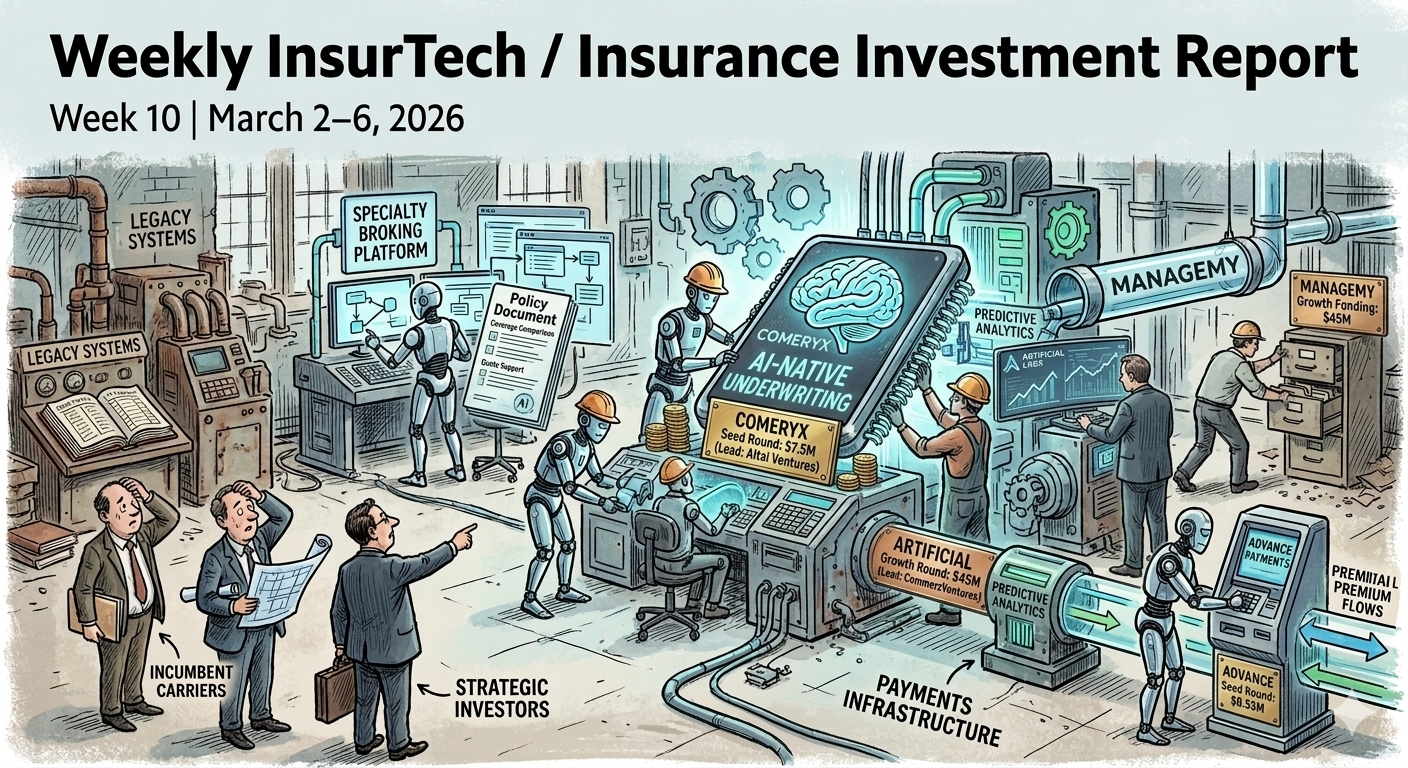
Week 10 | March 2–6, 2026
1. Comeryx Insurance (AI-Native Commercial MGA, US) — Seed Round
USD 7.5M seed | Lead investor: Altai Ventures | Strategic investors: American Family Ventures, Intact Ventures, Arch Capital Group, Boulder Ventures, Echelon
What happened
Comeryx Insurance launched publicly with a USD 7.5M seed round to build an AI-native commercial MGA. The financing closed prior to the announcement and supports the company’s initial market entry.
Strategic thesis
Comeryx is building an MGA designed around AI agents embedded across underwriting and servicing workflows.
Rather than layering AI onto legacy systems, the company is designing a fully AI-native underwriting stack aimed at commercial insurance distribution through brokers.
Strategic investors include multiple carriers and insurance venture arms, suggesting early industry alignment.
Why it matters
- One of the clearest examples of the emerging AI-native MGA model.
- Strong participation from strategic insurers signals carrier appetite for early exposure to AI infrastructure.
- Demonstrates that new MGA launches can now begin with AI-driven underwriting automation built into the core platform.
Competitive impact
- Raises expectations for automation capabilities among new MGAs.
- Adds pressure on legacy MGAs reliant on manual underwriting processes.
- Creates another venture-backed competitor for commercial lines distribution.
Bottom line
AI-native MGAs are emerging as a new category — startups designed from day one around automated underwriting and digital distribution.
2. Artificial Labs (Insurance Infrastructure / Digital Broking Platform, UK) — Growth Round
USD 45M funding round | Lead investor: CommerzVentures | Investors: Augmentum Fintech, Move Capital, 6 Degrees Capital, FOM, TrueSight Ventures
What happened
Artificial Labs raised USD 45M to expand its digital broking and underwriting workflow platform, with plans to double headcount and expand into the US market.
Strategic thesis
Artificial Labs focuses on digitizing the broker-underwriter placement process, particularly within specialty insurance markets such as the London Market.
The platform modernizes workflows around quoting, risk placement, and underwriting collaboration.
The funding will accelerate global expansion and strengthen its position as infrastructure for specialty insurance trading.
Why it matters
- Specialty insurance remains heavily reliant on legacy systems and manual processes.
- Platforms like Artificial Labs aim to modernize high-value commercial risk workflows.
- US expansion signals a push beyond the London Market into global specialty distribution.
Competitive impact
- Increases pressure on legacy broker management and policy administration vendors.
- Positions Artificial Labs as a digital infrastructure layer for complex commercial placements.
- Could accelerate broader modernization of specialty insurance markets.
Bottom line
Artificial Labs is betting that the next wave of InsurTech value lies in digitizing specialty insurance workflows, not reinventing distribution.
3. ManageMy (Broker and Policy Management Platform) — Growth Funding
USD 45M funding | Investors not fully disclosed
What happened
ManageMy secured USD 45M to expand its cloud-based broking, underwriting, and policy management platform globally.
Strategic thesis
ManageMy provides a modular platform designed to replace traditional broker management and policy systems with a cloud-native configurable architecture.
The company is targeting brokers, MGAs, and insurers seeking faster deployment and modern workflow tools.
Why it matters
- Core insurance systems remain a major bottleneck for operational modernization.
- Cloud-native platforms promise faster implementation and lower operational complexity.
- Demand for configurable infrastructure continues to grow among MGAs and brokers.
Competitive impact
- Adds pressure on legacy PAS and broker management systems.
- Accelerates shift toward modular insurance technology stacks.
- Reduces switching barriers for brokers moving away from legacy systems.
Bottom line
Modern infrastructure vendors continue to chip away at the dominance of legacy insurance core systems.
4. Advance (Insurance Payments Infrastructure, US) — Seed Round
USD 8.55M seed round | Investors not fully disclosed
What happened
Advance raised USD 8.55M in seed funding to build a payments platform focused on premium management for brokers and intermediaries.
Strategic thesis
The company is modernizing insurance payments by automating:
- Premium collection
- Payment reconciliation
- Broker settlement workflows
Payments infrastructure remains fragmented across the insurance ecosystem.
Why it matters
- Insurance payments remain one of the least digitized operational areas.
- Premium flow management can significantly reduce administrative costs for intermediaries.
- Embedded payments are becoming a core layer of the insurance technology stack.
Competitive impact
- Challenges traditional premium finance and payment processing providers.
- Improves operational efficiency for brokers and MGAs.
- Strengthens the ecosystem of “picks-and-shovels” InsurTech infrastructure.
Bottom line
Payments modernization is emerging as a key layer in the insurance technology stack.
5. Qumis (AI Coverage Intelligence Platform, US) — Seed Round
USD 4.3M seed | Lead investor: MTech Capital | Strategic investor: American Family Ventures
What happened
Qumis raised USD 4.3M to build AI tools designed to analyze insurance policies and automate coverage intelligence.
Strategic thesis
The company is developing attorney-trained AI models capable of interpreting policy language and assisting with coverage analysis.
Potential applications include:
- Automated policy review
- Coverage comparison
- Quote support
Why it matters
Coverage analysis is traditionally performed through manual legal review, which is expensive and time-consuming.
AI-driven policy interpretation could significantly reduce the cost and time involved in coverage analysis.
Competitive impact
- Introduces automation into an area traditionally dominated by legal expertise.
- Could accelerate quoting and policy analysis in commercial lines.
- Raises expectations for AI-assisted underwriting workflows.
Bottom line
AI is beginning to move into one of insurance’s most complex areas: policy interpretation.
6. Gradient AI (Insurance AI Platform, US) — Growth Capital Financing
Undisclosed growth capital facility | Investor: CIBC Innovation Banking
What happened
Gradient AI secured growth capital financing from CIBC Innovation Banking to support expansion of its underwriting and claims AI platform.
Strategic thesis
The company provides predictive analytics and machine learning models used by insurers for:
- underwriting risk assessment
- claims prediction
- loss ratio optimization
The financing structure is debt-based rather than equity.
Why it matters
Growth debt financing suggests lenders see predictable SaaS revenue and strong enterprise adoption.
This reflects increasing maturity within AI-driven insurance technology platforms.
Competitive impact
- Provides capital for platform expansion without equity dilution.
- Reinforces AI analytics as a core operational capability for insurers.
- Intensifies competition among AI underwriting and claims vendors.
Bottom line
AI insurance infrastructure is beginning to reach late-stage enterprise software maturity.
Strategic Themes This Week
1. Infrastructure dominates InsurTech funding
Most capital is flowing toward backend insurance technology, including:
- underwriting platforms
- policy management systems
- payments infrastructure
- AI analytics
Consumer-facing InsurTech models remain relatively quiet.
2. AI is moving into core insurance decisions
Several deals target AI applications in:
- underwriting
- claims prediction
- coverage analysis
This signals a shift from customer-facing automation to core insurance decision systems.
3. Strategic insurer investors remain active
Carrier-backed venture arms continue to participate in deals, including:
- American Family Ventures
- Intact Ventures
- Arch Capital
- MassMutual Ventures
These investments provide insurers early exposure to emerging technologies.
Bottom Line
The InsurTech investment landscape continues shifting toward infrastructure and AI-driven operational tools.
Rather than disrupting insurers directly, many startups are building the technology layers that will power the next generation of insurance operating systems.
Gilad Shai