
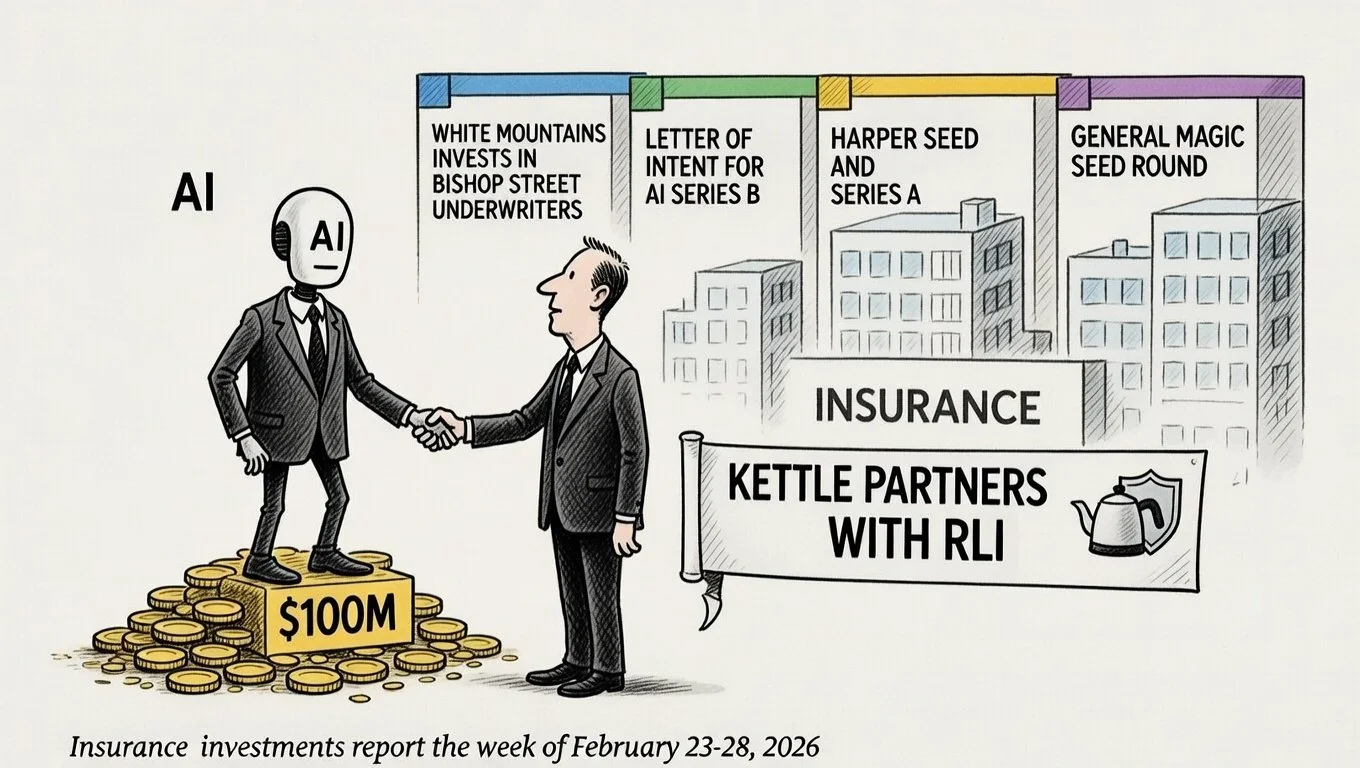
This week’s transactions reinforce three structural shifts: (1) PE-scale capital flowing into MGA platforms, (2) AI-native models reshaping brokerage and workflow economics, and (3) rated carriers using equity—not just paper—to secure differentiated underwriting partners.
1. White Mountains Insurance Group → Bishop Street Underwriters
Announcement: Feb 26–27, 2026 Status: Completed strategic structured investment
Capital: USD 125 million
Transaction Overview White Mountains deployed structured capital into Bishop Street, a RedBird Capital-backed MGA platform. The investment is positioned to support underwriting team recruitment, M&A, new program launches, and international expansion.
Strategic Rationale
- Consolidate elite underwriting talent
- Expand global MGA footprint
- Fund inorganic growth
- Increase negotiating leverage with capacity providers
Primary Competitors
- PE-backed MGA aggregators (e.g., BroadStreet-style rollups, specialty program platforms)
- Carrier-owned program administrators
- Large independent program managers competing for specialty talent and distribution
Impact on Competition
- Raises capital and scale requirements in the MGA platform space
- Increases competition for underwriting teams and specialty program capacity
- Strengthens Bishop Street’s position as a preferred partner for carriers and reinsurers
- Marginalizes undercapitalized or regionally constrained MGAs
2. Letter AI – Series B
Announcement: Feb 24, 2026 Round: Closed prior to announcement
Capital: USD 40 million Lead: Battery Ventures Participants: Y Combinator, Lightbank, Northwestern Mutual Future Ventures, Stage 2 Capital
Company Focus AI-native revenue enablement platform (Compass) delivering deal-level analytics and workflow automation.
Strategic Use of Funds
- Global expansion
- Product development
- Enterprise go-to-market acceleration
Primary Competitors
- Legacy revenue enablement suites (e.g., Seismic-style content platforms)
- Sales learning systems
- CRM add-ons with limited AI intelligence
- Generic AI copilots lacking vertical specialization
Impact on Competition
- Increases pressure on traditional enablement vendors serving financial institutions and insurance salesforces
- Signals growing insurer participation in AI sales tooling ecosystems
- Accelerates shift toward AI-driven deal intelligence embedded directly into insurance distribution workflows
3. Harper – Seed + Series A
Announcement: Feb 24–26, 2026 Status: Closed prior to announcement
Capital: ~USD 47 million Lead: Emergence Capital Participants: Y Combinator, Peak XV, Antler, 10x Founders, Fellows Fund, Outset Capital
Company Model AI-native commercial brokerage serving SMBs with automated submissions, follow-ups, document intake, and pipeline management. Reported 1–2 day placement cycles and ~5,000+ customers.
Strategic Use of Funds
- Expand engineering and AI infrastructure
- Scale national SMB reach
- Increase operational throughput
Primary Competitors
- Regional and mid-sized commercial brokers using manual workflows
- Digital-first brokers such as NEXT-style platforms
- VC-backed SMB-focused brokerages with partial automation
Impact on Competition
- Compresses brokerage cost structure and service timelines
- Increases throughput expectations from carriers
- May lead carriers to favor AI-enabled brokers with lower servicing friction
- Forces traditional brokers to invest in workflow automation or risk margin compression
4. General Magic – Seed Round
Announcement: Feb 23–24, 2026 Status: Closed
Capital: USD 7.2 million (USD 8.4 million total funding) Lead: Radical Ventures Participants: a16z Speedrun, senior operators from Figma and OpenAI
Company Model SMS-native AI agents embedded in broker management systems (BMS), quoting platforms, and CRMs to automate document collection, reminders, and quoting interactions.
Strategic Use of Funds
- Expand technical team
- Deepen embedded integrations
- Accelerate commercial deployments
Primary Competitors
- Call-center-based service models
- Email-driven broker workflows
- Generic chatbot overlays
- Standalone AI tools not embedded into insurance systems
Impact on Competition
- Demonstrates measurable reduction in quote turnaround time
- Elevates customer experience expectations in small commercial and specialty lines
- Encourages shift toward channel-native, embedded AI rather than external portals
5. Kettle × RLI Corp. – Strategic Equity & Capacity Partnership
Announcement window: Mid-February 2026 Structure: Strategic equity investment + surplus lines capacity via Mt. Hawley Insurance Company
Capital: Equity stake undisclosed
Business Focus AI-enabled multi-peril commercial property underwriting with emphasis on wildfire-exposed risks in California and Nevada.
Strategic Objectives
- Scale proprietary wildfire and catastrophe modelling platform
- Launch non-admitted multi-peril commercial property product
- Distribute via select wholesale brokers
Primary Competitors
- E&S carriers writing wildfire-exposed commercial property
- Cat-focused MGAs
- Insurtech MGAs using third-party catastrophe models
- Reinsurer-backed specialty property platforms
Impact on Competition
- Secures rated carrier backing in distressed markets
- Improves stability of capacity relative to purely VC-backed MGAs
- Raises modelling sophistication requirements for wildfire underwriting
- Signals carrier shift toward equity-aligned partnerships with data-driven MGAs
Special Cases
Special Case 1 – Bishop Street: MGA Platforms as Institutional Assets
The White Mountains investment confirms that scaled MGA platforms are now institutional-grade assets. Capital, talent aggregation, and M&A capability increasingly differentiate the leaders from fragmented regional players. The competitive set now includes full-stack carriers and large program managers—not just peer MGAs.
Special Case 2 – Harper: Brokerage as Software Infrastructure
Harper’s $47M combined round is unusually large at this stage for a brokerage. The company positions brokerage as a technology platform, not simply a distribution intermediary. If AI-native throughput becomes standard, brokerage valuation frameworks may increasingly resemble SaaS multiples rather than commission-based benchmarks.
Macro Highlights
1. AI Spend Is Shifting to Core Operations
With ~86% of insurers planning to increase AI spending in 2026 and scaled deployments expected to improve expense ratios by ~2 percentage points, capital is concentrating on production-grade AI—underwriting, quoting, workflow—not experimentation.
2. Carriers Are Using Equity to Secure Advantage
White Mountains and RLI illustrate a broader pattern: carriers and insurance-focused capital providers are investing directly in underwriting platforms to lock in differentiated access and long-term alignment.
3. E&S and Catastrophe Remain Structural Growth Segments
The E&S market’s expansion (from ~$40B in 2015 to >$115B by 2025) continues to attract capital toward specialty and distressed property risks. AI-driven modelling and aligned capacity are becoming competitive prerequisites, not differentiators.