
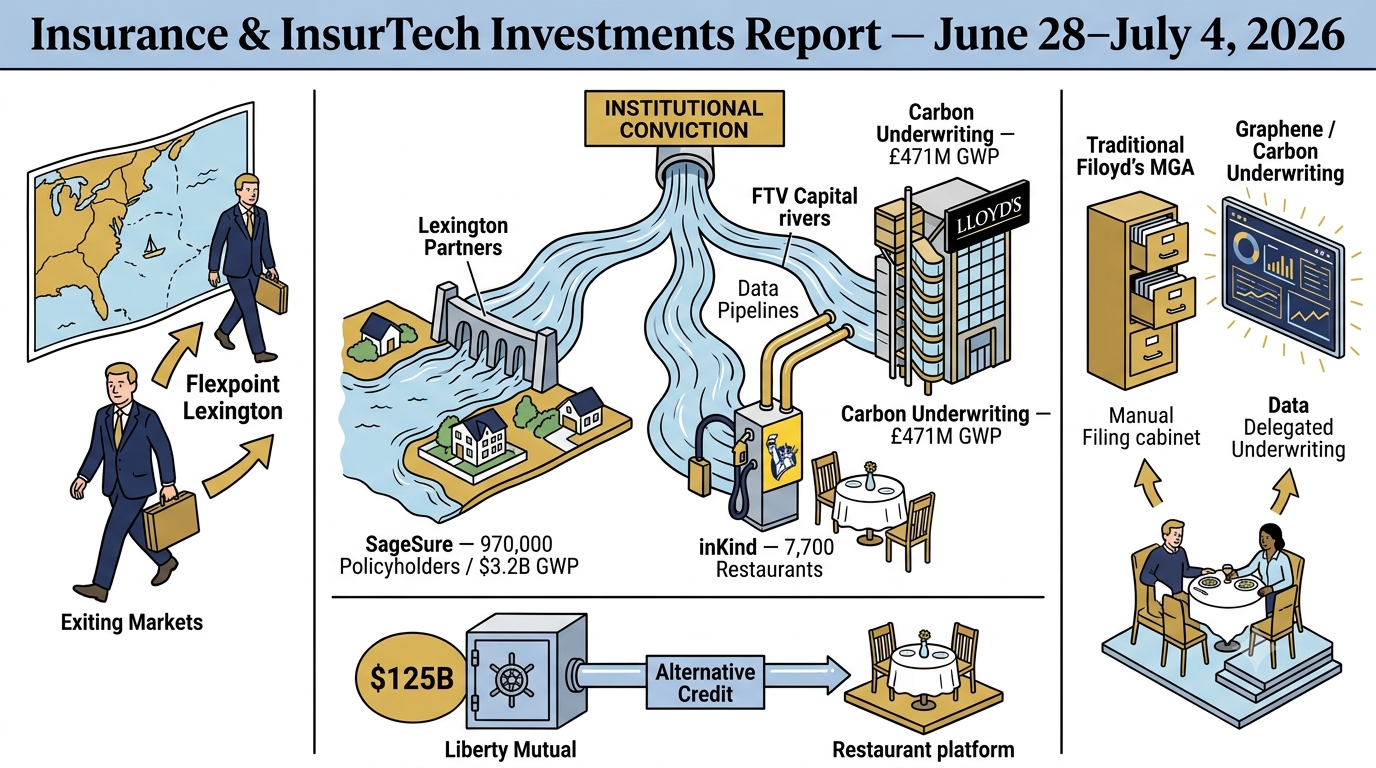
$780M+ in disclosed capital | 2 primary transactions + 2 special situations | PE doubles down on catastrophe property, Lloyd's data-driven MGA attracts US growth equity
A week defined more by structural depth than headline volume. Flexpoint Ford's $460M+ continuation vehicle for SageSure is the most technically sophisticated deal of the month — a GP-led secondary transaction that converts LP liquidity optionality into a new capital base for one of the US property MGU market's most operationally distinctive platforms. Carbon Underwriting's FTV Capital investment is the clearest signal yet that Lloyd's delegated authority underwriting, historically seen as a relationship business resistant to technology leverage, has been re-rated by growth equity as a scalable, data-driven platform category. Two special situations complete the week: Liberty Mutual's $320M alternative credit deployment into a restaurant technology company illustrates how insurance float is being deployed further up the risk spectrum than traditional bond portfolios; and Old Republic's conversion and acquisition of Everett Cash Mutual continues the quiet but persistent rationalization of the US mutual insurance sector. Individually these deals address different segments. Together they confirm that institutional capital — PE, growth equity, insurance float, strategic acquirers — is engaging with insurance infrastructure at every layer simultaneously.
1. SageSure / Flexpoint Ford (USA)
$460M+ Continuation Vehicle | Catastrophe-Exposed Property MGU — GP-Led Secondary Extends Conviction Date: June 30, 2026
What Happened
SageSure LLC — one of the largest managing general underwriters in the United States specializing in catastrophe-exposed residential and commercial property markets — became the subject of a $460M+ GP-led continuation vehicle closed by Flexpoint Ford, the Chicago-based specialist PE firm focused exclusively on financial services. Flexpoint first invested in SageSure in May 2023. The continuation vehicle was led by Lexington Partners (one of the world's largest secondary PE managers, $84B+ in total capitalization), with participation from Barings and Round2 Investment Partners, plus commitments from Flexpoint itself as GP and rollover investors choosing to maintain their positions. The transaction structure gives existing Flexpoint LPs a clean choice: realize liquidity at current valuations or roll into the new vehicle alongside fresh institutional capital. Lexington's lead role is the market signal — Lexington does not lead continuation vehicles for assets it considers fully valued; it leads them for assets it believes have material remaining appreciation potential. Founded in 2009 and headquartered in Jersey City, New Jersey, SageSure manages $3.2 billion in gross written premium across 16 states and protects 970,000+ policyholders. Since Flexpoint's original investment, SageSure completed two acquisitions: GeoVera (residential earthquake MGU, January 2026) and Olympus (premium mass-affluent Florida residential property MGU). SageSure also serves as the underwriting and distribution partner for Novel Financial Holdings' GeoVera Nova subsidiary — covered in last week's report — creating a capital and operational relationship that runs across two separate deals in two consecutive weeks. Terrence McLean (President and CEO of SageSure) and Chris Ackerman (CEO of Flexpoint) both confirmed the transaction publicly. Financial advisors: Jefferies (Flexpoint); Simpson Thacher & Bartlett (Lexington). Legal: Kirkland & Ellis (Flexpoint).
- GP: Flexpoint Ford
- Lead LP (continuation vehicle): Lexington Partners
- Participating: Barings, Round2 Investment Partners, Flexpoint GP commitment, rollover investors
Use of Funds
- Extend SageSure's expansion into additional catastrophe-exposed markets beyond the current 16-state footprint
- Continue platform acquisitions — GeoVera and Olympus established the M&A template
- Deepen carrier and distribution relationships across the admitted and E&S property markets
- Support technology and data infrastructure investment across SageSure's underwriting platform
Strategic Thesis
A continuation vehicle for a $3.2B GWP property MGU specializing in catastrophe-exposed markets — a category where most carriers and reinsurers are pulling back — is a precise statement about underwriting quality. Lexington Partners, with $84B in secondary capitalization and access to every PE continuation opportunity in the market, chose to lead this one. The reason is visible in SageSure's operating metrics: $3.2B in GWP at disciplined loss ratios, 970,000 policyholders in markets where coverage access is deteriorating, and two strategic acquisitions (GeoVera and Olympus) that extend the platform into earthquake risk and Florida's premium residential tier. Flexpoint's thesis — stated explicitly by Dominic Hood: "SageSure's ability to deliver innovative property insurance solutions in coastal markets while maintaining underwriting discipline has resulted in a company that is admired by a diverse group of stakeholders" — is a summary of what disciplined catastrophe underwriting looks like when it works. The continuation vehicle structure matters: Flexpoint is not selling SageSure. It is re-capitalizing its ownership in a transaction that provides LP liquidity optionality while bringing in Lexington's conviction alongside Barings' credit expertise. The Barings participation is particularly interesting given last week's Novel/Flexpoint deal — Barings is MassMutual's investment management subsidiary, MassMutual is a Flexpoint LP relationship, and SageSure's GeoVera Nova is integrated with Novel, which Flexpoint also owns. The institutional web connecting Flexpoint, Barings, SageSure, and Novel is tighter than any of the individual announcements has disclosed.
Why It Matters
- Lexington Partners leading a $460M+ continuation vehicle for a catastrophe-exposed property MGU at this moment — when carriers are exiting Florida, California, and coastal markets — is a direct institutional vote of confidence in SageSure's underwriting model at the exact moment its competitors are most constrained
- SageSure's $3.2B GWP with Novel Financial Holdings' GeoVera Nova integration means the SageSure platform is now embedded in two separate Flexpoint-backed insurance holding structures simultaneously — creating a carrier-MGU relationship with unusual capital alignment
- The GeoVera earthquake and Olympus Florida residential acquisitions, completed since Flexpoint's original 2023 investment, demonstrate that SageSure is executing an active consolidation strategy in catastrophe property — adding risk categories and geographic depth while maintaining the underwriting discipline that earned Lexington's conviction
Competition
- Direct competitors (catastrophe-exposed property MGU): Openly (homeowners, Allianz X-backed), Hippo (homeowners, NASDAQ: HIPO), Slide Insurance (Florida, NYSE: SLDE), Kin Insurance (catastrophe-exposed DTC), Heritage Insurance (Florida)
- Category competitors: Admitted carriers remaining in catastrophe-exposed markets (State Farm, Farmers, Travelers — all with limited appetite), surplus lines markets providing capacity for higher-hazard risks
- Emerging dynamic: As admitted carriers exit high-hazard coastal markets, MGUs like SageSure that can access E&S capacity become the primary coverage solution for millions of policyholders — not an alternative to the admitted market but the replacement for it
Market Consequences
The continuation vehicle signals to the broader PE and institutional investment community that catastrophe-exposed property MGUs at scale — with disciplined underwriting and diversified carrier capacity — are investable assets at PE-scale capital formation ($460M+), not merely venture-scale opportunistic bets. For SageSure's carrier capacity partners, the continuation vehicle demonstrates financial stability and long-term PE commitment that supports multi-year capacity agreements. For policyholders in Florida, Texas, and coastal markets where admitted coverage is contracting, SageSure's capitalization runway extends its ability to remain in markets that increasingly lack alternatives. For Lexington Partners and Barings, the investment provides access to catastrophe-exposed insurance risk with data-driven underwriting quality in a capital structure with defined GP-led governance.
Bottom line: Lexington Partners just led a $460M+ continuation vehicle for a catastrophe property MGU at a moment when admitted carriers are retreating from the exact markets it serves. That is not a contrarian bet. It is an institutional underwriting quality validation.
2. Carbon Underwriting / FTV Capital (UK)
Undisclosed Growth Equity | Lloyd's Delegated Authority MGA — Data-Driven Underwriting Platform Attracts US Growth Equity Date: June 30, 2026
What Happened
Carbon Underwriting Limited — a London-based delegated authority underwriting specialist operating Carbon Syndicate 4747 at Lloyd's of London — announced a significant growth equity investment from FTV Capital, a San Francisco-based global growth equity firm focused exclusively on financial technology and services companies. The investment was led by FTV partners Mike Vostrizansky, Richard Earnshaw, and Max Weber. Apiary Capital, Carbon's investor since 2023, exits as part of the transaction. Carbon will operate independently under Jacqui Ferrier (CEO) and Ben Laidlaw (Managing Director). Carbon was founded in 2018 by Ferrier, Laidlaw, and co-founder Nick Tye with a mission to "revolutionise the world of delegated underwriting." Between 2023 and 2026, Carbon grew gross written premium from £150 million to £471 million — a 3.1x increase in three years — while maintaining loss ratios that the company describes as market-leading. Carbon operates its proprietary Graphene platform — a real-time data and analytics system providing portfolio visibility, risk monitoring, and coverholder management at a granularity that traditional Lloyd's delegated authority arrangements cannot deliver. The company has approximately 89 employees. Financial advisors: Howden Capital Markets (Carbon); Houlihan Lokey and Acrisure Re (FTV). Legal: Browne Jacobson and Norton Rose Fulbright (Carbon); Skadden (FTV). Financial terms not disclosed.
- Investor: FTV Capital (growth equity, ~$4B+ AUM, financial services specialist)
- Exiting: Apiary Capital (invested 2023)
- Carbon Syndicate: Carbon Syndicate 4747 at Lloyd's of London
Use of Funds
- Accelerate growth across Carbon's delegated underwriting platform globally
- Fund continued development of the Graphene data and analytics technology
- Deepen AI capabilities across underwriting, risk monitoring, and portfolio management
- Build out Carbon's US business — FTV's primary strategic value-add
Strategic Thesis
FTV Capital invests exclusively in financial technology and services companies — its portfolio includes Flywire, Vindico (insurance distribution), Enfusion, and other fintech infrastructure plays. Carbon is the firm's most explicit insurance underwriting technology bet. Mike Vostrizansky stated the investment thesis precisely: "Carbon has cracked one of the most attractive, underserved corners of the insurance market, and its data-led approach to delegated underwriting resonates strongly with where the industry is heading. The U.S. represents a substantial, largely untapped opportunity for that proposition." The delegated authority market — MGAs, coverholders, binding authorities operating under capacity from Lloyd's and other carriers — is a $10B+ premium segment that remains largely relationship-driven and operationally manual. Carbon's Graphene platform is the counter-thesis: real-time portfolio visibility, coverholder performance data, and AI-driven risk monitoring at a granularity that allows Carbon to manage its delegated portfolio with precision that most traditional Lloyd's MGAs cannot approach. The 3.1x premium growth in three years — from £150M to £471M — at disciplined loss ratios is the operating proof. FTV's US network (Global Partner Network of 600+ financial services executives, FTV Propel operating team) provides the distribution infrastructure for Carbon's US expansion that organic hiring alone could not build as quickly. The Braven deal covered in Week 25 and the Carbon deal this week represent two simultaneously well-capitalized bets on the same infrastructure problem in the delegated authority market — Braven attacking the operational layer, Carbon attacking the underwriting data layer.
Why It Matters
- £471M in gross written premium at 3.1x growth over three years with disciplined loss ratios is the operating proof that data-driven delegated authority underwriting at Lloyd's produces a compounding commercial advantage — FTV Capital, with over $4B in AUM and a financial services specialization, does not make large growth equity investments in unproven theses
- The Graphene platform's real-time portfolio visibility and coverholder monitoring provides Carbon with underwriting intelligence that traditional Lloyd's MGAs manage manually — the data advantage compounds as the premium base grows, because each additional policy generates more data to optimize the next underwriting decision
- FTV's US market expertise and network positions Carbon to enter the US delegated authority market — which represents a substantially larger and structurally underpenetrated opportunity for data-driven MGA platforms than the already-competitive UK market
Competition
- Direct competitors (data-driven Lloyd's MGAs): Convex (data-led specialty insurer), Ki Insurance (AI-native Lloyd's syndicate), Renewal (Lloyd's coverholder platform), Volante Global (delegated authority management)
- Category competitors: Traditional Lloyd's MGAs without equivalent data infrastructure (estimated 350+ UK MGAs collectively writing 10%+ of the UK's £47B general insurance premium pool)
- Emerging dynamic: PE and growth equity capital entering the MGA category simultaneously from multiple angles — Bain Capital in Jensten Group (broker), FTV Capital in Carbon (Lloyd's MGA data platform), Braven (operational infrastructure) — accelerating the pace of data and technology adoption across what has historically been one of insurance's most relationship-dependent distribution channels
Market Consequences
Traditional Lloyd's MGAs and coverholders that manage their delegated portfolios without equivalent data infrastructure face a competitive disadvantage that compounds as Carbon's platform scales. For capacity providers (Lloyd's syndicates, London market carriers) choosing between MGAs, Carbon's real-time portfolio visibility and loss ratio data provides underwriting transparency that manual MGAs cannot match — a structural advantage in capacity allocation decisions. For the US delegated authority market that FTV has identified as "substantially, largely untapped," Carbon's data-led model enters with both Lloyd's market credibility and a well-capitalized growth equity partner providing US network access that most UK MGAs attempting US expansion have lacked. The timing relative to Braven (the delegated authority infrastructure startup covered in Week 25) is notable: both are building technology layers beneath the delegated authority market's relationship infrastructure simultaneously, one at the operational layer and one at the underwriting data layer.
Bottom line: A US growth equity firm just invested in a Lloyd's MGA because its data platform grew premium 3x in three years at disciplined loss ratios. The thesis: delegated underwriting is a financial technology category, not a relationship business. Carbon is the evidence.
Special Situation: Liberty Mutual Investments / inKind (USA)
$320M+ | Insurance Float Deployed into Alternative Credit — Restaurant Technology Platform Date: July 1, 2026
This is not an insurtech deal. It is an insurance float investing story — and one of the most distinctive examples of how large insurance carriers deploy their investment portfolios.
What Happened
Liberty Mutual Investments (LMI) — the investment firm managing Liberty Mutual Group's $125B+ investment portfolio — committed more than $320 million in alternative credit financing to inKind, a restaurant commerce enablement platform connecting 7,700+ restaurants with 4–5 million diners through a rewards app. LMI provided both senior and mezzanine debt through its Alternative Credit platform. inKind's model is unusual: it provides restaurants with upfront capital by purchasing food and beverage credits at a discount, then sells those credits to diners through its app as rewards (up to 25% back on dining). The restaurant repays the financing not in cash but in future dining capacity — converting customer demand into growth capital. inKind has provided $600M+ in cumulative financing to restaurants and distributed $175M+ in dining rewards to date. The transaction follows an earlier $450M raise by inKind to expand its network.
Why an Insurance Carrier Is Lending to a Restaurant Platform
LMI manages $125B in assets on behalf of Liberty Mutual. That capital must generate returns to pay claims — which is the insurance float thesis in direct action. The question is always how to deploy float at the best risk-adjusted return. LMI's Alternative Credit platform provides the answer: tailored financing structures in asset classes that commercial banks do not serve efficiently, earning higher spreads than investment-grade bonds at risk levels LMI's underwriting teams can assess and monitor. inKind's credit quality from LMI's perspective: the loan is secured against a portfolio of 7,700 restaurant relationships and future dining credit receivables, not against the restaurants' physical assets. The diversification across 7,700 operators reduces individual credit risk. The platform's $600M+ in cumulative financing history provides actuarial loss data. And the consumer-facing app with 4–5 million active users provides real-time demand data that supports LMI's ongoing credit monitoring.
CEO Johann Moonesinghe framed LMI's value proposition as the critical differentiator: "inKind was built to help operators access growth capital and bring more guests to the table without relying on expensive debt, dilutive equity, or discount-driven marketing. Liberty Mutual Investments understands that this is not just about financing transactions — it is about backing entrepreneurs, creating jobs, and helping the places where communities gather continue to thrive."
The Float Investing Connection
The HHH/Vantage deal three weeks ago made the Berkshire float model explicit: collect premiums, invest the float at compounding returns, use the spread to fund underwriting losses and generate equity value. LMI's inKind deployment is the same thesis expressed through alternative credit rather than equity investing: Liberty Mutual collects $40B+ in annual premium, holds it as float, and deploys portions into higher-yielding alternative credit that commercial banks do not efficiently access. At $125B in AUM, even a 1% allocation to alternative credit generates $1.25B in deployment capacity. The $320M inKind commitment is a single expression of that allocation. The insurance industry's investment arms — LMI, PIMCO (Allianz), PGIM (Prudential), MassMutual's Barings, and others — are collectively among the most sophisticated credit allocators in the world. The inKind deal is a visible example of a deployment strategy that runs largely below public awareness.
Bottom line: Liberty Mutual just lent $320M to a restaurant app. That sentence sounds wrong until you understand that Liberty Mutual manages $125B in insurance float and its alternative credit platform exists to earn higher spreads than bonds at manageable risk. This is insurance float investing made visible.
Special Situation: Old Republic International / Everett Cash Mutual Insurance Co. (USA)
~$25M in Common Stock | Mutual-to-Stock Conversion + Acquisition — Agricultural Specialty Lines Date: June 30, 2026
What Happened
Old Republic International Corporation (NYSE: ORI) — a Chicago-based insurance holding company with $26B+ in assets, operating through its General Insurance Group, Title Group, and Life & Health Group — announced that members of Everett Cash Mutual Insurance Company (ECM) voted at a special meeting to approve ECM's conversion from a mutual insurance company to a stock insurance company, simultaneously approving the acquisition of the newly formed ECM Insurance Company and its subsidiaries by Old Republic. The transaction involved the delivery of approximately 956,000 shares of ORI common stock to ECM members — at current ORI pricing (approximately $26/share) representing roughly $25M in consideration. Old Republic also raised approximately $25M through concurrent capital market transactions to fund the acquisition. ECM operates in agricultural and specialty lines insurance. The Everett Cash family name reflects the mutual's agricultural roots and policyholder base. ECM's subsidiaries become wholly owned by Old Republic, expanding its specialty lines footprint in agricultural risk.
Why Mutual-to-Stock Conversions Matter
Mutual insurance companies — owned by their policyholders rather than shareholders — have faced structural capital constraints for decades. They cannot issue equity, cannot participate in stock-based M&A as sellers, and cannot access capital markets except through surplus notes. As insurance capital requirements have risen and technology investment demands have increased, the mutual structure has become progressively less competitive for smaller and mid-size mutuals that lack the scale to self-fund transformation. ECM's conversion and acquisition by Old Republic is the latest in a multi-decade rationalization of the US mutual insurance sector. For ECM policyholders who are now ORI shareholders, the transaction provides liquidity and diversification they did not have as mutual members. For Old Republic, it provides a specialty agricultural insurance platform with established underwriting relationships in a line of business that benefits from climate-driven demand growth.
Bottom line: Another US mutual insurance company converted to stock and sold to a larger carrier. The mutual structure's capital constraints are producing a slow but persistent consolidation — and agricultural specialty lines, with climate-driven demand growth, are an increasingly attractive acquisition target.